Asia Democracy Network's 2026 Democracy Overview Tackles, Youth and Power Across Asia
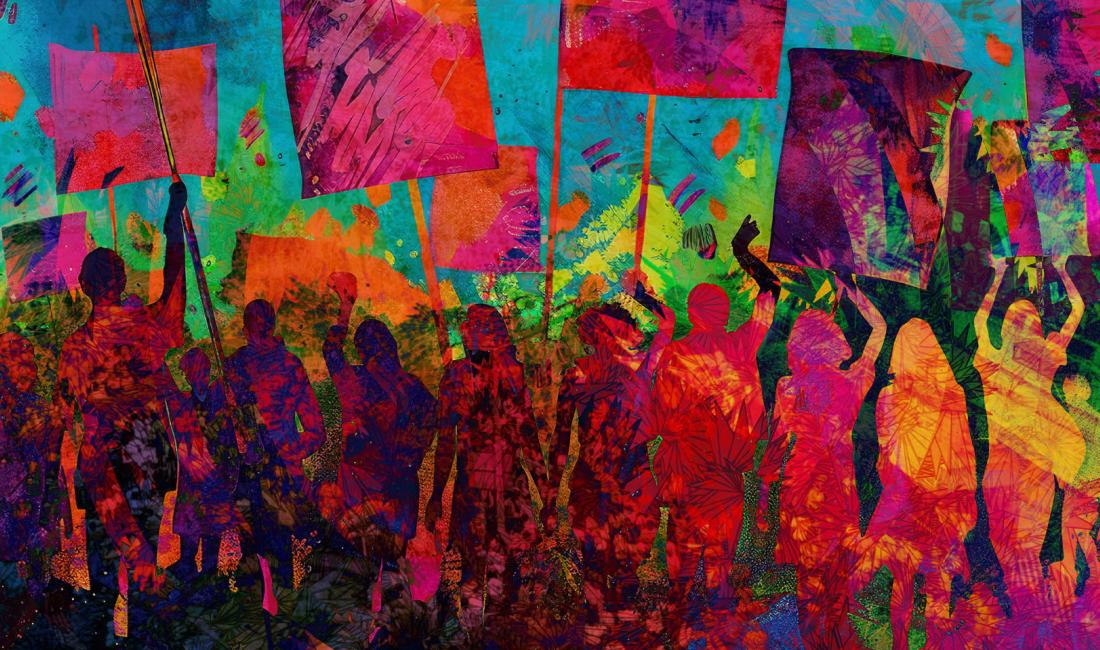
This essay and image were produced and published by Asia Democracy Chronicles
For many, the story of how democracy comes into being may seem familiar and predictable at first: elections take place, governance processes function as usual, civil society keeps watch – and accountability, though slow, seems guaranteed.
These are core components of a democracy narrative that has been repeated often enough that it feels settled. But a segment of populations, youth in particular, across Asia sits uneasily with that narrative. Recent protest movements passionately seeking structural change in public governance attest to this.
A newly released report by the Asia Democracy Network offers a close look at what happens when young people question how democracy plays out in their respective countries, because its democratic aspirations contrast sharply with their lived reality.
“Signals from the Streets: Civic Resistance and Democratic Trajectories in Asia” specifically looks into the youth-led movements that have emerged in Nepal, Bangladesh, the Philippines, Indonesia, and Mongolia in the past two years. It is an earnest attempt to come to terms with the tensions between the promise of democracy and the complex challenges confronting it. What emerges from the stories it examines across these five countries is not disengagement or apathy but a careful understanding of the persisting democratic system.
As votes keep coming, the systems kept failing
In Nepal, the mobilization that unfolded on Sept. 8 and 9, 2025 went beyond demanding incremental reform. The prime minister resigned, parliament buildings were set on fire, and the political order was visibly shaken.
In this chapter, writer/journalist Pranaya Rana carefully draws out the distinction between disruption and transformation. The protests did not reject democracy as an idea but as it was practiced — with electoral routines firmly in place but where corruption was normalized, with token federalism that did not deliver, and where accountability was merely signaled but never embodied.
The mobilization itself did not follow familiar organizational paths. It moved through social media networks and decentralized relationships of trust, without clear leadership or established coordination structures.
Even the selection of an interim prime minister through an online platform, often treated as an anomaly, points to a shift in the source of legitimacy and negotiating authority outside conventional institutions.
Bangladesh has shown a similar pattern, though at a much greater cost. What began as public opposition to a Supreme Court ruling on civil service quotas quickly expanded into a massive mobilization triggered by deep concerns about fairness and equitable access to opportunity. The protests spread across urban and rural areas, drawing in different segments of society and ultimately leading to the ouster of long-standing Prime Minister Sheikh Hasina.
The violence that accompanied and followed this process complicates any straightforward reading of transition. Reported state use of lethal force, arbitrary detention, and enforced disappearances were widely documented. So were high levels of trauma among those directly exposed to government crackdowns.
The killing of youth leader Sharif Osman Hadi in December 2025, during what was dubbed a transition period, underscores how instability and violence continued beyond political change, shaping its aftermath.
In the Philippines, publicly funded flood control projects were found to be non-existent or grossly substandard, with large sums of public money unaccounted for and now the subject of investigations. For Filipinos including youth already dealing with calamities and their aftermath, this stark reality did not just signal corruption but a failure in governance with extremely dire consequences for the poor.
What followed was sustained mobilization in various forms — digital exposure of public officials, memes and online campaigns, alongside street protests. By Sept. 21 last year, the anniversary of martial law, protests in Metro Manila and beyond had escalated, with a large contingent of young people, many from working-class backgrounds and unaffiliated with established organizations, moving beyond traditional forms of dissent.
The state’s militaristic response included arrests, dispersals, and violence in some parts of the country. Succeeding events also exposed tensions within civil society, where some organizations distanced themselves from the more confrontational segments of the movement, raising questions about how legitimacy is defined and by whom.
Not collapse, but adaptation
In Indonesia institutions remain formally intact, yet manage citizen pressures to dent their impact, a move tantamount to curtailing the people’s fundamental rights including citizen engagement in democratic processes such as protests. Following the 2024 election, the expansion of the military’s role in civilian governance marked a shift that reversed earlier reforms.
The emerging protests were met with state arrests while legal action blurred the line between citizen participation and the criminalization of what was otherwise a constitutional right. Yet movements adopted new strategies, using legal spaces and collective defense to pursue collective action.
In Mongolia, sustained mobilization in 2025 led to the resignation of the prime minister following public outrage over ostentatious displays of wealth by political elites. Public protests combined political action with broader civic engagement. Sukhbaatar Square, the central square in the heart of the capital Ulaanbaatar, became a site of teach-ins, constitutional readings, and nightly communal singing, while organizers published real-time financial accounts of every donation received.
Yet, the conditions that sparked mass mobilizations such as deeply entrenched party structures, limited transparency, and ongoing outmigration remain. What has changed as a result of the protests remains to be seen.
All in all, the five-country report evokes an image of citizens’ collective actions that are not focused solely on the incumbent government or any single protest. The gap between procedural and substantive democracy, and what happens when young people, who struggle through that gap, become fed up with being told that democratic form is enough.
Mass movements and demands
The protest movements documented in the report were not without direction and clearly conveyed the people’s demands: accountability, transparency, eradication of corruption, and inclusive and participatory governance – which are well within the scope of democratic systems. What stands out from the mass actions is the public insistence that these demands be taken seriously and acted on with urgency – not deferred or managed.
The report also draws attention to what these moments revealed about civil society.
In Bangladesh and Nepal, established organizations struggled to engage with youth-led mobilizations that moved more quickly than their conventional processes allowed. In the Philippines, tensions were more visible, with some parts of civil society distancing themselves from forms of protest that did not align with established norms. In Mongolia, civil society took a more deliberate step back, offering support without directing the movement. In Indonesia, civil society organizations pivoted toward legal defense, turning courtrooms into spaces of collective action and the judicial process itself a platform for democratic resistance.
While civil society responses across these varied, taken together they pointed to this question — how to take part in youth mobilizations that transcend existing frameworks.
The report does not try to reconcile these tensions or force a single conclusion. What it does is to put these different protest experiences side by side, listen to the voices rising from movements, and compare these voices to how democracy is usually talked about by governments and institutions.
Thus the report is less about offering answers and more about giving voice to what the movements articulated, and allowing public institutions and policy spaces to respond accordingly.
When (dis)engagement shifts
What readers take away from the report may not be entirely comfortable. What is often labeled apathy across these contexts must not be viewed as disengagement, nor approached as something that needs to be corrected or channeled into more familiar forms.
What is often read as withdrawal is, in many cases, a deliberate distancing from democratic institutions widely seen as exclusionary or compromised. Engagement does not disappear; it shifts. And when institutions respond in ways that are credible and accountable, engagement returns. What these movements suggest is not a loss of belief in democracy but a refusal to equate it with so-called democratic institutions.
In this light, ADN’s 2025 Overview is unlikely to sit comfortably with readings of democracy that rely primarily on elections taking place and public institutions continuing to function while it spotlights protest movements across geographical contexts that do not align neatly with those measures and came about at considerable cost to those involved.
What comes through is a public demand to be heard more directly, without being filtered or deferred, and without being made to conform to traditional molds or structures. This report is therefore an earnest attempt to hold that articulation in place and to facilitate candid engagements that do not smooth over its implications. What follows remains an open question awaiting an answer.