Forced out of Myanmar and Perhaps Soon India, Rohingya Women Refugees Find Ways to Rise
This essay and image were produced by Asia Democracy Chronicles.
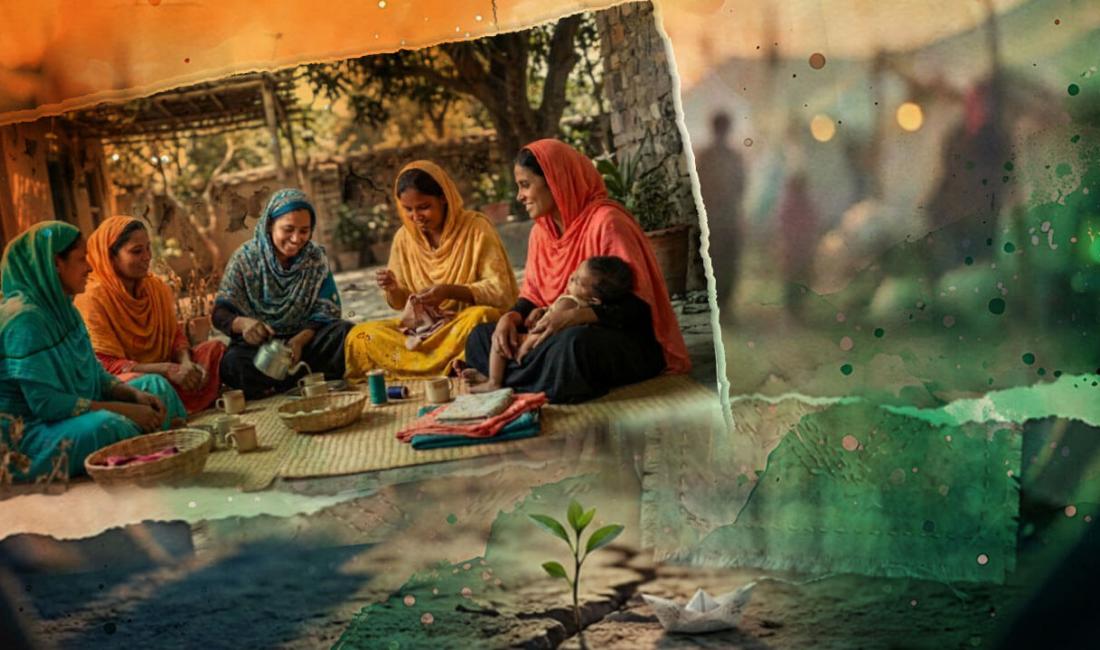
The room is small and the afternoon heat can be overwhelming. But every day, at 3 p.m., several women start streaming into the room and settle down on the floor, where they arrange their materials for yet another crocheting session.
As the sounds of barefoot children playing outside penetrate the room, the women begin crocheting in earnest, with laughter almost always bubbling up in the middle of conversations. This, however, is no ordinary afternoon get-together of neighbors exchanging the latest gossip. The women are all Rohingya refugees who have found a way to bond while earning some money; the room they are in is in the Madanpur Khadar refugee camp on the outskirts of India’s National Capital Territory in Delhi.
“I always wanted to do something for my community,” said Mizan Akhtar, a young Rohingya refugee who began the initiative a few months ago after picking up the idea from YouTube. “I realized that our women also wanted to work to support their families, as they can’t go out to work. That’s why I thought of doing this.”
The Rohingya of Myanmar are considered the most persecuted ethno-religious minority in the world, with around 2.8 million of them now displaced. Fleeing persecution and violence from their homeland’s Rakhine state, they have tried to find shelter mainly in Bangladesh, but have also turned up in Malaysia, India, Thailand, and Indonesia.
Their host communities have not always been welcoming, and they often end up in settlements that are cramped and lacking in basic services. In India in the last several years, the Rohingya have been living in constant fear as authorities often round them up and detain them, with some getting pushed back to Bangladesh where they had originally sought refuge, while others get deported back to Myanmar, where there is a raging civil war.
Just last May, international and local media reported that Indian authorities had ordered a group of approximately 40 Rohingya refugees to be flown to the Andaman and Nicobar Islands, put on a naval ship, then forced into the sea near the Myanmar coast with only life jackets. The Rohingya reportedly survived, but their condition and exact whereabouts remain largely unknown to their families.
Yet some academics have been noticing that Rohingya refugees – particularly the women, and particularly in India – have been able to overcome many barriers and even report, as one study put it, “high levels of satisfaction” and happiness. This is despite the “extreme poverty, loss of family and community, and high levels of gender-based violence after resettlement” experienced by the refugees, said the study that was published in the October 2025 issue of the Journal of Ethnic and Minority Studies.
One apparent reason for this may be that while the living conditions of Rohingya refugees in their host countries are often downright bad, what they had fled from had been far worse. The study’s authors also wrote, “Our research suggests that safety concerns, legal restrictions, and cultural norms all eased for Rohingya following migration to India, enabling new forms of autonomy that were previously unimaginable.”
‘Illegal migrants,’ not refugees
Denied citizenship in a country where their families had lived for generations, the Rohingya have been among the poorest in one of Myanmar’s poorest states. Predominantly Muslim, the Rohingya are also subjected to discrimination in Buddhist-majority Myanmar, as well as to bouts of large-scale violence. The most recent was a military-instigated attack on Rohingya villages in 2017, which saw houses, schools, and mosques burned to the ground, residents chased out or killed, women assaulted, and families torn apart.
Those who somehow wound up in India — which is not a signatory to the UN 1951 Refugee Convention or its 1967 Protocol – now live lives that are far from ideal. The nearly 90,000 or so Rohingya seeking refuge in the South Asian country are not considered “refugees” by the central government, including the more than 23,000 registered with the UN High Commissioner for Refugees (UNHCR). Instead, authorities have been detaining Rohingya under the Foreigners Act 1946, branding them as “illegal migrants” under its provisions.
In 2019, the ruling Hindu nationalist Bharatiya Janata Party (BJP) passed a controversial bill aiming to provide citizenship to persecuted minorities of the neighboring countries who entered India before Dec. 31, 2014. But it explicitly excludes Muslims such as Rohingyas, many of whom had fled to India in 2012, after deadly riots broke out in Rakhine state.
Remarked Sabber Kyaw Min, founder and director of the Rohingya Human Rights Initiative: “It is part of the identity politics that the current regime employs for their electoral benefits in India, reacting the way the Myanmar regime did.”
Nearly 90 percent of the estimated 1.3 million Rohingya refugees are in Bangladesh, where most live in two overcrowded camps near the Myanmar border. Malaysia is host to the second largest Rohingya refugee population, followed by India.
But perhaps because the Rohingya migration to India has been “looser” compared to those of Bangladesh and Malaysia – coming in far smaller groups or a few individuals at a time – the refugees here have been more mobile. Their makeshift communities are spread across the country, although the larger ones are in Delhi, Hyderabad, Jammu, and Nuh.
While their settlements are called “camps,” these are actually informal affairs situated within slum areas. And with no legal framework to assert their rights in India, the Rohingya have had a hard time making a living or accessing basic services, including education for their children and health care. The women’s hijab also marks them as Muslim, putting them at risk in a country currently prone to fear-mongering against non-Hindus, but many Rohingya have been choosing to live in areas where there are more locals who share their faith.
Still, researchers have noted that refugee camps, not only of Rohingya, cause disruptions in social norms and practices within communities and put pressure on relationships. But while this could lead to increased friction within and outside the group, indications are some Rohingya women are using the shifts to reshape and redirect their paths.
Pushing upward and forward
In a paper published in February 2025, social geographer Madhusree Jana said that her fieldwork among Rohingya women in Delhi revealed evidence of their mobilizing “resources within their capacity” to overcome obstacles. She even observed more women choosing their own spouses instead of going through the usual practice of arranged marriages, and “in spite of meeting with resistance and disapproval from families and inter-community politics.”
Like other scholars, Jana found newfound confidence among the women as aid organizations and particularly UNHCR encouraged gender balance in community decision-making. In fact, the researchers who focused on finding the reasons behind the “high levels of satisfaction” among Rohingya women also cited this, along with the women’s “newfound ability to work outside the home (and) travel unaccompanied.”
These researchers, though, cautioned that their findings may be applicable only to Hyderabad, where they conducted a survey, and the time when it was done. In an email response to Asia Democracy Chronicles’ (ADC)’s queries, one of the study’s authors, legal scholar Katerina Linos, repeated one of their caveats: “Since our 2019-2020 survey, conditions have deteriorated due to COVID-19, community exhaustion from hosting refugees, and growing nationalism in India.”
Yet ADC’s recent visit to Madanpur Khadar in Delhi indicated that their findings still hold, even outside of Hyderabad, and despite the continuing political rhetoric against the Rohingya.
For sure, the Rohingya remain wary; even the women who talked to ADC demurred to give too many personal details about themselves. But they were more than willing to discuss their crocheted products and how working on these has helped them.
“At first it was difficult, but then I enjoyed making these items,” said Sabra Khatoon, a mother of four. She said that after Akhtar broached the idea to them, she joined others in learning how to crochet while her children were away at school. Now it keeps her busy.
“I like making keychains and sunflowers and it relieves me when I am practicing it,” Khatoon said. “It has also done one amazing thing that there are less fights among women now because they are busy with this.”
Haseena Begum, with a sleeping child on her lap, said that she always wanted to work to earn some income.
“My husband works as a laborer, and I take care of the children and the household,” she said while preparing to make a flower. “When I am done with household work, I use the time to make these items.”
NGOs have invited them to join events where they have sold their crocheted works. They have also received direct orders, but these have not been consistent.
“Right now only a limited number of women are learning because of space, resources, and time,” Akhtar said. “One of our biggest challenges is selling the products. We don’t have many contacts or platforms where we can regularly sell our items. The women are learning skills and making products, but reaching buyers and finding a proper market is still very difficult for us.”
Minara Begum said that even though they don’t earn much, she can now help pay for household expenses. “In one sitting, I make two items, and it earns me almost INR 300 ($3.30),” she said. “Since we make items on orders, the income is not steady, but I am happy at least that I am earning something.”
In their study, Linos and her colleagues wrote, “(Any) income-generating work, even in the informal sector, can constitute a dramatic expansion of economic autonomy for women from highly restrictive societies.”
Akhtar believes, though, that this initiative not only helps these women to become independent but also “helps them to come out of daily stress by engaging in something creative and meaningful.”
For all the Rohingya refugees’ self-reported satisfaction, studies show that living under constant fear of persecution has led to several Rohingya refugees in India suffering from serious mental health issues, including anxiety and depression. Researchers themselves say that domestic violence also remains a problem among the refugees.
Mental-health services are hard to come by in India, however, even for locals. For the refugees, keeping their hands busy and their minds focused on a task helps. Said Tasleem, who goes by a mononym: “When I am engaged in this skill, I forget everything, and it makes me happy from the inside. It gives me immense happiness when I see the item in completion which I set out to make. Also, I like the company of these women, where we joke and laugh together.”
Akhtar has plans to expand her initiative to other camps, pointing out, “The expenses are high nowadays, and a woman earning her own income, especially refugee women, becomes almost necessary.”
She added, “Even though the income is not so great, it provides me with a sense of solace to see smiles on the faces of these women. It gives us a sense of community.”