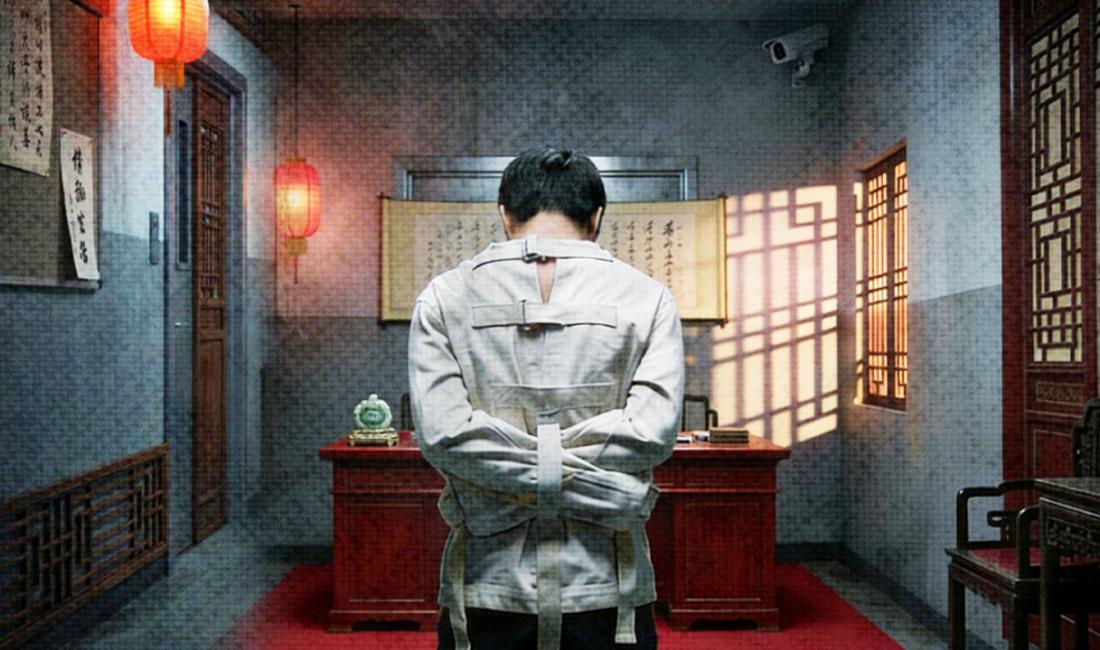
Local Authorities in China Put Complainants in Psychiatric Detention
This series and lead image were produced by Asia Democracy Chronicles.
Second of two parts (First part here)
On Dec. 28 2013, China’s leaders decided to formally abolish the country’s system of re-education through labor, which had been in place for more than half a century. Long criticized for enabling extrajudicial detention under administrative authority, it had been often used against petitioners, dissidents, and other “politically inconvenient” individuals.
Its abolition was thus widely interpreted, both domestically and internationally, as a symbolic step toward legal reform in China. At the time, however, Amnesty International raised a critical voice, pointing out that “the camp closures are a positive step forward for human rights, but the fundamental problems of arbitrary detention remain in China.”
The global rights monitor proved right, as there are internment camps in China’s Xinjiang province currently believed to have hundreds of thousands of Uyghurs doing forced labor. Too, China had actually set up another system that in many ways beats the cruelty of re-education through hard labor.
As early as a year before the supposed abolition of labor camps, Chinese authorities began to formulate the Mental Health Law, which came into effect on May 1, 2013. Its stated purpose emphasized patient rights, voluntariness of treatment, and protection against arbitrary confinement. In practice, however, the law created a parallel pathway for deprivation of liberty outside the criminal justice system.
Unlike re-education through labor, psychiatric detention requires no formal adjudication, no defined sentence, and no clear exit mechanism. The law introduced the concept of compulsory treatment based on assessments of “risk to self or others,” with significant discretion granted to the police and medical professionals.
This legal structure proved especially useful to local authorities facing the sudden loss of an arbitrary detention tool that re-education through labor had provided – and as dissidents and individuals engaged in public criticism no longer fit neatly into criminal categories, yet were still perceived as destabilizing.
The Ankang system of high-security psychiatric hospitals under the new law offered a solution that was legally defensible, politically deniable, and operationally flexible. Inevitably, it began to be practiced in other hospitals, such that the process came to be called “Ankang” as well.
Even today, arbitrary detention in psychiatric institutions remains a highly effective tool of repression against dissidents. But the net of repression seems to have been cast even wider, with more and more of those merely seeking redress for an injustice done to them finding themselves tied to a bed and forcibly made to take drugs they do not need.
In 2018, the Mental Health Law was revised, with coordination mechanisms among police, community organizations, and medical institutions refined. Procedural language was clarified, reporting requirements standardized, and community level management emphasized.
Rather than correcting abuses, however, these changes enhanced system efficiency – in favor of the authorities.
Observers say this has caused overcrowding in several psychiatric facilities. According to Zhang Junjie, who has been forcibly confined in mental institutions twice – the last being in 2023 – he saw 64 people crammed into a space measuring 60 square meters at one hospital. Zhang also echoed other former psychiatric patients in describing these facilities as often being in an unhygienic state, sometimes without anyone cleaning up vomit and excrement on the floors for hours.
Petitioners turn into psychiatric patients
Like many others, Zhang was detained in a psychiatric hospital after being deemed as a critic of the government. But there are numerous more who wind up in the Ankang system after simply filing a petition or complaint against a powerful individual or institution. In some cases, it even appears that local authorities resorted to forcibly detaining a petitioner in a mental health facility out of sheer irritation.
For example, Li Yanli, who was involved in a labor dispute over her work for a real estate company in Chengdu, had petitioned repeatedly for her salary to be released. Instead of getting her pay, Li has been forcibly sent by the police in her hometown to the Leshan Mental Hospital on three occasions. The most recent incident occurred on Dec. 19, 2025; she remains in detention in the hospital to this day.
There is also the case of pharmacist Ye Jian from Jintang County, Chengdu, who was detained for over six years in a psychiatric hospital after she filed a petition over land requisition issues. Police intercepted her in Beijing, after which local authorities transferred her into the Psychiatric Hospital of the Fourth People’s Hospital of Jintang County, where she was subjected to forced medication, physical restraints, and electroconvulsive therapy (ECT). According to a 2022 report by the rights organization Safeguard Defenders, ECT is usually done without anesthesia on those forcibly detained in psychiatric facilities.
Xu Xinrui, meanwhile, has been confined to the Dekang Psychiatric Hospital in Chengdu for more than eight years now. She was working at the Chengdu Oil Community Library when she discovered that the community’s Party secretary and several staff members were playing mah-jong and gambling for long periods during work hours. She filed a real‑name report online to the Sichuan Provincial Commission for Discipline Inspection. She ended up being forcibly sent to a psychiatric hospital by the police and the community staff.
Xu’s case came to light only because another victim of forced psychiatric confinement was interviewed by independent investigative journalist Wu Huaijun last year. According to the other patient, who is identified only as ‘He’ in Wu’s report, Xu Xinrui is not mentally ill at all; she has a penchant for literature and often communicated with well-known literature teachers online before she was locked up. He said that Xu had even repeatedly told her not to file a petition if she is ever released if she wanted to avoid another forced detention.
Wu was able to contact Xu Xinrui herself by phone, pretending to be her cousin when asked by the hospital staff who picked up the call. According to Xu, now 44 years old, she had been forced to take medication every day, tied to the bed if she didn’t comply, and “punished” with ECT many times. She told Wu that she hoped that society would be able to free her.
Wu’s report sparked public attention and discussion. Psychiatric detention was described as “the epitome of a social silencing room,” reflecting the misuse of the Ankang system to suppress whistleblowers.
From Douyin to being disappeared
But perhaps the most widely known case of forced detention in a mental health facility that does not involve political dissent is that of social-media influencer Li Yixue. In April 2022, she was sent to the Jiangxi Provincial Psychiatric Hospital by the Dinglu Police Station in Nanchang, the provincial capital, where she spent nearly two months.
According to Li, her hospital detention happened after she filed a molestation complaint against a local auxiliary police officer. She filed a lawsuit against the hospital following her release, alleging medical negligence, among other things. She also started uploading videos on Douyin, the Chinese version of TikTok, in which she recounted her experiences at the hospital. She even mentioned that more than half of the victims in that psychiatric facility had been sent there by the police.
Li’s videos, which essentially expose the true inner workings of the Ankang system, have to date received a combined total of more than a billion streams. But while these garnered her public support, they also earned her the ire of authorities, who began to put pressure on her. In one of her videos, Li says: “Threatened every day, intimidated every day, and they said that if they could make me disappear for the first time, they could make me disappear for the second time.”
The last two videos posted by Li Yixue were on Dec. 14, 2024. In one, she says that the local police station chief had brought more than a dozen people to break into her home and destroyed the security cameras at the entrance. The other is a plea for help from netizens.
Li has not made any updates since, and her whereabouts remain unknown. On Dec. 22, 2024, though, Nanchang Public Security, Jiangxi Province, issued a statement saying that Beijing An’ding Hospital experts had made an appraisal of Li Yixue and diagnosed her as having “obsessive-compulsive disorder, personality disorder,” and that in view of her condition, the community street office “in accordance with the law” will send her “to the clinic.”
Noticeably, the statement reframes police actions here are reframed as protective rather than coercive. Responsibility is also shifted onto medical institutions, fragmenting accountability.
These cases demonstrate a more crucial shift: Psychiatric detention is no longer reserved for politically explicit acts; it has almost become a default response to frictions at the local level.
The role of the police has been undergoing a significant transformation as well. Instead of acting as enforcers within a legal process, police increasingly function as referral agents to hospitals. They initiate psychiatric assessments, coordinate transfers, and frame individuals as risks requiring medical intervention. This role minimizes institutional liability. Once an individual is categorized as mentally ill, any subsequent complaint they make can be dismissed easily as a symptom of their supposed psychological problem rather than a legitimate claim that needs to be addressed.
Yet while there is little proof that the public took the official statement on Li Yixue to heart, it may have inspired the Chenghua District Government of Chengdu to issue its recent announcement on the “Xu Xinrui case,” in which it not only denied that Xu had worked in the local library, but also alleged that after the death of her parents, she behaved strangely, and was diagnosed as suffering from “schizophrenia” by the Chengdu Fourth People’s Hospital.
Therefore, it said, the “rumor” that Xu was “locked up in a psychiatric hospital as a result of reporting” rule violations by Party secretary and colleagues is not true.
Authorities, however, apparently still saw the need to threaten He, who had told journalist Wu about Xu Xinrui, and demand that she shut up. They also went after Zhou Qinling, who had been following up on Xu’s case; she was arrested on a Chengdu city street while she was on her way to the Department of Justice.
In an effort to find out more about the case, lawyers Yu Kai and Wang Fei visited both Chengdu Dekang Hospital and the local police station; neither got a real response. Journalist Wu was luckier. He was able to talk to a physician surnamed Xie at the hospital who said that Xu Xinrui has long been eligible for discharge.
But the doctor said that he had insisted that either the community staff or the local police should come to pick her up. Otherwise, he told Wu, the hospital will not release Xu.