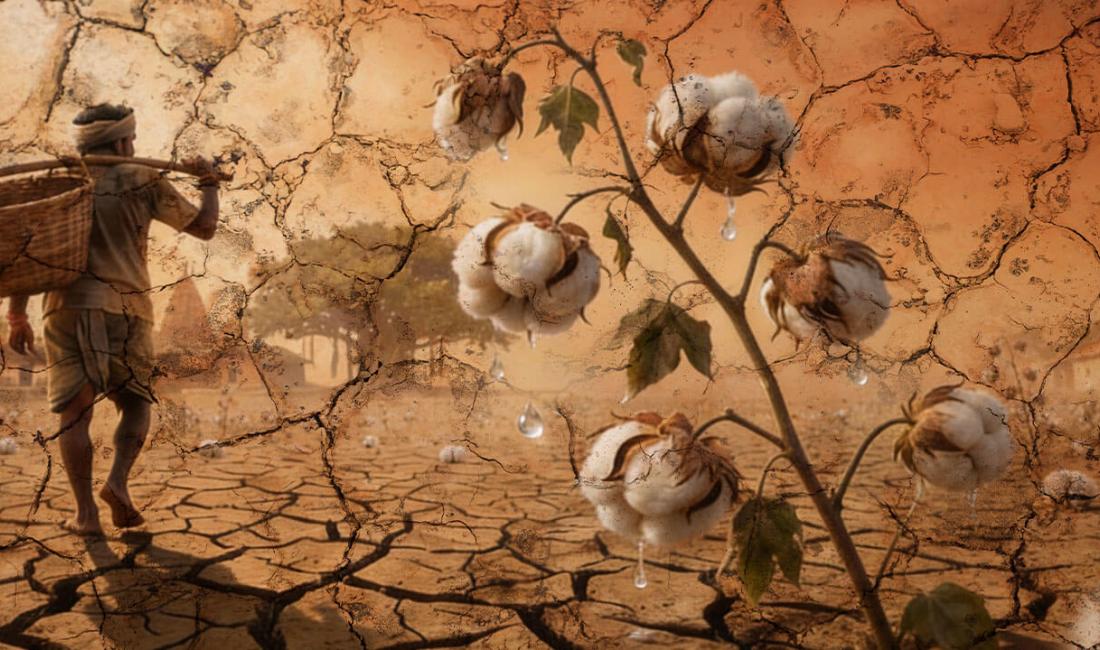
In India's Suicide Belt, Tariffs Push Farmers to the Brink
This story and image were produced and published by Asia Democracy Chronicles.
In most agricultural areas, tallies are all about produce — such as how many sacks of rice each field can yield per season, how many bushels of corn per farm, or how many liters of milk per cow. In Maharashtra and Telangana in India, most of the tallies are bales of cotton, a major product that the two states have in common. But there is a tally that both would rather not have: farmer suicides.
This is nothing new, as cotton-growing regions across India have struggled with sustained agrarian distress, including a troubling rise in farmer suicides in the past few decades. More than likely, the unfortunate trend will continue. Several observers and farmers’ groups say it may even escalate with the central government’s recent decision to roll back cotton import tariffs.
Last Aug. 19, the Indian government scrapped the 11-percent import duty on all cotton, first until Sept. 30 and later extended to Dec. 31 2025. The move, which reflects India’s evolving economic alignment with the United States, is meant to stabilize the textile sector by lowering the input costs. But it has triggered a new wave of anxiety among the South Asian country’s cotton farmers, who already feel like they are perpetually standing on the edge of a cliff.
“As farmers, this is our work … this is what we do,” says Mandatai Prabhakar Thakeray, whose son grows cotton and other crops on their 20-acre (about eight hectares) farm in Wardha, in the western state of Maharashtra. “But now, we can’t even complete a full farming cycle.”
A 64-year-old widow, Thakeray has watched their harvest suffer repeatedly due to changing weather patterns, her son often struggling to produce enough to feed their small family of five, including her daughter-in-law and two grandchildren.
“Earlier, we managed,” she says. “Now everything is so expensive. We need help from the government. Cotton and soybean prices have to be increased. We work so hard, but the price we get is too low,” Thakeray adds. “The price isn’t enough, and the costs are too much. So, we end up taking loans just to survive.”
The cotton-growing regions of Maharashtra, Punjab, Telangana, and other states are among the areas where farmers face the highest levels of indebtedness in India. Unsurprisingly, these same cotton belts also record some of the highest rates of farmer suicides in the country.
National Crime Records Bureau (NCRB) data reveal that in 2023, 10,786 people involved in the farming sector, including 4,690 farmers/cultivators and 6,096 agricultural laborers, died by suicide. This accounts for 6.3 percent of the total 171,418 suicide deaths reported across India that year. Nearly 40 percent of those farming sector suicides occurred in Maharashtra.
According to a July 2025 New Indian Express report, the state has been having an average of eight farmer suicides per day, or one every three hours, in the last five years or so.
Without doubt, climate change, which has brought erratic weather everywhere, is partly to blame for the farmers’ growing despair. Add to that plummeting prices of cotton amid the rising input costs, as well as those of just about everything else.
But many farmers have also become increasingly convinced that officials have simply stopped listening to them. Just last March, an award-winning farmer from Maharashtra’s Buldhana district committed suicide after his pleas for irrigation received no response from the state government. A note found in his pocket included this line: “The administration is ignoring farmers’ issues.”
Dr. Sunilam, national president of the Kisan Sangharsh Samiti (Farmers’ Struggle Association), says that aside from urging the government to roll back the 11-percent waiver, farmers’ groups have also asked New Delhi to implement Minimum Support Price (MSP) guarantees to protect farmers from such shocks. “The biggest thing is that the government is not ready to talk in any situation,” he adds.
After the first announcement of the cotton duty waiver, farmers’ organizations like the Samyukta Kisan Morcha (SKM) quickly pointed out that the move would undermine domestic growers and drive prices down further. SKM called for a three-day nationwide protest against it, beginning Sept. 1. Farmers burned copies of the notification in several states. But despite the backlash, the government went ahead with the waiver and even extended it to the end of this year.
Problem with a long history
India is among the top five cotton-producing countries worldwide, according to the U.N. Food and Agriculture Organization (FAO). In 2024, India’s cotton export revenues reached some $6.4 billion, with China, Bangladesh, and Vietnam among its top markets for raw cotton.
India has around 6 million cotton farmers. Including their families and the people employed in related sectors, as many as 50 million lives depend on the cotton economy. Under the administration of U.S. President Donald Trump, India has become one of the most heavily tariffed suppliers in the U.S. market, with a 50-percent duty slapped on Indian goods, among them textiles and garments.
In 2024, India’s total cotton exports to the United States amounted to $102.66 million. But the new, higher duty made Indian products less competitive, hurting exports to the U.S. and triggering a sharp drop in garment orders.
That slowdown traveled down the supply chain, weakening demand for raw cotton and deepening the distress of farmers already struggling with falling prices. With the current cotton duty waiver, the pressure has eased somewhat on India’s textile manufacturers, but has grown heavier on its cotton farmers.
Agricultural policy analyst Indra Shekhar Singh says that India’s cotton crisis is the result of long-standing structural failures that have made farmers in the cotton belt uniquely vulnerable. It antedates the administration of Prime Minister Narendra Modi, who first came to power in 2014. In fact, during the 2014 election campaign, Modi told farmers in Dahbadi village in Maharashtra, “I want to tie myself to this promise. I want to talk to experts and find such solutions that no poor farmer has to kill himself.”
A 2021 study traces the problem back to the 1990s, when India took on policies that favored the open market, leading to the withdrawal of government subsidies for farmers and minimum state support for procurement.
“The open market also promoted the entry of Multi-National Companies (MNCs) into the farming sector, ushering in an era of expensive hybrid seeds,” said the study.
“Consequently, most small and marginal farmers, in order to make up for the escalating input costs of seeds, fertilizers and labor, shifted farming from food to commercial crops such as cotton, chilies and sugarcane.”
But this required large amounts of capital from farmers who had little or no money to invest. They then turned to loans that they subsequently had a hard time paying. One of the consequences of this desperate move was what the study described as “an agricultural crisis that led to an epidemic of farmer suicides.”
Time to go organic?
Years later, the situation of Indian farmers remains dire, even as they face more challenges from U.S. subsidies and distorted global prices.
“Cotton is one of the most subsidized crops in America,” explains Singh. “The U.S. government pays farmers the income gap directly, so the global cotton price is artificially low.”
Indian textile manufacturers then push to import that cheaper U.S. cotton, he says, because it boosts their margins. “What they call a low global price is actually funded by U.S. taxpayers,” he adds. This, he argues, creates a fragile system that harms Indian farmers.
“It’s an artificial balloon that will burst,” Singh warns. “If prices don’t stabilize, farmers will pay the cost because India doesn’t subsidize them as much as the U.S.”
He says that one solution is to shift decisively toward organic cotton. India already has a strong global demand for certified organic fiber, and very few countries can supply it at scale, Singh says. “So why not support farmers who want to shift to non-Bt, organic cotton?”
Bt-cotton is the highly controversial genetically modified cotton introduced by an agrochemical multinational company to India more than two decades ago. To Singh, a shift to organic cotton would align with global market trends while also improving soil health, biodiversity, and farm incomes.
Additionally, Singh calls for a national hemp policy, which he says could be a game changer for rural economies. Organic hemp, he notes, “sells at rates equal to or even higher than organic cotton,” grows across diverse Indian climates, and faces minimal global tariffs.
While he says that income support such as what U.S. farmers get from their government can be a temporary cushion – “like nursing a child” – it’s not a permanent one. Ultimately, Singh says, “policies must shift toward what is good for the nation, good for the farmer, good for the ecology, and good for the economy.”
Thinking beyond borders
Economist Sanjay Kathuria proposes a more regional solution to protect South Asia from trade shocks and protectionist policies.
“At a broader level, not just in raw cotton, South Asia has yet another opportunity to deepen its regional collaboration,” says Kathuria, a co-founder of Trade Sentinel, an online platform on South Asian trade policies.
“The world is increasingly volatile and trade uncertainty is highly elevated. South Asia, the fastest growing region in the world, is also the least integrated. Greater trade and intra-regional investment is a low-hanging fruit, and can help each country in the region, including India. Moreover, it is high time that the freeze on India-Pakistan trade is lifted, because the lost opportunities on both sides are immense.”
Public finance analyst Dr. Vaqar Ahmed echoes this view. He says: “The critical step is to urgently and pragmatically revitalize intra-regional trade agreements like SAFTA (South Asia Free Trade Area), allowing deeper trade integration to create a resilient regional value chain. This regional stability acts as a necessary buffer and counterbalance against external geopolitical trade shocks emanating from distant major economies.”
The deputy director at the Sustainable Development Policy Institute in Islamabad, Ahmed says that while Washington’s 50-percent tariff on Indian goods provides “a short-term market opportunity for Pakistani exporters to capture some of U.S. market share in textiles and garments … the large volume of uncompetitive Indian exports would be redirected to other major markets, where they would intensify price competition.”
“This influx of Indian goods,” he says, “would force down prices and erode the profit margins of Pakistani exporters, forcing a ripple of volatility through Pakistan’s foreign exchange earnings and domestic industrial employment.”
Geopolitics, however, probably seems a world away for most of India’s cotton farmers, even though it has pushed them into deeper distress.
In widow Thakeray’s village, many have switched to other crops. Yet they may still be far from being problem-free, since many of the factors that had made their cotton-growing a disaster remain, including erratic weather and government indifference.
For now, cotton is still among the crops grown by Thakeray’s family, even if “there is no steady income.”
“The government gives free grain, but that doesn’t solve anything,” she says. “We don’t want to live on charity. We just want fair loans so we can stand on our own feet.”