The Tycoon's Rise Was Fueled by the Same Convictions That Led Him to Risk His Fortune for His City
This story and image were produced and published by Asia Democracy Chronicles.
ABOUT THE AUTHOR: Patrick Poon is a former researcher of Amnesty International and former reporter of South China Morning Post, East Asia Consultant of Human Rights Measurement Initiative, and Consultant of Asian Lawyers Network
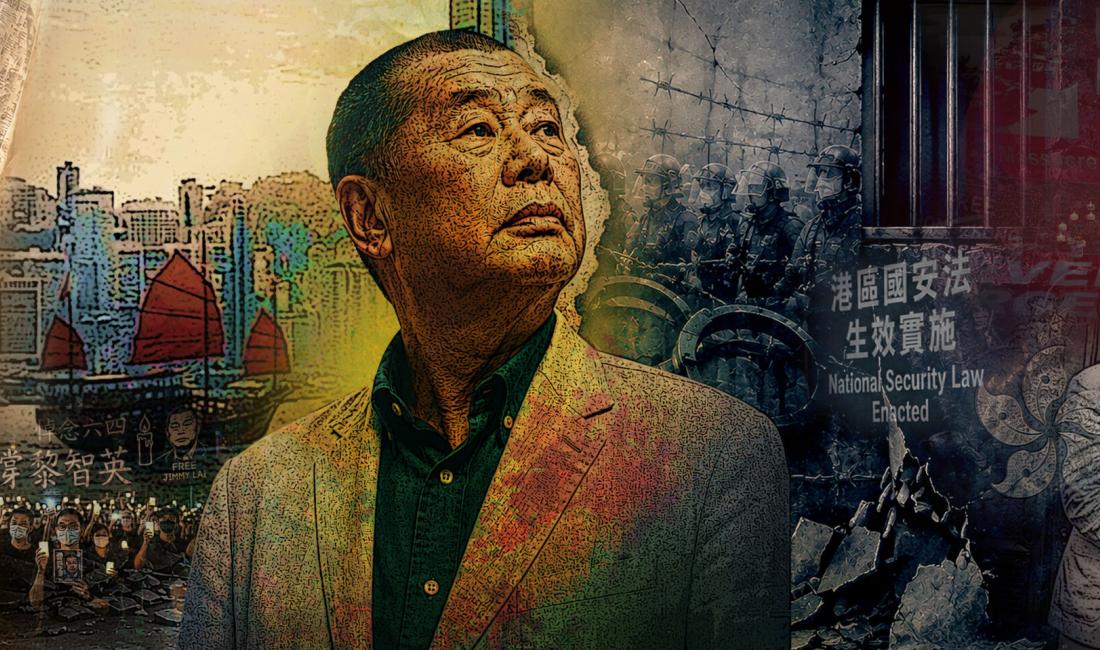
Jimmy Lai Chi-ying, a stowaway-turned-media tycoon, has become one of the most consequential figures in Hong Kong’s democratic history.
His new outlet, Apple Daily, was once one of the city’s most influential newspapers, bravely chronicling the slow erosion of rights and freedoms in Hong Kong. Its front pages documented key events in Hong Kong’s democratic journey: from the annual candlelight vigil at Victoria Park commemorating the 1989 Tiananmen Square massacre to the July 1 marches marking Hong Kong’s handover from British to Chinese rule, and demanding greater democratic representation. The newspaper also consistently opposed attempts to impose restrictive legislation under Article 23 of the Basic Law, warning of threats to freedom of expression, assembly, and association.
Each story carried risks for Lai and his editorial staff. As a billionaire entrepreneur, he could have chosen a life of comfort and political indifference. Instead, having arrived in Hong Kong at the age of 12 as a penniless refugee, he saw the city’s freedoms and opportunities as inextricably linked with his own success.
As recounted in The Troublemaker, Mark Clifford’s biography of Lai, he arrived in Hong Kong with only five dollars in his pocket. Through determination and hard work, he built a business empire and accumulated assets worth HK$1.2 billion ($153.1 million) before his first arrest in August 2020.
In April 2026, the Hong Kong government confiscated Lai’s personal assets worth approximately HK$127 million ($16.2 million).
An unforgettable meeting
I first met Lai in Oslo in December 2010 during the Nobel Peace Prize ceremony honoring Chinese dissident Liu Xiaobo, who was then serving an 11-year prison sentence in China and could not attend the momentous event. The evening before the ceremony, Lai – affectionately known as “Fat Lai” – invited several Hong Kong pro-democracy leaders and activists to dinner at a cozy hotel overlooking the city.
He spoke enthusiastically about politics, China, Hong Kong, wine, and food. Although he was one of Hong Kong’s most famous entrepreneurs, he treated me, a relatively unknown former journalist and NGO worker, with warmth and respect. He engaged everyone at the table with curiosity and generosity, sharing both his concerns about China’s future and his knowledge of fine wine.
The following day, I was fortunate enough to sit beside him at the Nobel ceremony. Together with former student leaders from the 1989 Tiananmen movement and human rights advocates from around the world, we witnessed the international community honor Liu in absentia. At the time, few could have imagined that Lai would one day follow a similar path.
Today, Lai is serving a lengthy prison sentence under Hong Kong’s national security regime and faces charges carrying penalties that could keep him incarcerated for the rest of his life. Like Liu before him, Lai has been accused of crimes related to subversion and national security.
Liu died in state custody in 2017. Now 78 years old, Lai’s family and supporters fear that he, too, could spend his final years behind bars.
Lai first achieved commercial success in the 1980s through Giordano, the casual clothing chain that became popular throughout Hong Kong and mainland China. Yet as Hong Kong approached the 1997 handover, he shifted his focus toward media, founding Next Magazine in 1990 and Apple Daily in 1995.
It’s no secret that operating a media company is a surefire formula for incurring the ire of those in power. Media is a high-risk industry with little income. Undaunted, Lai proceeded to run his own media outfit and step into the turbulent era.
He later expanded into Taiwan, establishing Apple Daily Taiwan and Next Media Taiwan. Although some critics argued that Lai’s support for democracy merely reflected the political preferences of his readership and even those of his closest friends and associates, events have shown that his commitment ran deeper; his experience fleeing Communist China and finding freedom in Hong Kong shaped his worldview.
Unlike many Hong Kong tycoons, he never forgot where he came from. He understood the importance of freedom, and the power of the media and its ability to mobilize the masses. In this light, he became an easy target for the government, who considered him a troublemaker.
In an interview with BBC, just before his arrest in 2020, he said that although he was a British citizen, he refused to leave Hong Kong. “This place gave me everything,” he said.
Facing his arrest, he said: “This is my redemption.” Soon afterward, more than 250 police officers raided Apple Daily’s newsroom. Authorities froze the assets of Next Digital, where Lai held a majority stake, effectively crippling the company. The spectacle shocked Hong Kong and demonstrated how rapidly the city’s institutions were unraveling. The handling of his case has severely damaged the rule of law, due process, and judicial independence that Hong Kong once proudly upheld.
Perhaps Lai never imagined that broad national security laws would become a weapon for dismantling civil society and independent media. Yet he became one of the primary targets of the crackdown. The forced closure of Apple Daily sent a chilling message throughout Hong Kong: running a media outlet can be obliterated not by market forces but by the government.
In the preface to The Troublemaker, former Soviet dissident Nathan Sharansky recalls several lengthy conversations with Lai before his arrest. Lai, who converted to Catholicism in 1997, viewed his decision to remain in Hong Kong as a moral obligation; he was determined to stand with other Hong Kongers.
Similar to his response to BBC during his interview, Lai, despite being the wealthy businessman that he was known to be and having a British passport, told Sharansky in no uncertain terms that leaving Hong Kong was not an option for him. “I can’t do that. I called on my fellow citizens to fight for democracy. They looked [to] me. I can’t let them down.”
For many Hong Kongers and overseas Chinese, Jimmy Lai symbolized innovation and ambition. Giordano revolutionized affordable fashion in Hong Kong and mainland China. (I remember seeing Giordano stores throughout Guangdong during family trips in the 1990s.)
Yet his greatest impact would come through the media. When Apple Daily launched in 1995, its marketing campaign immediately captured public attention. One memorable television advertisement showed Lai sitting calmly while dozens of arrows struck him. Unfazed, he picked up an apple and took a bite. The slogan was unforgettable: “An apple a day. Nobody can cheat me.”
Lai later explained that the newspaper’s name was inspired by the biblical story of Eve eating the forbidden fruit and gaining knowledge of good and evil.
From the beginning, Apple Daily was controversial, irreverent, and determined to challenge authority. But had Hong Kong’s freedoms not deteriorated so dramatically, Lai might have remained primarily a businessman. Apple Daily could have continued thriving as a commercially successful newspaper catering to young professionals, balancing political coverage with entertainment and celebrity news.
Instead, the worsening political environment pushed him into the front lines of Hong Kong’s democracy movement. In the end, Jimmy Lai’s transformation from entrepreneur to political prisoner was not the result of personal ambition. It was shaped by his lifelong belief that freedom mattered, by his gratitude toward the city that allowed him to carve out a path to success despite a rough patch, and by his refusal to abandon the people he had inspired to stand up for their rights.
Ironically, it was the Chinese Communist Party (CCP) itself that pushed people like Lai to engage in the fight for democracy. His case also serves as a stark lesson to other moguls who kowtow to the CCP: once they are no longer considered useful to the regime, they, too, could find themselves in the crosshairs of the government.
Whether one sees him as a media mogul, dissident, entrepreneur, or troublemaker, Lai’s story has become inseparable from Hong Kong’s struggle to preserve its freedoms. His life stands as a sobering reminder that prosperity and liberty are often intertwined, and that defending both can come at an extraordinary personal cost. ◉