Demolitiions Are Tools of Urban Governance, and Right-Wing Propaganda
This story was produced and published by Asia Democracy Chronicles.
It has been 18 months since Shabana Akbar Shaikh’s children last attended classes. She and her husband have been trying to pool some money together to get their 12-year-old daughter and seven-year-old son re-admitted somewhere, but they keep coming up short.
Shabana works as a day housekeeper in various homes in the Vatva neighborhood of Ahmedabad, the largest city in India’s western coastal state of Gujarat; her husband irons clothes for a living. But between rent, food, and the city’s rising costs, they simply do not have enough to send their children back to school.
Before April 2025, Shabana’s family did not have to worry about rent. Their home on the banks of Chandola Lake had been theirs since before Shabana was born, and she lived there along with the rest of her family. As April ended last year, however, dozens of bulldozers arrived alongside police personnel, and leveled people’s homes without any prior notice or due process.
“The bulldozers came without any notice or warning early that morning,” said Shabana, 27. “We were forced to vacate and take our children along. Our homes have obviously been destroyed, but the thing is that my kids haven’t been able to attend school since then. They even took away my children’s future.”
And yet Shabana considers herself among the more fortunate ones, her family having found a room at a rent they can afford. Many of her former neighbors have had no such luck and have been left without accommodation; they have since scattered across the city. All of them are still waiting for compensation for their demolished homes.
The mass demolition at Chandola Lake had been ordered in the immediate aftermath of the April 22, 2025 militant attack in Pahalgam, Kashmir, as part of a nationwide crackdown launched by the ruling Bharatiya Janata Party (BJP) against what the central government described as “illegal encroachments” and homes of so-called Bangladeshi nationals.
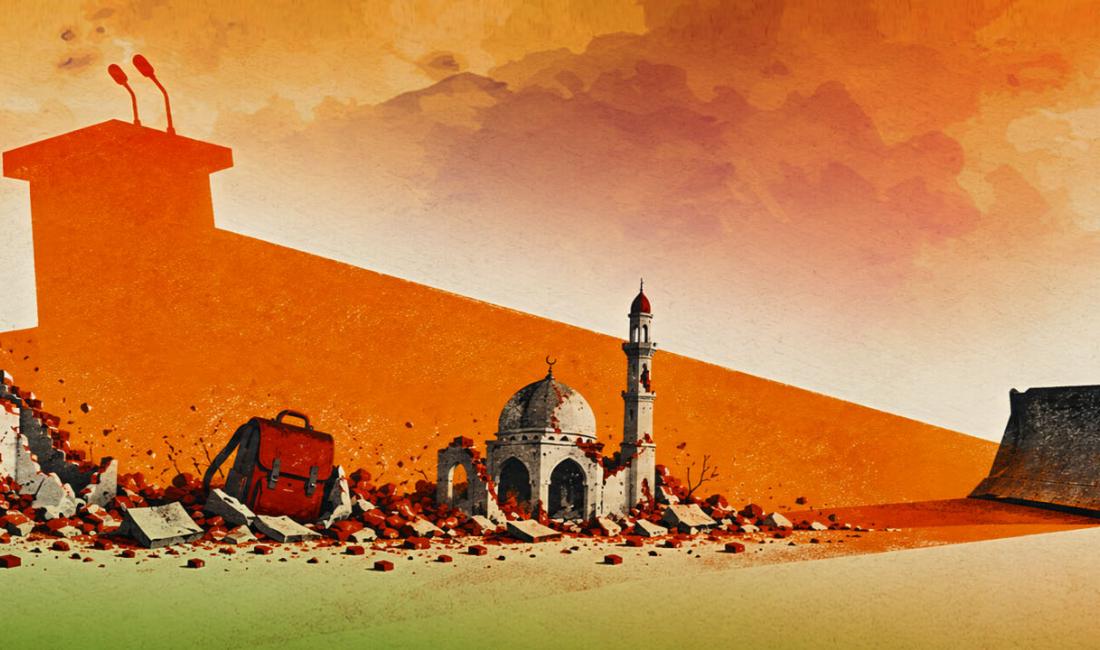
In Ahmedabad, the drive was conducted in two phases between late April and early May, razing over 12,500 residential, commercial, and religious structures in Muslim-majority neighborhoods near the lake. The homes of mostly Muslim wage laborers — many of whom had lived there for generations — were classified as a national security risk and cleared with heavy police deployment.
Document verification later revealed that of the 890 people detained during the crackdown, only around 150 were confirmed as Bangladeshi nationals. The overwhelming majority were working-class, Indian Muslims. The state acknowledged this fact, but then the homes of people like Shabana and her family had already been destroyed.
The big, distressing picture
In Muslim-concentrated localities, Amnesty International found that Muslim-owned properties were selectively razed while adjacent Hindu-owned structures on the same allegedly encroached land were left untouched.
The Punjab and Haryana High Court, examining similar demolitions in Haryana’s Nuh district in 2023, also posed this question directly in its hearings: Did the targeting of Muslim-owned structures amount to “an exercise in ethnic cleansing“?
Eventually, India’s Supreme Court intervened in November 2024 with a ruling that should have ended the practice. The Court held that demolitions used as punitive measures against those accused of crimes, without trial or conviction, were unconstitutional. In its verdict, the top court said that “the executive can’t become a judge and decide that a person accused is guilty and, therefore, punish him by demolishing his properties.”
Two years later, however, these demolitions continue. Lawyer Faizan Ahmad, who practices in the Supreme Court of India, told Asia Democracy Chronicles (ADC) that the Supreme Court judgment had carved out an “exception, that it does not apply to encroachments.” Ahmad said that the loophole lies in this phrasing, which has allowed local authorities to come in and raze properties by labeling them as encroached-upon land.
“Legally speaking, even then you require a notice and due process standards to be followed, but that’s not done,” Ahmad said. “Also, it targets mostly people who cannot afford these technicalities and don’t know what is to be done. Many people have an address mismatched where they get these notices, or they get it too late for it to be legally challenged.”
The central government and BJP-led states have repeatedly said that they are merely enforcing laws and not targeting any particular group in their demolition drives. But BJP has never been shy of asserting its Hindutva point of view, and in the political economy of BJP-governed India, the bulldozer has been consciously transformed into a punitive symbol to showcase strength and majoritarian power.
JCB machines and bulldozers have even been used as political campaign floats, with BJP supporters standing atop them for campaigns. The title “Bulldozer Baba” was adopted with pride by Uttar Pradesh Chief Minister Yogi Adityanath and his followers who fete him for this idea of “justice.” Under his leadership, the Uttar Pradesh government has pioneered the tactic as a form of collective punishment against Muslim neighborhoods and alleged “gangsters” and “criminals.”
The past few years have also seen the same phenomenon spread beyond just targeting people’s homes, with religious sites, including mosques, madrasa schools, tombs or mazaars, shrines, and even some Christian churches increasingly turned to rubble.
The demolitions do not always wait for official sanction either. Noted lawyer and former Uttarakhand Bar Council chairperson Razia Beig: “It takes one allegation by the Bajrang Dal or Hindu Yuva Vahini and then a mob comes and starts demolishing or vandalizing these places, too, without any orders. Or a place is labeled as an illegally occupied land and authorities demolish it without following any due process. And the courts do not stop this impunity.”
Beig said that to her knowledge, at least 30 to 35 madrasas have been either closed and demolished across Uttarakhand in recent years. She suspects the true number is much higher.
According to Delhi-based lawyer Faizan Ahmad many of India’s religious structures usually pre-date modern urban planning laws and roads. He said that such properties are over 700 to 800 years old, “older than your city, so you simply cannot term them as encroachments.”
Due process shortcuts?
Admittedly, the Muslim religious structures destroyed last June in Rajasthan for allegedly being in a no-build zone were all less than a century old. But social activist Muzammil Rizvi nevertheless believes that the way Rajasthan administration issued mass eviction and encroachment notices to mosques, madrasas, Eidgahs, dargahs, and shrines across the border districts of Barmer and nearby Jaisalmer were designed to “demoralize and instill fear” among Muslims.
Rizvi is with the Association for the Protection of Civil Rights (APCR), a pan-India civil society group for minority rights. He and his APCR colleagues formed a fact-finding team to track the actions leading to the notices, as well as recording the aftermath.
According to their report, “Notice, Faith, Justice,” the notices issued to 71 Muslim religious institutions across Barmer and Jaisalmer districts were served not through proper legal channels but via WhatsApp, delivered by hand, or affixed to walls. Most notices were dated June 11 but were actually served only on June 17, with June 18 fixed as the final deadline for both submitting a response and even vacating the premises.
The affected institutions and individuals thus had less than a day to gather documents, obtain legal advice, and mount any defense. Moreover, no site maps, revenue records, or supporting documents were attached to the notices to allow recipients to verify the encroachment claims being made against them.
The report also says that when mosque management committees appeared before authorities on the scheduled date, officials in several cases allegedly declined to meet them. In others, written representations were reportedly not accepted.
Between June 18 and 21, at least six mosques in the Barmer district and one in Jaisalmer were demolished.
The administration maintained the action was part of an anti-encroachment drive targeting allegedly unauthorized constructions within 50 kilometers of the international border, and was not directed against any particular community. Local residents and elected representatives disputed these claims, though, pointing to religious institutions belonging to other communities also within the 50-kilometer border belt, but which had not been served notices.
Former Rajasthan Chief Minister Ashok Gehlot rejected the government’s framing, and said that border communities had maintained communal harmony for decades and had actively supported national security during the 1965 and 1971 wars. Action directed exclusively against mosques and madrasas, he warned, “could create social tension and polarization.” The Rajasthan Waqf Board’s chairman, for his part, said valid documentary evidence and Waqf records were being disregarded.
Legal hurdles for victims
“Whenever a demolition occurs, the only place we can go is the courts,” said lawyer Beig. “But the process itself becomes punishment, because the process is so lengthy, and the search for justice is met with endless delays. We have to keep taking our writs to the courts and wait for months for a final order. How long can one wait? Sometimes a demolition takes place without any notice and happens overnight, but we’re left fighting the case for years.”
Beig speaks from experience, having been involved in such cases. She said that legal appeals usually go unanswered.
“Our government and our administration is silent,” said Beig. “Our (Uttarakhand) Chief Minister has chosen to remain silent, and they’ve given impunity to these mobs, to these vigilante goons.”
She cited the case of the Ashrodi mosque in Uttarakhand. Authorities said the mosque, which is over 100 years old, had been built illegally on forest land. But “when you go and speak to locals there and investigate,” Beig said, “you find that the forest land is in a separate area, and this is not on it.”
“The case went from the Nainital High Court to the Supreme Court, where the mosque was finally recognized as a heritage structure,” she recounted. “The Supreme Court didn’t open it up for prayers but still ordered it to be locked and preserved instead of demolished. Getting there took many months.”
Yet that may not mean it cannot end up as a heap of stones. Uttarakhand Chief Minister Pushkar Singh Dhami’s BJP government has publicly endorsed the phrase “land jihad” and pushed the claim that Muslims are engaged in a coordinated, sinister campaign of illegal land occupation. Using this as his rationale, Dhami has systematically demolished hundreds of mosques, shrines, and madrasas across the hill state.
“I shall continue taking stringent action against the encroachers and the land jihadis,” Dhami said at public event early this year. “We won’t allow anyone to disturb the demography of Devbhoomi – Holy Land – Uttarakhand.”