Sri Lanka Struggles with Past, Copes With Present
This story is from Asia Democracy Chronicles. Image from Shutterstock.
When one of her close friends passed away a few weeks ago, freelance journalist Munza Mushtaq mourned on her own at home in Sri Lanka’s capital Colombo. The funeral was held about 40 to 50 kilometers away, and Mushtaq and a group of friends had planned to travel together in one car. But recently reintroduced fuel quotas meant they would be unable to make the trip.
“There simply wasn’t enough fuel left in the vehicle’s weekly allocation,” said Mushtaq, 44. “So while we don’t have long fuel queues, we still have an underlying problem where people are severely affected by both fuel quotas and fuel prices.”
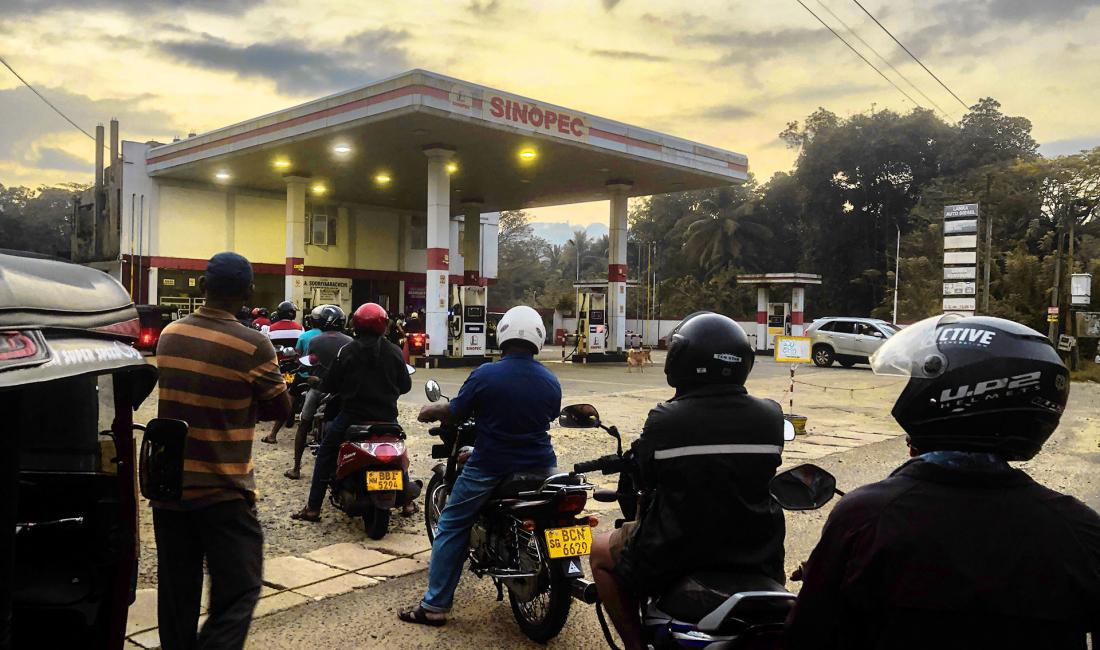
Across the globe, many countries are being hit by a fuel shortage triggered by the closure of the Strait of Hormuz amid the ongoing conflict between the United States, Israel, and Iran. In Sri Lanka, though, memories of 2022, when the country’s economic collapse led to acute fuel shortages, with people spending days in queues outside petrol stations, are also bubbling up.
Sri Lanka, an island nation in the Indian Ocean, has no significant oil or natural gas reserves and relies heavily on imports to meet its energy needs. Four years ago, shortages in fuel and other basic necessities led to protests that eventually toppled the Rajapaksa administration.
Some South Asian nations are already seeing demonstrations triggered by public frustration over fuel shortages and price hikes, among others, largely due to the war in Iran. Yet while there are experts who warn that Sri Lanka could follow suit, the current government’s quick application of previously effective strategies has so far managed to help Sri Lankans cope.
That doesn’t mean they aren’t hurting – and even if many Sri Lankans appear better prepared for disruptions.
“Household costs have risen sharply,” said Mushtaq. “Let’s say a family previously paid LKR 20,000 ($59.60) in electricity bills. They may now be paying as much as LKR 40,000 ($119) after multiple tariff increases. The price of cooking gas has also gone up. All these things are interconnected.”
The restrictions have already changed how people move around, as Mushtaq’s failed attempt to attend a funeral showed. Communications professional Aarefa Husain Ezzi also recounted how she now increasingly relies on public transport, takes tuk-tuks (three-wheeled public transport) instead of private vehicles, and carpools with friends and family whenever possible to conserve fuel.
Avoiding a crisis repeat
According to the Asian Development Bank, Sri Lanka spends, on average, up to 50 percent of its annual export earnings on importing crude oil, coal, and refined petroleum products. This places significant strain on its economy, which has yet to fully recover from the 2022 crisis. A devastating cyclone late last year has made it even more vulnerable to external shocks.
It thus comes as no surprise that Sri Lanka has increased fuel prices five times since the start of the conflict in West Asia, with the state-run Ceylon Petroleum Corporation (CEYPETCO) citing disruptions in global energy supplies. Shortly after Tehran shut down the Strait of Hormuz, Sri Lankan authorities also reintroduced fuel quotas tied to a QR system, as well as drew up other measures, to manage supplies.
Under the quota system, fuel can only be purchased on designated days based on a vehicle’s registration number. Even-numbered vehicles are assigned Mondays, Wednesdays, and Fridays to buy fuel, and odd-numbered vehicles Tuesdays, Thursdays, and Saturdays.
The quota renews every Sunday. This has helped avoid not only mad scrambles over petrol, but also a buildup of queues, which had defined the 2022 crisis.
“Everyone’s been abiding by (the quota system), which I think is great,” said Ezzi, who lives and works in Colombo. “Last time there was no system and people started panic buying, and we really ran short of petrol.”
For the 23-year-old, the memories of 2022 are still fresh.
“People were fleeing the country,” Ezzi recalled. “Migration was at its peak. Young people and families were desperate because of starvation and because they were wondering how they were going to survive the price hikes. Everything was unimaginably expensive, inaccessible, and unattainable.”
As the economic crisis deepened four years ago, more than 300,000 Sri Lankans left the country to seek better opportunities abroad. That was also the year the fuel quota system was first implemented – but only weeks after Gotabaya Rajapaksa had already fled Sri Lanka and resigned as president.
“It’s definitely much better (now) than the last time,” said Ezzi, crediting in particular the current government’s early intervention and the reintroduction of the QR code system.
“So far, because of the quota system, things are manageable,” Mushtaq said. “Without the quota system, I think the situation would have been much worse.”
Beyond petrol quotas, the government has also introduced a series of measures to help Sri Lankans deal with the latest shock.
These included a LKR 100-billion ($297 million) relief package, a temporary three-month emergency economic assistance program rolled out by President Anura Kumara Dissanayake to cushion households from inflation and rising energy costs linked to the conflict in West Asia, as well as a four-day work week, restrictions on non-essential lighting, and targeted fuel subsidies for critical sectors such as agriculture.
The measures have been backed by emergency fuel imports from India, which on March 28 delivered 38,000 metric tons of petroleum to Colombo, including 20,000 metric tons of diesel and 18,000 metric tons of petrol. Sri Lanka has since explored cheaper fuel imports from Russia, while also seeking additional emergency supplies from India to ease pressure on domestic energy markets.
Like many other Sri Lankans, Mushtaq seemed in agreement with what the government is doing so far, and indicated overall optimism that Sri Lanka can ride out the current crisis.
“The Strait of Hormuz situation has fluctuated, with shipping routes reopening at times,” she said. “We’ve also received fuel from India. There have been assurances from some Middle Eastern countries that they would step in if needed.”
“Right now, the government says there is enough fuel until the end of July,” said Mushtaq, who has been closely following the government’s response to the crisis. “There are also additional shipments expected in June.”
No time for complacency
Yet Sri Lanka’s energy minister, Anura Karunathilake, has warned that the country remains in a tough situation and urged people to conserve fuel.
“We are in a crisis, so we need to reduce our fuel consumption as much as possible,” Karunathilake said. “By introducing the QR code system, we were able to reduce it, but not to the expected levels.”
Former CEYPETCO chairperson Mohammed Owais Mohammed estimated that “with the implementation of QR rationing [this time], Sri Lanka’s total fuel demand has fallen by around 25 to 35 percent.”
Mohammed oversaw CEYPETCO between 2022 and 2024, including during the peak of the country’s fuel crisis. The QR code-based fuel rationing system was introduced at a time when CEYPETCO was effectively bankrupt and struggling to secure fuel imports.
In an interview with Asia Democracy Chronicles (ADC), Mohammed pointed out: “Even though demand has declined, due to global price increases we are paying almost double what we used to pay monthly for fuel imports. Previously we paid around $250 to $300 million per month. Now we are paying roughly $500 to $600 million.”
According to an analysis by JPMorgan cited by the Financial Times, fuel shipments in Asia have fallen by as much as 35 percent, while global oil demand is expected to decline by around 1 million barrels a day due to policy measures and higher prices. For countries that are dependent on imported fuel, however, lower demand has done little to offset the impact of soaring costs.
“Sri Lanka, like India, is almost completely dependent on imported fuel,” said Mohammed, “so these price increases directly affect us.”
Even as many Sri Lankans believe the country is handling the latest disruption better than it did in 2022, Mohammed said that the crisis has once again exposed the country’s vulnerability to external shocks. In a recent article for the online magazine meer, Dr. Jayathry Gunaratne went further, saying, “Sri Lanka’s vulnerability is not simply the result of external shocks but of internal structural dependencies that have remained largely unaddressed. The Middle East conflict, in this sense, is less a cause than a catalyst—amplifying existing weaknesses rather than creating new ones.”
“While policymakers often frame external crises as unpredictable and unavoidable,” wrote Gunaratne, who has studied the political dimensions of Sri Lanka’s 2022 crisis, “the scale of Sri Lanka’s exposure suggests a failure to adequately diversify and future-proof the economy.
Without meaningful reforms – particularly in reducing import dependence, diversifying export markets, investing in energy security, and creating sustainable domestic employment – the country will remain trapped in a cycle of vulnerability, where each external shock threatens to undo hard-won gains.”
First, though, the current problems have to be dealt with. Mohammed argued that higher prices naturally curb consumption and reduce the need for fuel imports. “The most important lesson is that cost-reflective pricing must remain in place, even if prices rise dramatically,” he said.
Lower fuel imports ease demand for foreign currency, helping reduce pressure on the Sri Lankan rupee and contain inflation at a time when the country remains heavily dependent on imported energy, he added.
“Sri Lanka should minimize foreign currency outflows as much as possible,” he said. “For example, I believe vehicle imports should be completely halted for the time being.”
He said that enough vehicles had entered the country in recent months and that reducing such imports would help limit foreign currency outflows during a period of uncertainty.
“We must plan as though the conflict could continue,” Mohammed said, “while hoping it ends tomorrow.”