Local Communities Suffer in Global Race for 'Transition Minerals'
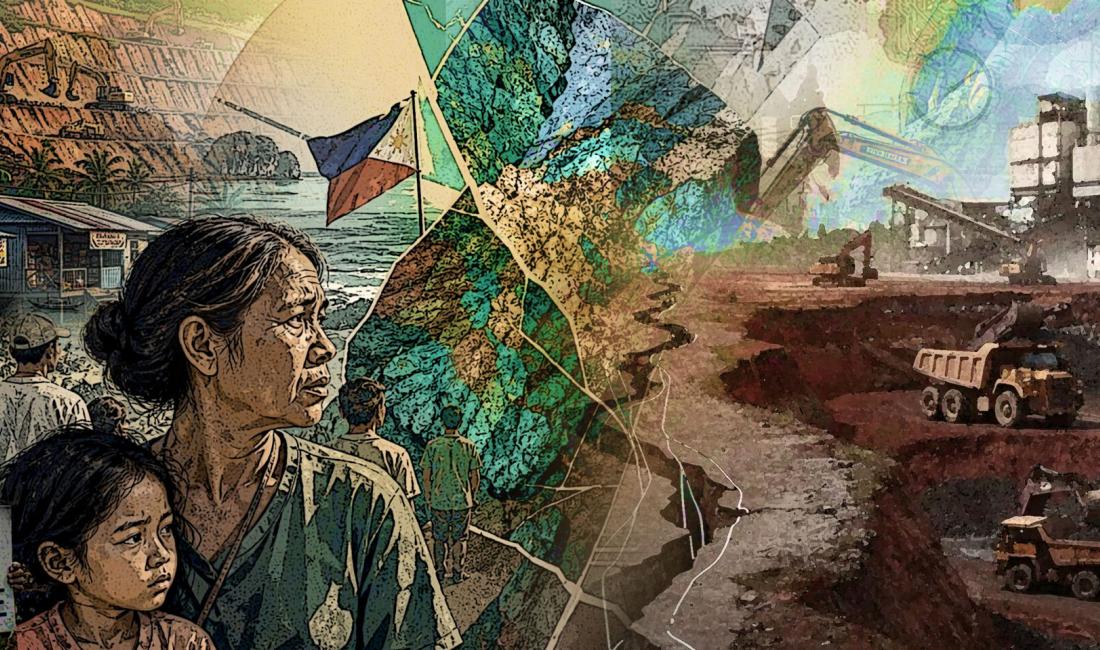
This report and image were produced and published by Asia Democracy Chronicles.
As the Iran war continues to hold much of the global supply of oil and gas hostage, what was a slow marathon toward renewable energy has become a race, with increased competition to secure the materials needed to make the ‘clean’ transition.
But in many communities where mining the so-called ‘critical (or transition) minerals’ is already occurring or is being planned, the promised transition is emerging instead as displacement, environmental damage, militarization, and deepening social conflict.
In the Philippines, one of the world’s mineral-rich countries, those tensions are becoming harder to contain. In Nueva Vizcaya in the north, residents on May 9 erected barricades in Barangay Paquet to block access roads leading to the village where Northern Luzon Mineral Resources Corporation was conducting exploration activities. Villagers from nearby communities joined the protest the following day and established another blockade in Barangay Kakiduguen.
Days earlier, residents of Dupax del Norte, also in Nueva Vizcaya, forced Woggle Corporation to withdraw its exploration equipment from Barangay Bitnong after months of barricades and protests. Similar resistance has surfaced elsewhere in the country – from the Cordillera and Zambales in the north; Leyte, Sibuyan, and Homonhon islands in central Philippines; and Palawan and South Cotabato in the south.
The Ferdinand Marcos Jr. government considers mining as among the country’s major economic drivers, and is pushing it forward some more. In 2025, the mining and quarrying sector employed nearly 208,000 workers and contributed an estimated PHP 208.4 billion in gross value added, or still a modest 0.74 percent of the country’s GDP.
For Sarah Dekdeken, Asia program director of Land is Life, the current wave of mining conflicts in the country reflects a pattern that has persisted across administrations: a “nationwide surge in anti-mining protests” amid aggressive mining and widespread violations.
Dekdeken, whose home region in the Cordillera hosts some of the country’s oldest operating mines, believes the latest expansion push is closely tied to rising international demand for minerals considered critical to the energy transition and national security. Indeed, governments frame the current global trend as a necessary rush for renewable energy, strategic industries, and economic growth.
Referring to a US$76.4-million bridge loan to Makilala Mining Company for a copper project in Kalinga, Dekdeken said, “This was Marcos Jr. announcing his administration’s full backing for large-scale mine projects. They’re promoting mineral extraction under the pretext that these are essential for ‘green technologies’.”
For Prabindra Shakya, convenor of the Asia Indigenous Peoples Network on Extractive Industries and Energy, official postures on transition minerals are increasingly shaped less by climate policy and more by geopolitical competition. “These deals are happening based on geopolitical circumstances with minimal understanding or consideration of impacts on communities that will be affected by the projects being pushed under these agreements,” Shakya said.
Deals and policy shift
Southeast Asia holds some of the world’s largest reserves of transition metals such as nickel, cobalt, and copper, as well as post-transition metals like bauxite and tin. The Philippines itself is the world’s second-largest nickel producer after Indonesia, the largest exporter of nickel ore, and home to the fourth-largest nickel reserves globally. The Philippines also has copper, cobalt, gold, and silver.
Since the launch of the U.S.-led Indo-Pacific Economic Framework for Prosperity in 2022, several agreements involving exploration, extraction, processing, and supply chains for critical minerals have emerged among the United States and partner countries, including Australia, India, Japan, Indonesia, and the Philippines.
In April, the United States and 14 other states launched Pax Silica, a State Department initiative focused on AI and supply chain security. More recently, the Philippines-Indonesia Nickel Corridor was announced.
These agreements form part of efforts to reduce dependence on China, which controls much of the global processing and production of critical minerals and rare earths.
But Shakya pointed out, “The troubling trend is that these geopolitical deals are also resulting in legal and policy changes within countries. In Nepal and India, we have seen similar legal changes to accelerate extraction in the name of energy transition.”
India’s National Critical Mineral Mission, launched in 2025, has faced criticism for bypassing public participation processes in mining projects. Similar concerns have emerged in Nepal following the approval of over150 mining concessions, including projects involving the country’s largest iron deposits.
In the Philippines, the changing global landscape has also steadily translated into policy adjustments.
Just over a month after Marcos Jr.’s presidential inauguration, then Finance Secretary Benjamin Diokno promoted mining as a pillar of economic recovery, linking the strategy to opportunities under the Indo-Pacific framework. That direction was later reinforced by U.S. technical assistance totaling PHP280 million (US$5.03 million, using 2023 rates) to develop the country’s critical-minerals sector.
A major policy shift came in September 2025, when the government amended mining fiscal policies to establish a tiered royalty and windfall profits tax system projected to generate around PHP6.26 billion (US$101.5 million, based on current rates) annually from 2026 to 2029.
In February, Manila and Washington formalized a partnership on critical minerals. According to Energy Secretary Raphael Lotilla, the agreement “underlines the need for financing and technical know-how to ensure environmental sustainability and the responsible mining of…critical minerals and rare earths.”
Industry observers described the shift as a move away from a purely export-oriented mining model toward one centered on strategic mineral supply chains, domestic processing, and international partnerships. Environmental groups, however, warned that the changes could deepen existing risks.
“The Marcos administration has been issuing new mining policies to fill the soaring demand for so-called critical minerals needed for renewable energy and security,” said Maya Quirino, national coordinator of the SOS Yamang Bayan Network. “But these policies will only intensify risks for people and nature.”
Old problems, new pressure
Concerns grew in May after the National Commission on Indigenous Peoples (NCIP) approved revised Free, Prior, and Informed Consent (FPCI) guidelines. Critics argued that the revisions weaken Indigenous protections by introducing a tiered project classification system that could bypass full community consent.
Across the Philippines, FPIC processes remain heavily contested, with communities accusing both the NCIP and project proponents of manipulation, intimidation, and the absence of genuine consent.
Yet at a recent forum in Türkiye, the country’s trade officials promoted the reforms, presenting the Philippines as an emerging player in the global mineral supply chain. They also announced plans to reduce mining permit processing time from 11 years to 11 months.
For environmental lawyer Antonio La Viña, the accelerated push raises familiar concerns.
“Our laws may not be equipped to handle that kind of investment,” he said. “The same thing happened when we boasted about the 1995 Mining Act. What followed was widespread opposition, numerous gaps in the law, and the policy also failed to bring in the massive investments it promised.”
Government policy papers released in 2019 and 2024 identified longstanding problems in the mining sector, including conflicting national and local policies, unresolved land and Indigenous claims, lengthy permitting processes, and weak implementation of safeguards. According to La Viña, consultation and environmental protection mechanisms remain largely “ineffective and performative,” while accountability for social impacts continues to lag behind.
“Where there are corporations entering Indigenous peoples’ lands, farmers’ lands, communities, militarization automatically follows, because they don’t want to enter without protection,” he said.
Local and international reports have documented deforestation, water pollution, livelihood loss, militarization, and rights violations linked to transition mineral extraction in Caraga, Homonhon Island, Zambales, and Palawan. Critics are seeing little meaningful changes on the ground even as governments and mining firms increasingly frame extraction as “responsible mining.” To Shakya, in fact, transition mineral extraction continues in “a business-as-usual manner.”
“There is no enhanced impact assessment process, no improvement in environmental and social behavior of mining companies, and no improved legal protections for impacted communities,” he said.
Instead, said Shakya, governments are weakening oversight to accelerate extraction. Citing a pattern noted in Southeast Asia by a 2025 UN study, he said, “Governments are fast-tracking permits, weakening environmental review, and, in some cases, even using security forces to push mining operations…there’s lots of systematic subversion of FPIC and the legal process that is supposed to protect indigenous communities.”
Harmful impact
Voluntary standards and industry initiatives are currently insufficient to implement human rights and environmental due diligence, said Germanwatch in a 2022 paper reviewing these. Human Rights Watch has also raised similar concerns regarding the new voluntary certification standards, noting a failure to prevent these issues due to a lack of meaningful community participation.
Global studies and reports have documented worsening environmental and human rights conditions tied to transition mineral extraction, including those in Indonesia and Myanmar, and in Chinese mining projects in several countries.
From 2021 to 2023, Global Witness recorded an average of 111 violent incidents and protests annually related to critical minerals. In 2024, 29 people were reportedly killed in mining and extractive-related incidents.
Research on mining tied to battery and renewable-energy supply chains has also identified a recurring pattern: while some regions experience short-term job creation and reduced monetary poverty, Indigenous and rural communities often bear the costs through land dispossession, environmental degradation, and deeper marginalization.
Shakya and La Viña agreed that stronger legal safeguards, stricter enforcement, and community-centered governance are necessary for mining projects to proceed without worsening existing harms.
La Viña argued that mining revenues should stay in the country and directly benefit affected communities, rather than be reduced to token royalties or infrastructure projects.
“If there are harmful impacts, criminal prosecution and fines are not enough,” he said. “Corporations that destroy the environment should pay for the damage and its consequences, not just pay a fine.”
Two bills filed in the House of Representatives propose shifting mining policy away from export-oriented extraction toward national industrialization and domestic mineral processing. Both House Bills 1852 and 8248 propose stronger environmental and social safeguards. The measures also seek to limit foreign participation and impose stricter fiscal measures, including a government share of net revenues ranging from 10 percent to 50 percent and a progressive environmental excise tax.
With more than half of the reserves found in or near ancestral domains, however, the discussion ultimately returns to “the recognition and respect for indigenous peoples’ rights,” said Shakya.
“Indigenous people want to be part of the solutions,” he said. “We don’t want to be continuously on the opposing side of the projects… For that to happen, FPIC needs to be at the center of Indigenous people’s rights to land territories and resources.” He also urged international financial institutions to adopt safeguards that go beyond national regulations and align with international human-rights standards.
Shakya pointed as well to a larger question: whether or not the current model of energy transition depends on extraction levels that communities and ecosystems are expected to absorb indefinitely. “An important discourse that needs to happen,” he said, is about “how we use that energy more sustainably and consume more sustainably. So that we don’t have to extract more.” ◉