Burdens of Renewable Energy Shift From Governments to Local Communities
This story and lead image are produced and published by Asia Democracy Chronicles.
As nations across the world try to reduce their fossil-fuel use, conflicts and challenges presented by the shift to renewable energy have become evident. In the Philippines, acknowledged as among Southeast Asia’s champions of renewable energy, there seems to be no better place to reflect this than the home province of President Ferdinand Marcos Jr.: Ilocos Norte.
Branded as the “Renewable Energy Capital of Southeast Asia,” the province is the site of Ilocos Region’s first wind farm. It is also among the places where the disconnect between the “just transition” slogan used to justify renewable-energy (RE) projects and what communities experience on the ground is blatantly evident.
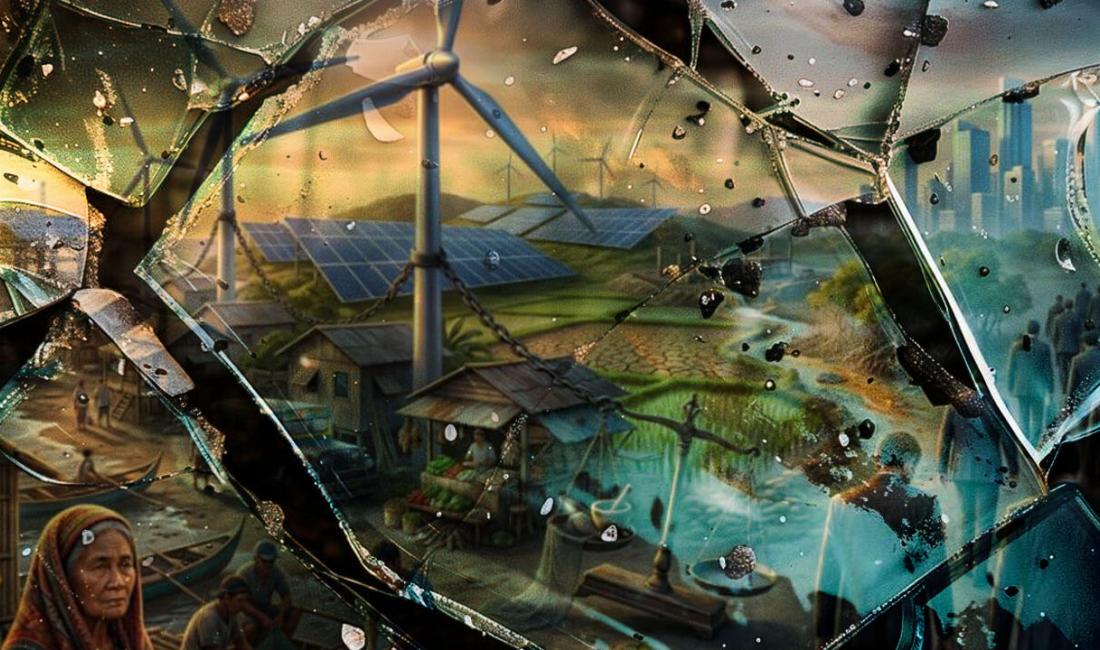
In Bangui town, for instance, a solar-energy farm was built on Isneg ancestral land without community consent. Fishers and church groups have also raised concerns that a proposed offshore wind farm in Bangui Bay could threaten livelihoods and harm marine ecosystems.
In Currimao, residents blame the tree-cutting for solar farms for flooding and extreme heat.
These cases are not unique. Similar projects and problems are emerging across the Philippines and elsewhere. Indeed, the global “just transition” push in response to the climate crisis seems to be reproducing many of the same issues it sought to address, leading more than a few observers to ask: How just is the energy transition, really?
For the Center for Environmental Concerns (CEC), the answer to that is, not much. According to CEC, state policies provide for technological expansion, commercial application, and streamlined procedures, but with insufficient safeguards for social, environmental, and climate justice.
The aggressive push for RE projects and the easing of processes have actually undermined environmental measures, public participation, and social acceptability procedures, says CEC Community Services Coordinator Mattie Balagat.
“The current assessment is that there is really nothing ‘just’ about it,” she says. “Even as the share of renewable energy increases, because the industry remains privatized, we still do not see lower costs or greater energy security for the wider population.”
The Philippines has the third-highest average residential electricity rate in Southeast Asia from 2023 to 2025. Balagat also says that communities hosting RE facilities often do not benefit from the electricity generated.
For example, the Cordillera region depends mainly on fossil fuels despite having 16 commercial hydropower facilities that produce 316 megawatts. Ilocos Norte has similar dependence, even though it produces 615 MW of RE from wind and solar farms.
Setting goals, streamlining processes
The Just Transition Framework had entered global policy through the Paris Agreement, with its principles outlined by the United Nations at COP24. While there is no single definition for the phrase, it broadly refers to ensuring the shift to low-carbon, sustainable economies is fair, inclusive, and protects affected workers and communities.
The Philippines’ own “just energy transition” framework is embedded in the National Renewable Energy Program 2020–2040 and the Philippine Energy Plan 2023–2050. It aims to expand access to affordable, reliable, resilient, clean, and sustainable energy, “guided by the principles of equity and inclusivity, ensuring the uplift of all Filipinos.”
The government says that RE targets and the country’s Nationally Determined Contribution are meant to cut exposure to global fossil-fuel price volatility, strengthen energy security, and reduce emissions. It has set targets of 35-percent renewable energy in the power mix by 2030 and 50 percent by 2040.
For Marcos Jr., RE “is the way forward” to meet these targets and commitments, reiterating it during Abu Dhabi Sustainability Week last January, and citing incentives, streamlined regulations, and financing as key measures to boost RE development.
The Renewable Energy Act of 2008 (RA 9513) governs the expansion of renewable energy to achieve energy self-reliance and reduce fossil fuel dependence, offering fiscal and non-fiscal incentives to investors. A 2022 amendment now allows 100-percent foreign ownership in RE projects.
It also requires distribution utilities and electric cooperatives to source a minimum share of renewable energy under the Renewable Portfolio Standards (RPS). Moreover, the Department of Energy has raised the annual increment from one percent in 2018–2022 to 2.52 percent starting in 2023 to align with 2030 targets.
Other measures have streamlined processes, including the Energy Virtual One-Stop Shop Act and the “Green Lanes” initiative. The Green Energy Auction Program (GEAP) also offers 20-year contracts with revenue guarantees and regulatory risk protection. The government has likewise designated Competitive Renewable Energy Zones (CREZ) to fast-track development in areas with high RE potential.
Under GEAP-4, awarded projects for its 2026-2029 target reached almost 10,196 MW, or about 67 percent of the 2030 objective.
On this alone, the Philippines appears to be moving in the right direction toward a green-energy transition. But energy experts and rights advocates argue that meeting numerical commitments is not the sole measure of success.
Food security sacrificed?
Francis Dela Cruz, policy advisor at the Institute for Climate and Sustainable Cities (ICSC), even challenges the dominant framing of the energy transition that foregrounds climate and investment metrics. The starting point, he says, should be access to affordable, reliable, and clean electricity, especially for underserved communities.
“I wouldn’t put climate action at the forefront,” he says, “because for countries like the Philippines, which have a relatively small carbon footprint, the priority should be the possibility of productive use—what is more economic and more practical.”
While “climate action” is important and currently popular for defining big-ticket projects, Dela Cruz says, the benefits of providing more accessible, affordable, and clean energy are a more compelling reason to develop RE sources. He argues that even without framing it as “climate action,” the goal remains a “noble undertaking” because it provides energy access while phasing out fossil fuels.
A 2025 paper from the Manila Observatory’s Klima Center shares that viewpoint. It said that achieving carbon and emissions goals requires shifting from a “narrow, carbon-centric transition agenda” to a more integrated strategy that considers both greenhouse gas (GHG) reductions and social equity, as well as food security.
Focusing solely on regulatory compliance risks treating agricultural and fishing areas as “sacrifices” for energy projects, it warned. While these may help meet carbon targets, the paper said, they harm food production and rural livelihoods. According to Klima Center, to meet the country’s commitments “justly,” the transition should provide farmers and fisherfolk with livelihood stability and access to affordable food, and be aligned with human development goals.
Balagat says, though, that the Philippine energy transition has been “business as usual,” following “patterns and practices seen in fossil-fuel dependence and extractive investments that harm communities and the environment.”
Designated energy zones often overlap with areas of high biodiversity and economic value to communities, such as agricultural and fishing areas or those inhabited by indigenous peoples, she points out.
Other non-profit groups have raised similar concerns, noting that around 56 percent of CREZs could overlap with ancestral lands, while others are within or near ecologically sensitive areas. Farmers and fisherfolk groups are also raising alarms over possible economic displacement from their traditional cropping and fishing areas.
Based on GEAP-4 targets of 10 gigawatts by 2026, an estimated 10,000 hectares would be allocated for solar projects, using the one-hectare-per-megawatt scale for utility-scale solar. This increases to roughly 56,500 hectares under the 2050 targets. Major RE projects in coastal areas meanwhile threaten more than 14,000 fisherfolk and over 2,000 people in the aquaculture sector.
A rise in abuses
Balagat also says that many RE investments are classified as nationally significant or security-related, leading to militarization, violent displacement, and human-rights violations against those resisting the projects.
International and local rights groups have documented abuses ranging from red-tagging, terrorist labelling, and legal charges to extrajudicial killings. In their 2025 reports, Global Witness and PAN Asia Pacific ranked the Philippines as the deadliest in Asia for land rights, Indigenous rights, and environmental activists.
Then there are the “false solutions,” which, according to Balagat, include “waste-to-energy” facilities that are incinerators. Liquified natural gas (LNG), designated as “transition fuel,” conflicts with the Paris Agreement and poses environmental and health risks, and could also raise power costs. The 2020 coal moratorium also applies only to “greenfield” projects, while existing and pipeline plants continue to expand.
Meantime, reports from Amnesty International and Climate Rights International, released in 2025, have underscored the detrimental impacts of the transition minerals rush, particularly nickel, in Palawan and the Caraga region, respectively.
Both documented environmental degradation and the increased climate vulnerability of local communities. They highlighted as well the lack of corporate and government accountability and human rights violations, with environmental defenders often facing intimidation, legal harassment, or physical violence.
The country’s 121 electric cooperatives – out of the 147 distribution utilities nationwide — are thought to be better placed to help implement grassroots RE transition. After all, they serve about 60 percent of connected households, and extend lines to unconnected households.
Unfortunately, the cooperatives face major constraints and challenges. In a Philippine Rural Electric Cooperatives Association (PHILRECA) survey, only 15 of 79 respondents declared compliance with RPS requirements. PHILRECA Executive Director Janeene Colingan says that this is due to the cooperatives’ “existing corporate nature” that “strains their financial, operational, and regulatory capacities.”
Barriers include concerns over revenue loss, limited project funding, complex bureaucratic red tape, and gaps in technical infrastructure, keeping cooperatives dependent on fossil fuels, and adoption of stand-alone home systems slow.
Policy rethink needed
Dela Cruz says that electric cooperatives are obligated to have an RE mix, but there is less incentive for them to invest further on these once they reach the required percentage. Besides, he says, these are still economic enterprises that need to generate profit.
Beyond phasing out fossil fuels and shifting to RE, Dela Cruz says, the transition to cleaner energy requires modernizing the power grid and electrifying transport and industry. This includes restructuring the power system—from generation to consumption—to reflect the country’s archipelagic geography and social realities.
Reliance on centralized grids and fossil fuel–based generation remains costly, slow to build, and ill-suited to dispersed islands, says Dela Cruz. Smaller, flexible, and distributed RE systems using local sources and decentralized mini-grids are more practical, he says, since these lower costs by eliminating fuel expenses and reducing dependence on imports, while protecting consumers from global petro-politics.
“The laws are already there,” Dela Cruz says. “The programs are in place. What we need is … to strengthen the capacity to implement.”
Policy makers may be forced to rethink strategies sooner than expected, however, as a people’s movement challenging “business as usual” practices gains ground.
In the Cordillera, the National Commission on Indigenous Peoples is considering recommending that energy project applications be temporarily suspended in Kalinga. It said rejections, community concerns, and demands have already halted most projects.
Balaga reiterates that power generation should be based on people’s needs and toward energy democracy, which prioritizes small-scale, community-based generation and “mini-grids” to empower local communities rather than private corporations.
She asserts as well, “For a pro-people transition, the energy industry must be further nationalized and regulated so the benefits of a just transition reach communities.”