A Land Dispute on Sri Lanka's East Coast Involves Buddhist Monks, Raises Tensions, Pressures President
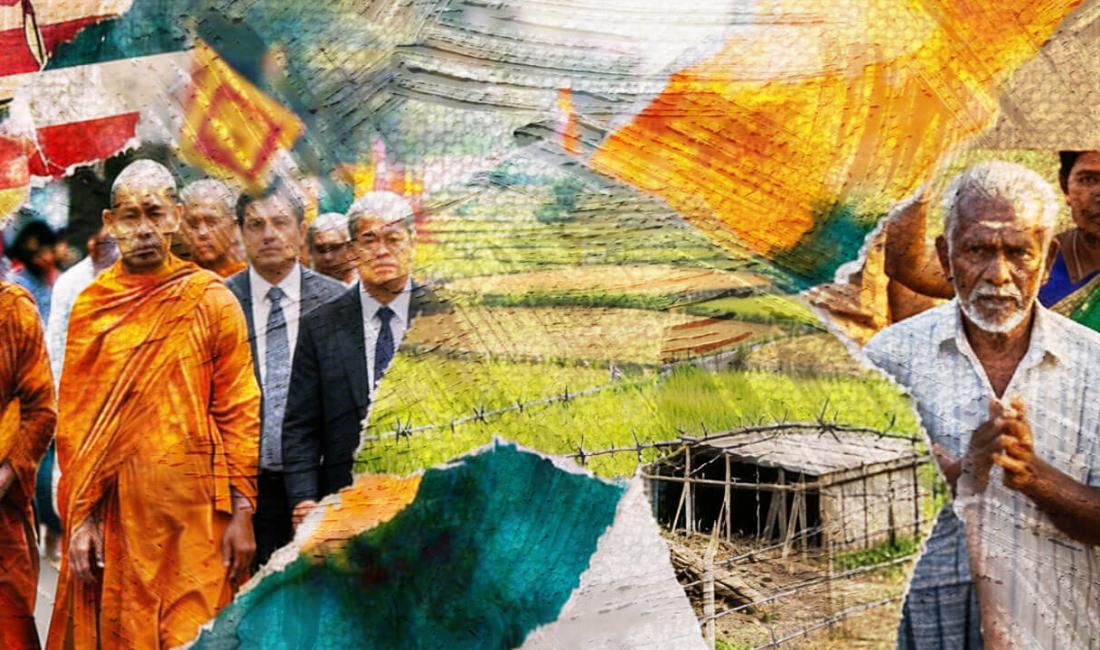
This story and image were produced and published by Asia Democracy Chronicles.
Karthi Hayan, a Tamil youth activist in Sri Lanka’s eastern coastal city Trincomalee, has watched this pattern repeat throughout his life: A land dispute emerges. Buddhist monks arrive. A statue appears. The law bends.
“As someone who has grown up here, I have seen how Buddhism is used as a tool to take over Tamil lands through organized land grabs,” Hayan said. “It has happened at Thirukoneswaram, around the Kanniya Hot Water Springs, the Periyakulam Boralus Kantha Viharaya, and across the Kuchchaveli Division. These are not isolated cases.”
Last November, the pattern resurfaced on a strip of coastline near Fort Frederick Road in Trincomalee’s Dutch Bay. What began as a dispute over illegal construction on land controlled by the Coast Conservation Department transformed within hours into a confrontation involving monks, police, political actors from outside the district, and ultimately, the installation of a Buddha statue under police protection.
For Trincomalee’s many Tamil and Muslim residents, the rapid escalation from permit violation to symbolic religious claim mirrors years of battles against state-backed temple expansion and land appropriation that have reshaped the demographic landscape in Sri Lanka’s Northern and Eastern Provinces in the last 15 years.
In Trincomalee’s Kuchchaveli Division alone, more than 41,000 acres (some 16,600 hectares) — or half its total area — have been appropriated in the past decade through coordinated actions of the Archaeology Department, Forest Department, military, and Buddhist clergy, according to a September 2024 report by the U.S.-based policy think tank Oakland Institute.
In July that year, the international rights monitor Human Rights Watch also released a report asserting that this reclassification of seized land as archeological property was being used by police and military personnel as a pretext to stop Tamil Hindus from accessing temples.
“The North and East have witnessed decades of land conflict,” constitutional lawyer and activist Bhavani Fonseka told Asia Democracy Chronicles (ADC). “Recent appropriation in the name of heritage or sacred sites continues to inflame tensions.”
Ethnically and religiously diverse
Sri Lanka’s population is ethnically and religiously diverse, though unevenly distributed geographically. The predominantly Buddhist Sinhalese make up roughly 74 percent of the country’s 23 million-strong population and are concentrated mainly in its southern, western, and central parts.
Tamils account for around 15 percent, consisting of Sri Lankan Tamils (largely Hindu) in the Northern and Eastern Provinces, and Indian-origin Tamils, mainly in the central hill country. Muslims make up about nine percent of the population and are spread across the island, with significant concentrations in the Eastern Province, including Trincomalee. Christians, largely Sinhalese and Tamil, form a smaller minority.
Although tensions among these groups erupt into conflict from time to time, by far the animosity between the Sinhalese and the Tamils runs the deepest. Historians trace this back to colonial times, when the British favored the Tamils while the Sinhalese were sidelined. The post-colonial era, however, saw official policies benefiting the Sinhalese more, to the detriment of other groups, especially the Tamils.
By the late 1980s, some Tamils had organized an armed force and set out to carve out a Tamil territory within Sri Lanka. This developed into a full-scale insurgency that would take at least 40,000 civilian lives before ending in 2009.
Among the Sri Lankan military’s tactics at the time was to seize property belonging to non-Sinhalese. While campaigning for the presidential post two years ago, Anura Kumara Dissayanake pledged to return land taken by the military during the civil war. Addressing a gathering in Jaffna in November 2024, he promised to correct “two historical crimes” against Tamil and Muslim communities and vowed to “gradually” return lands grabbed from communities and occupied by the military and state agencies to their “rightful” owners.
Dissanayake’s National People’s Power coalition received unprecedented support from Tamil voters in districts like Jaffna and Trincomalee. In January 2025, the newly elected leader reiterated his pledges in Jaffna that “land belonging to the people should rightfully remain with them.” Local media reports have quoted him as saying land disputes in the Northern Province were under review, with steps being taken “to expedite the process of returning land to its rightful owners.”
During the campaign for the May 2025 local polls, Dissanayake expanded his pledge by saying land earmarked by the forestry department for the state — which had included swathes of farmland and reservoirs — would be re-evaluated.
Pledges still unfulfilled?
So far, however, there is little indication that any piece of land or property appropriated by the state under the circumstances noted by Dissayanake has been returned to its private owner. Instead, a campaign using religion to justify land grabs and — say observers and activists — forcibly change the demographics in particular areas, has gathered even more steam.
According to Fonseka, the November incident in the Trincomalee was just “the latest in a district already marked by land struggles linked to Buddhist clergy and state authorities.”
Indeed, by 2020, the Presidential Task Force for Archaeological Heritage Management in the Eastern Province (where Trincomalee is located), staffed by military officers and Buddhist monks, had already entrenched a system seen by Tamil and Muslim communities as institutionalizing religious expansion and land grabs. Similar moves had also been taking place in the Northern Province.
In its 2025 annual report, the U.S. Commission on International Religious Freedom (USCIRF) included “expropriation of land” as among the reasons why it was recommending Sri Lanka’s inclusion in its Special Watch List.
Throughout 2024, said USCIRF, “the government continued facilitating the expropriation of land from religious minorities in the north and east under the auspices of protecting Buddhist cultural sites. In February, Sri Lanka’s National Physical Planning Department declared 11 additional Buddhist temples as sacred sites, bringing the total to 142. In March, the minister of BRCA proposed a new bill to safeguard ‘sacred Buddhist sites’.”
Sri Lanka was also on the USCIRF’s 2024 Special Watch List. In its 2024 report, the USCIRF said, “Under the Ministry of Religious Affairs, the Department of Archeology collaborated with the Ministry of Defense’s Task Force for Archeological Heritage Management to identify cultural sites across the country.
“In the Northern and Eastern provinces, authorities have used this mandate to expropriate Hindu and Muslim land for the construction of Buddhist sites…. A 2023 report identified 37 cases in the north and east in which the Department of Archeology attempted to construct Buddhist temples on Tamil land, despite the lack of Buddhist populations in those locations. Human rights groups additionally report as many as 68 instances of land disputes in Batticaloa, as of September 2023,” it added.
The land acquisition is not random. There is a clear pattern tied to Sri Lanka’s archaeological law, which allows the state to acquire land if archaeological value is identified. Buddhist archaeological remains are undoubtedly widespread across the island. Inexplicably, however, many of the properties being taken belong to Tamils or Muslims.
A strategic spot
In Trincomalee, once such remains are identified or declared, Buddhist religious institutions often intervene and assert custodianship over the land. But control over land in Trincomalee is not only symbolic or religious.
Geopolitically and historically significant, it hosts one of the world’s largest natural deep-water harbors and has long been of strategic interest, from British colonial rule to present-day regional power competition involving India and China. This makes Trincomalee particularly sensitive to state-led land control initiatives framed as development, security, or heritage protection.
The land at the center of last November’s dispute was granted in 2014 to the Buddhist temple Sri Sambuddha Jayanthi Bodhiraja Viharaya under a Puja Land deed. This legal mechanism allows land to be transferred or declared as property dedicated permanently for religious use. Once land is classified under a Puja deed, it cannot legally be sold, transferred, or reclaimed for secular purposes.
Yet there were earlier attempts to open a commercial establishment at the site. The land is also within a coastal buffer zone; construction on it requires explicit approval from the Coast Conservation Department. The department eventually cancelled the permit in July 2025 and ordered the structure already built there removed.
Instead of complying with the order, a group of monks and supporters laid a foundation stone at the site last Nov. 16, claiming to reopen an old Sunday Dhamma School. When police intervened, tensions rose quickly. A Buddha statue was brought to the site that evening. Police removed it for security reasons, prompting clashes that left officers and monks injured. The statue was returned the next day under heavy police protection, and remains there as of this writing.
Nationalist monks, including Bodu Bala Sena General Secretary Gnanasara Thero, arrived in the days that followed, issuing statements on-site that carried undertones of Sinhala-Buddhist territorial claims.
Balangoda Kassapa Thero and 10 others were later arrested in connection with the Trincomalee incident. Several of their bail applications were rejected before they were finally released on bail last Feb. 11.
A challenge for the president
The city’s Tamil and Muslim residents remain wary, however. Similar concerns have surfaced repeatedly across the district, with affected communities saying state institutions failed to enforce court orders or protect minority land rights.
To rights advocate Ruki Fernando, such reactions are grounded in lived history.
“Demography in the East has been changed dramatically for decades to increase Sinhalese (mostly Buddhist) and reduce Tamils,” he said. “This is different from natural population change. When new Buddhist structures appear while laws and court orders are openly violated, the fear of Sinhala-Buddhist domination is reasonable. People lose faith in the rule of law when the police cannot apply the law equally.”
The incident has placed new pressure on President Anura Dissanayake, with many reminded of his repeated pledges regarding state land grabs. During a parliamentary debate days after the Nov. 16 incident, Dissanayake reportedly insisted his government would prevent attempts to ignite ethnic tensions “under the guise of religious rights.” But he did not explain why state agencies and police have repeatedly failed to enforce land-related laws in similar cases – or what consequences officials would face for allowing the statue installation to proceed despite the cancelled permit.
Commented Hayan: “If the Anura administration wants credibility, it must prove that the law applies equally to everyone.”
For him and other Trincomalee residents, the contradiction is glaring. “In this case, the land was first taken for a restaurant built for someone’s personal benefit,” Hayan said. “The President himself admitted this in Parliament. Buddha statues are being used to protect these private interests.”
“The deeper problem,” he said, “is that Sri Lanka has no effective mechanism to remove a Buddha statue once it is placed, even when it is illegal. That is why injustice continues.”
It is also why Tamil and Muslim communities now view each new statue installation as a territorial claim disguised as religious expression. Once a Buddha statue is installed, removing it becomes politically impossible regardless of the law’s requirements. Buddhist nationalist groups mobilize rapidly, framing any enforcement action as an attack on Buddhism itself – as what happened in a coastal buffer zone in Trincomalee. Politicians retreat. Courts delay. The statue remains.
Hayan recalled that a court had ordered a Buddha statue installed at the Trincomalee clock tower in 2006 to be removed.
It is still there.