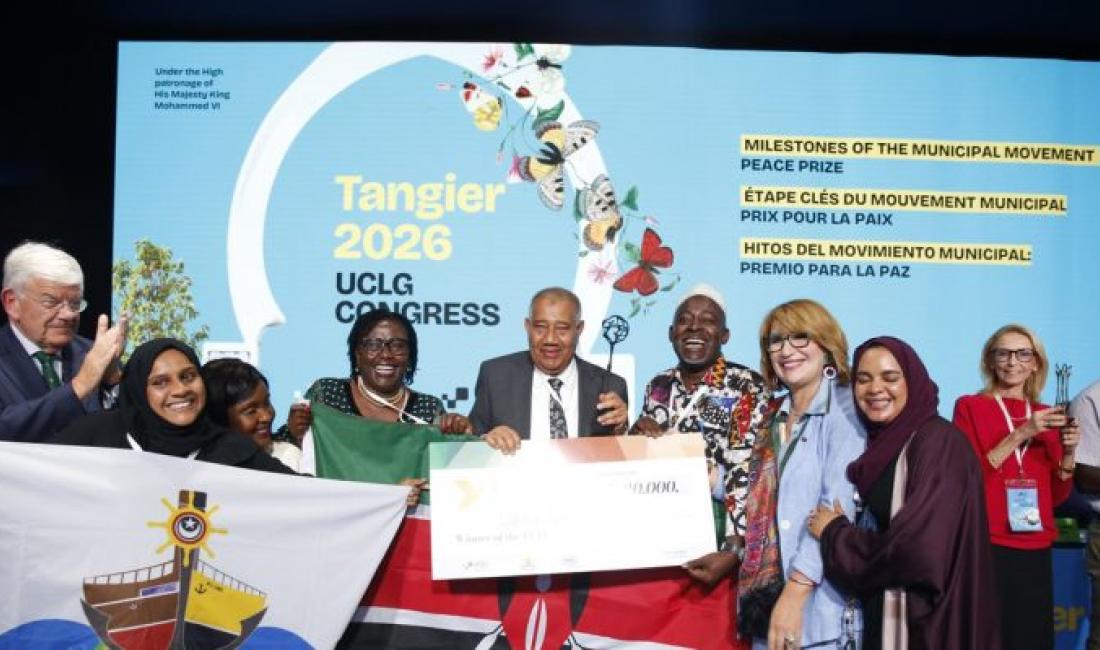
The north Kenya government codified peace in municipal law and budget.
Local governments make peace too.
Lamu County, Kenya was awarded the 2026 United Cities and Local Governments Peace Prize for building a holistic, localized framework called "Breaking the Wall of Peace Fragility in Disaster Zones."
Lamu County, along the northern coast of Kenya and including an archipelago of 65 islands, built its own peace policy in response to a volatile mix of challenges: cross-border security threats, climate-inflicted droughts, displacement, and the threat of radicalization.,
Lamu, the first local government in Africa to receive the award, took home a €20,000 cash prize, which local official said would be invested in expanding early-warning dialogue systems
Lamu’s peacebuilding included a local law, the Lamu County Peacebuilding and Conflict Management Policy and Act (2022), which enshrined conflict resolution as a permanent, budgeted function of the municipal government. The county also won praise for a camp-less refugee model that integrates displaced populations directly into local neighborhoods
The Lamu model emphasizes environmental infrastructure, including the Kiunga Solar-Powered Desalination Project, which provided clean water to a remote border zone, directly defusing long-standing tribal and pastoralist conflicts over scarce water holes.
“Today, the world has recognized the power of local leadership in building lasting peace,” said Lamu County Governor Issa Timamy in accepting the award during the UCLG World Congress in Tangier. Our experience demonstrates that addressing insecurity requires more than law enforcement measures; it must include inclusive governance, access to essential services, and meaningful community participation."
There were four other finalists for the award.
Manabí, Ecuador’s, provincial government, instead of relying on heavy policing, launched a massive preventive net to stop cartel recruitment at the roots. The province built local capacity by funding youth sports programs, deploying mobile health brigades to isolated rural areas, providing specialized domestic protection services, and boosting economic support for small-scale farmers to ensure communities have stable, legal livelihoods.
North Minahasa Regency (Indonesia) codified religious harmony into official municipal policy. The local government created a transparent system to fairly facilitate and fund worship facilities across different faiths, eliminating a frequent source of community friction. They combined this with mandatory youth tolerance education in schools and established a permanent interfaith council to handle local disputes before they escalate.
São Paulo (Brazil) utilized its Metropolitan Civil Guard to conduct regular, unannounced home visits and preventive neighborhood patrols specifically for women marked as "high risk." The city integrated this with a specialized, geolocated emergency alert app that allows victims to instantly signal for backup, bridging the gap between the municipal police, the judiciary, and public prosecutors.
Kapoeta North County (South Sudan) approached a raw environmental crisis through transparent governance. Working alongside traditional tribal elders, youth, women, and local health organizations, the county established collaborative water-management committees. By putting rivals in charge of co-managing and maintaining shared water and sanitation infrastructure, they turned scarce water points from flashpoints of war into centers of community cooperation.