The Search for Eternal Goodness Is Folly; The Bad Teach Us More
This column is co-published with Zócalo Public Square. Image by Joe Mathews using Google Gemini.
Wander around California, and watch the great civic purge in real time: Communities are stripping the names of supposed paragons from our parks, plazas, and schools. Cesar Chavez. Junipero Serra. John Muir.
This cycle of honoring and then dishonoring our heroes has become a depressing routine. We scour the past for unblemished virtue, only to crash into the inescapable truth captured by George Orwell: “Saints should always be judged guilty until they are proved innocent.”
So, let’s stop the exhausting charade. Since California’s heroes keep failing us, and we keep having to take their names off our street signs, we should start honoring our villains, anti-heroes, and scoundrels instead.
Why celebrate the wicked? Because there is a profound, stabilizing value in acknowledging the evil. The pioneering sociologist Émile Durkheim argued in The Rules of Sociological Method that deviance and villainy are essential ingredients of a healthy society.
“Crime is normal because a society exempt from it is utterly impossible,” he famously wrote. Transgressions serve an indispensable function—they force jurisdictions to come together, define moral boundaries, and clarify their goals. Then, by applying our definitions of crime and singling out our villains, our communities drag our civic shadows into the light.
For Californians, the place to start this work is Sacramento, where the state Capitol is undergoing a massive renovation. Why name the shiny new annex for some distinguished politician, like Govs. Jerry or Pat Brown, or the late legislative leader John Burton?
The more fitting choice would be to call the project—which has been dogged by cost overruns and allegations of corruption—the Arthur “Artie” Samish Annex.
Active from the 1930s into the 1950s, the 300-pound Samish was a lobbyist who dropped out of school in seventh grade but possessed a genius-level understanding of political leverage. Representing powerful liquor, brewing, and gambling interests, he poured untraceable cash into races to buy politicians, and heavily funded opponents of anyone who defied him. He famously posed for a magazine with a ventriloquist’s dummy (whom Samish called “Mr. Legislature”) on his lap. He helped invent America’s modern, pay-to-play, nakedly corrupt political system.
The first law passed in Artie’s Annex should be one requiring public buildings, if they are to be named for anyone, to be named after similarly notorious figures. The good news is that such a law wouldn’t cost much to implement, because so many things in California are already named after terrible people, many of whom we pretend were noble.
For instance, we don’t need to rename Stanford University or Mulholland Drive or the city of Fremont, though the new law will help us appreciate their namesakes’ villainy. Leland Stanford was a robber baron who funneled taxpayer money into his own railroad and amassed a fortune by brutally exploiting thousands of Chinese immigrant workers.
William Mulholland engineered the Los Angeles Aqueduct, using deception and backroom political bullying to strip the Owens Valley of its water and its rights. And in 1928, he ignored geologists’ warnings and cleared the St. Francis Dam for operations just hours before it collapsed, killing more than 400 people.
John C. Frémont was celebrated as an explorer, California’s first U.S. senator, and one of the founders of the Republican party, serving as its inaugural presidential nominee in 1856. But, in his expeditions, Frémont, often with his friend Kit Carson, killed untold numbers of California Indians as part of a 19th century genocide.
To be sure, we shouldn’t limit honors to these sorts of outsized evildoers. We also need to appreciate our anti-heroes. Clint Eastwood, who built a cinematic empire playing the most violent Northern California cop ever, taught us that the anti-hero appeals to a society where the traditional institutions of justice have failed. When the law itself is corrupt, the outlaw becomes the only honest man left in the room. Monterey County should rename itself after Eastwood, a longtime resident, and change its motto to Dirty Harry’s famous line: “Go Ahead, Make My Day.”
Similar anti-hero honors should accord to Joaquin Murrieta, the legendary Gold Rush figure known as the “Robin Hood of El Dorado,” who turned to banditry and murder only after suffering violent mistreatment and racism by white miners who drove Latino prospectors from their claims. (A note: the Riverside County city of Murrieta should be named for this bad hombre, as opposed to the landowning family of the same name that pioneered the growing of avocados.) Or Tiburcio Vásquez, a bandit leader who viewed his criminal acts as a righteous rebellion against the Anglo American settlers marginalizing native Californios. The Vásquez Revolution would be a great name for any movement that kicks the U.S. government out of California.
We could honor those whose crimes were polite, tactical strikes against corporate greed. Let us rededicate our financial districts to Black Bart, the Northern California robber who held up 28 Wells Fargo stagecoaches without ever firing a single shot, leaving mocking, self-penned poems at the scenes while explicitly targeting corporate mining wealth. Or to Amil Dinsio, who bypassed sophisticated alarms with Styrofoam and dynamite in his $30 million 1972 Laguna Niguel bank heist.
And let us reserve a special plaque for those who were just messes. Take Juan Bautista Alvarado, the longest-serving governor of Mexican California. He wasn’t a monster, but he did lose California to the Americans, and he was famously too drunk to make it to his own wedding. (His half-brother stood in for him.) The Alvarado name, which already appears on some California things, should grace every street full of bars.
In San Francisco, historical possibilities for honoring corruption and cruelty are almost limitless. City Hall should by all rights be named for Abe Ruef, the corrupt early 20th century political boss who did a great job responding to the 1906 earthquake but was nevertheless convicted in subsequent graft trials and sent to San Quentin.
Speaking of which, that old prison should be renamed for Laura Fair (Fair State Prison!), a 19th-century San Francisco hotelier who was sentenced to hang after shooting her married lover, State Senator A.P. Crittenden. (After her acquittal thanks to an early version of the insanity defense, she joined Bay Area high society.) San Francisco Bay itself, by the way, should carry the name of Frank Morris, famous for successfully escaping Alcatraz with the Anglin Brothers in 1962.
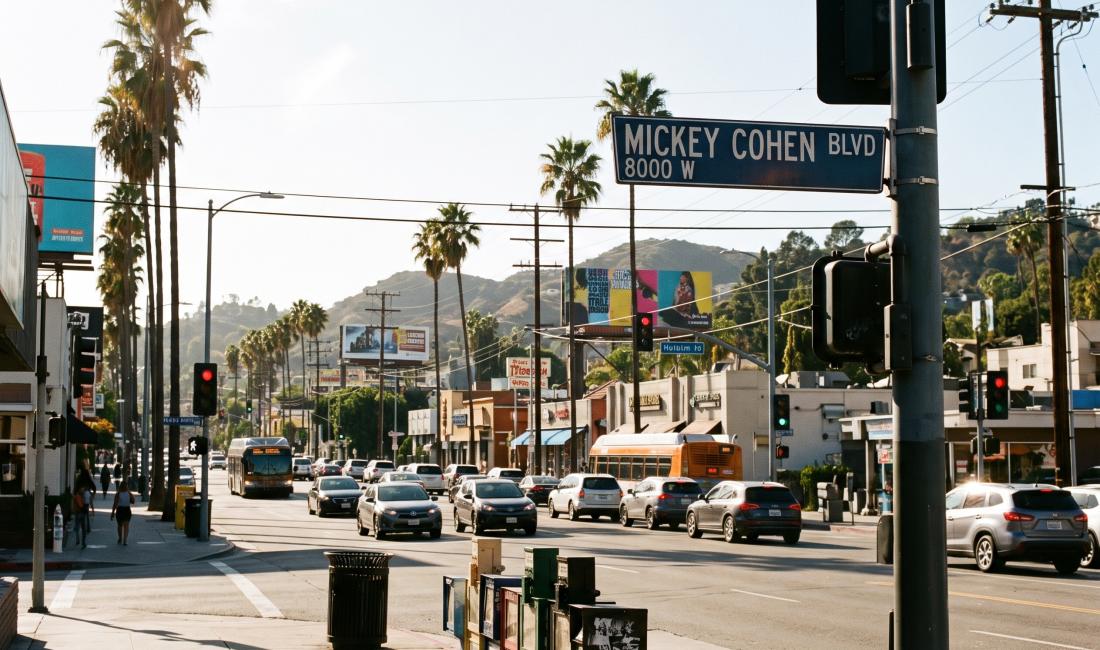
In Southern California, it’s well past time for the LAPD to name its glassy downtown headquarters after the murderer it let get away, O.J. Simpson. And if officials ever take Cesar Chavez’s moniker off that boulevard through East L.A., they should rename it for the most colorful Angeleno of all time, gangster Mickey Cohen. A resident of Boyle Heights and later Brentwood, Cohen mixed violence and racketeering with extraordinary personal generosity to needy people, civic causes, and the Israel independence movement.
“I’m not an educated man, but I’ve read some history,” Sean Penn, playing Cohen, says in the film Gangster Squad. “Every kingdom comes up bloody. Every castle is built on a pile of bones. When I came out here, L.A. was nothing. Back East I was a gangster, out here I’m God.”
Let’s embrace that wisdom. Let’s stop wasting our time searching for goodness or waiting for pristine saviors who will betray us. Instead, let every sign and state building be a monument to human frailty, greed, and the occasional brilliant crime.