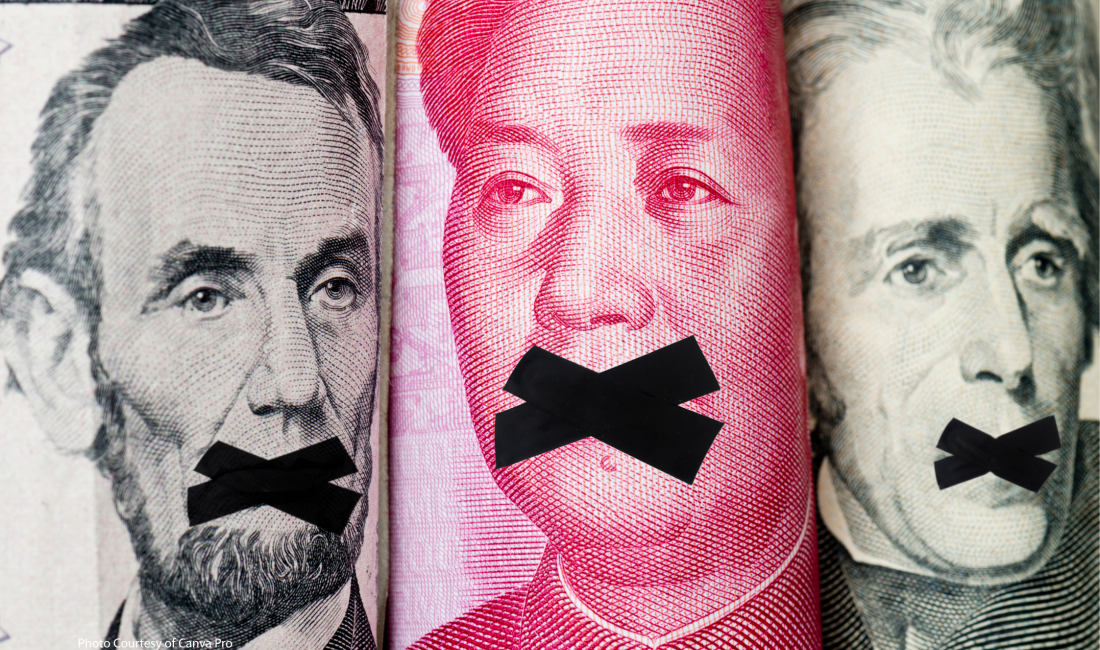
The deliberate suppression or restriction of access to certain parts of works, or entire works, deemed offensive or inappropriate, has never been limited to a single region, culture or era.
From the earliest civilisations, controlling public morale, especially during times of war, was often seen as essential to maintaining unity and order.
The term 'censor' traces its origins back to ancient Rome, where it referred to officials appointed by the state to oversee and conduct the census. This instinct to control narrative is ancient and universal:
In Ancient Egypt, pharaohs expunged the names of rivals from monuments and official records. In ancient Greece, Plato advocated for censorship in The Republic, while Socrates was executed for "corrupting the youth", and dramatic plays that mocked politicians were also subject to control.
In Ancient Rome, Emperor Nero and many others ordered books to be burned and poets exiled for the "immorality". In ancient China, the Qin dynasty infamously suppressed Confucian thought.
In Ancient India, the Brahmin caste controlled access to sacred texts and prohibited certain religious traditions and practices.
This perennial practice evolved through the medieval Church's strict suppression of anti-religious views and heretical ideas. This pattern continued with the rise of modern nation-states, through heavy-handed censorship of the Soviet Union and persists in various forms today as a strong tool of power.
Censorship has taken many forms throughout history, from burning books and silencing dissenters to banning social media platforms and waging information wars online, with the introduction of media bringing forth unprecedented risks and opportunities. While the methods, forms and technologies have changed, especially with the rise of globalisation and digital communication and shift in world order, the calculated purpose essentially has remained the same.
What governments and regimes aim to control is not just information, but the minds of their citizens.
Censorship is this very assault on a hard-won fundamental human right that different generations have struggled to achieve:
The freedom to know, to question and to think independently.
As author George R.R Martin once wrote:
"When you tear out a man's tongue, you are not proving him a liar, you're only tellng the world that you fear what he might say."
Even today, there are authoritarian regimes around the world that deny their citizens this basic freedom.
This article examines this enduring struggle through the lens of three distinct nations: Myanmar, Türkiye and the United Arab Emirates.
Myanmar: Under the Strong Hand of the Military Junta
Myanmar, also known as Burma, the 'Golden Land' for its thousands of sacred Buddhist temples, natural resources, traditional textiles, the natural beauty of the beaches along the Bay of Bengal, its diverse Burmese street food, but also its ongoing political instability and its status as one of the world's most aggressively censored states.
According to Freedom House, the country's Internet Freedom Score stands at just 9 out of 100, categorising it as "Not Free".
The ruling military junta, having seized power in a February 2021 coup, continues to enforce localised internet shutdowns, raise data prices, organise online harassment campaigns, and pursue arbitrary prosecutions that have resulted in lengthy prison sentences. In May 2024, the authorities restricted access to WhatsApp, X (Twitter) and Instagram, while the Ministry of Information launched a domestic alternative to YouTube, known as "MTube" for hosting state-produced media content. A new draconian cybersecurity law, effective 1 January 2025, controls communications and prohibits the use of virtual private networks (VPNs), such as NordVPN, severing a critical lifeline for activists.
Myanmar's current repression is rooted in a long history of censorship. In the late 1840s, Buddhist officials banned the distribution of Bibles and other religious texts. Under British colonial rule, administrators tightly controlled Burmese-language newspapers like Thuriya, targeting criticism of colonial authority or support for Burmese identity. After General Ne Win's 1962 coup, the military's one-party socialist regime required prior approval for all media, banning any criticism of the armed forces or socialist ideology.
Censorship intensified after the 1988 coup, when the State Law and Order Restoration Council banned public gatherings and suppressed publications or speeches deemed disruptive to the military. Unauthorised distribution of literature carried prison terms of up to twenty years, and many journalists were arrested. Between 2011 and 2020, Thein Sein's quasi-civilian administration briefly eased restrictions, allowing private newspapers and expanded political reporting.
However, coverage of military affairs, ethnic conflicts, and the Rohingya's crisis remained tightly controlled.
The military coup of 1 February 2021 abruptly ended Myanmar's fragile democratic transition, shutting down independent media, detaining journalists, and restricting internet access. Mass protests and a nationwide civil disobedience movement emerged, but the junta responded with violent crackdowns, widespread human rights violations, and a return to authoritarian rule.
By late 2021, military forces were destroying villages and committing massacres, forcing thousands to flee to India and Thailand. Targeted internet shutdowns and the 2025 VPN law, which imposes prison terms and fines for unauthorised VPN use, have further restricted activists from documenting military abuses.
These measures accompany intensified repression ahead of the December–January elections, as Senior General Min Aung Hlaing calls for heightened 'security' to safeguard the process. This trajectory shows the massive cost of authoritarian rule in one of the world's poorest nations, a cost measured not only in the destruction of civil liberties but also in the destruction of countless human lives.
Türkiye: Between Democracy and Authoritarianism
Straddling the divide between East and West, Türkiye presents a complex paradox.
It is a centre of culture and history, known for its Ottoman heritage, unique Turkish cuisine and tea, lively bazaars, traditional crafts such as Turkish carpets, iconic mosques and natural wonders like Cappadocia, but also for the authoritarian leadership of its president, Recep Tayyip Erdoğan.
Although the Turkish Constitution enshrines freedom of expression, restrictions on literature, media and internet platforms raise doubts about the actual implementation of this right.
The Radio and Television Supreme Council (RTÜK) has frequently imposed fines and broadcast suspensions on opposition-oriented TV channels, eviscerating any pretence of impartiality and intensifying debates.
This censorship extends powerfully into the literary world.
Under the Turkish Penal Code and the Anti-Terror Law, for instance, the writings of Fethullah Gülen, the U.S.-based cleric accused of orchestrating the 2016 coup attempt, and Abdulla Öcalan, the imprisoned leader, justify restrictions on terrorist or incitement-related works as a security measure, the banning of publications with LGBTQ+ themed publications, reveals a wider agenda to suppress marginalised voices and homogenise public discourse.
The situation threatens cultural diversity and the plurality of ideas.
The digital sphere is equally constrained. Access to platforms such as Wikipedia, YouTube and Twitter has been periodically blocked. The 2020 Social Media Law required platforms to appoint local representatives and comply with takedown requests, while content platforms like Netflix have been banned for "violating public morality". These practices frequently violate Article 10 of the European Convention on Human Rights, which guarantees freedom of expression.
Beyond silencing dissent, censorship limits the flow of ideas, fosters a culture of self-censorship, and weakens democratic institutions.
Over the years, many works such as Sabahattin Ali's 'The Glass Palace', Ahmet Sik's 'The Imam's Army', Murat Kahraman's 'Veda and Çiğlik', and Jeanette Winterson's 'The Sex of the Cherry', have been banned in Türkiye.
Historically, censorship reached its peak after the 1980 coup, when publishing houses were closed and socialist literature was outlawed, while in the 1990s, books addressing Kurdish identity were regularly destroyed.
In more recent years, publications dealing with minority rights or LGBTQ+ issues have also been targeted. This cycle has not only restricted authors and publishers but also permanently limited readers' access to diverse perspectives and cultural expression.
In conclusion, there remains a profound gap between Türkiye's formal commitments to freedom of expression and its actual practices.
United Arab Emirates (UAE): Digital Authoritarianism and the Regulation of Dissent
In the gleaming cities of the United Arab Emirates, on the other hand, where glass towers reach for the sky and artificial islands rise from the Persian Gulf, another edifice exists. A nation that proclaims itself a global crossroads, a bustling hub of commerce and cosmopolitanism, simultaneously maintains one of the most sophisticated apparatuses of information control in the Arab world.
From its founding back in 1971, the United Arab Emirates has employed censorship as a core tool of statecraft, evolving from blunt print media controls into a well-varnished, all-encompassing digital authoritarian system. Initially, federal laws regulated the press to project unity and shield the nascent federation from regional instability.
However, the advent of the internet served as the masterstroke to transform this apparatus swiftly.
The state astutely mastered the digital realm, enacting the Decree-Law No. (5) 2012 on Combating Cybercrimes, effectively using it as a legal cudgel. Its deliberately vague provisions for "fake news" and "offending" the regime became omnipotent, malleable tools for criminalising dissent and ensuring the boundless digital frontier adhered to the state's contours.
This legal framework was weaponised alongside advanced technological capabilities, creating a ubiquitous digital panopticon. The harsh decade-long imprisonment of Emirati human rights activist Ahmed Mansoor demonstrated the state's willingness to snuff out even the mildest of criticisms.
A comprehensive internet filtering system blocks political dissent, LGBTQ+ content, and independent journalism, while the initial blocking of VoIP services such as WhatsApp protected state monopolies and hindered private communication.
Surveillance escalated through programmes such as 'Project Raven', which employed foreign intelligence to hack into the phones of dissidents and journalists, actively policing the digital sphere and rendering privacy a flimsy notion of illusion. The UAE has expertly branded this repression, coupling it with a polished image of tolerance and modernity.
The establishment of a Ministry of Tolerance and Coexistence in 2016 exemplified this duality.
Economic imperatives are deeply entwined with this control.
Projecting an image of stability and openness is deemed essential for attracting foreign investment and capital, tourism and global business.
This results in a system of calibrated tolerance, where cultural events that look like book fairs are celebrated, but their content is strictly vetted.
Policies like licensing social media influencers professionalise the digital economy, while ensuring messaging remains state-approved.
This creates a powerful 'chilling effect', where unspoken red lines constrain expression without the need for constant overt intervention.
As the UAE advances, its censorship model continues to adapt, with new laws against 'fake news', further expanding state control. Yet cracks are appearing, evidenced by widespread VPN use to bypass filters and regional bans, and growing, if tempered, international scrutiny.
The central tension remains unresolved:
Whether a nation can truly be a global hive of ideas while severely restricting the expression of its citizens.
The sustainability of the UAE's economic miracle may hinge on this very debate, as the most powerful architecture in its scintillating cityscape remains the invisible framework of laws and technologies that dictates what can be said, heard, written and thought,
In conclusion, though distinct in culture and governance, Myanmar, Türkiye and the UAE are united by a common feature:
The strong, state-sanctioned control of information.
The UAE, a monarchy projecting an image of futuristic luxury, employs its wealth to concentrate authority and maintain a veneer of tolerance. Türkiye, a nation that outwardly presents as a democracy, reveals under Erdoğan an increasingly authoritarian system that reshapes law to silence journalists and intellectuals. Myanmar, finally, represents the most brutal extreme, where a military junta rules through sheer fear and violence.
What fundamentally connects these countries, and many others across the world, is the absence of truth and the sacrifices made by individuals to uncover it. Leaders fear the truth because it threatens their control, and they fear most the moment when society refuses to accept anything less.