'We Are Unstoppable' And Other Climate Optimism
This is co-published with Zócalo Public Square. Photos by Joe Mathews.
“I’m taking you to church,” Arnold Schwarzenegger told me.
“Have I sinned?” I asked.
“There’s a new organ. You have to hear it. The vice president might be coming too.”
We were inside Vienna’s Hofburg Palace, the seat of Austrian imperial power for 600 years. The church to which I was being invited was St. Stephen’s Cathedral, an emblem of the country.
I found myself in this peculiarly Austrian moment last month because I’m writing a book about AB 32, the groundbreaking California climate change law Schwarzenegger signed in 2006. As part of my research, I was attending the 10th annual Austrian World Summit of the Schwarzenegger Climate Initiative, which supports accelerated action to reduce carbon pollution. The vice president in question was California’s own Kamala Harris. A featured speaker at the 2026 gathering, she was standing across the palatial room, chatting amiably with a group of Schwarzenegger’s aides and childhood friends from Thal, his tiny hometown.
This is the parallel universe known as Arnold Land. Reentering it—two decades after I covered Schwarzenegger for the L.A. Times and wrote a book about his political life and governorship—has been unmooring.
No combination of people (VP Harris and former Thal Mayor Peter Urdl?) or ideas (bodybuilding, Nietzsche, Austrian desserts, quantum physics, and atmospheric science, and all in the same conversation) is out of bounds. Existing in Arnold Land can feel like traveling backward and forward in time simultaneously.
On the summit stage, below ceiling frescoes in a ceremonial hall, Harris answered questions as if she were president, suggesting that the future requires systemic change in governance, an intolerance for nostalgia, and an embrace of Gen Z impatience and solve-it-yourself ingenuity. “They are not waiting for us” to address big problems, she told the audience.
Schwarzenegger, sitting next to her, spoke for California as if he were still its governor, taking shots at the state legislature—“they are confused”—for weakening elements of the California climate regime he created, including alterations to the cap-and-trade market he championed.
The two longtime Brentwood neighbors were chummy (he, a Republican, voted for her, a Democrat) and praised each other’s records. When CNN’s Elex Michaelson, the third Los Angeles resident on the stage, pressed Harris on whether she’ll run for president again, she claimed her future plans were limited to finding “a Sacher torte to take home with me.”
Schwarzenegger then eagerly jumped in to indicate his willingness to run. Harris had promised him “immigration reform” to make foreign-born Americans constitutionally eligible for the office, he quipped.
Such jokey confidence could come off as campy and weird at a climate action meeting taking place in an unusually sweltering Vienna, as global greenhouse gas emissions keep increasing. But it’s also refreshing. Arnold Land and the climate summit are not places for political polarization, catastrophizing, or existential dread.
You expect people to grow tired and sour when they get old. Schwarzenegger, who turns 79 on July 30, is doing the opposite.
The former governor insists that “carbon pollution” (his preferred phrase, since “no one gives a s—t” about “climate,” he has said) can be solved, even reversed. His strategy for inspiring enormous cuts to emissions and warming is to offer a vision of an idyllic ecological future to counter the apocalypse of our fears. He imagines air and water cleaner than any living humans have experienced, beautiful new architecture made of solar panels, advanced vehicles that themselves produce clean energy, healthy food farmed in climate-friendly ways.
How could all this be possible? Because states, provinces, local governments, innovative businesses, and everyday people are taking action, he said during the summit. Because today’s divisive politicians, including Trump, are on their way out, to be replaced by people and parties who will work together. Because with a challenge so far-reaching, there is no other way.
“We need everyone to work together,” he told the gathering, with 1000% earnestness.
Before you ask what Arnold is smoking, I’ll tell you what was on his table in the palace green room: boxes of Cohibas. In Arnold Land, conversation about how to clear greenhouse gases from the air is often conducted amidst cigar smoke.
Somehow, this mix of contradiction and cockeyed optimism is infectious. During the session, Harris grew more upbeat, closing by enthusiastically reciting the summer’s Schwarzeneggerian slogan, “We are unstoppable!” Pope Leo XIV then appeared by video to suggest that with faith and works, the climate will surely be restored.
Backstage, before and after their summit conversation, Arnold and Kamala chatted about the L.A. mayor’s race and about the animals he keeps in his backyard. She said she wanted to meet his pig, who patrols the pool area. Then she ran off to get that torte, and he gave a half-dozen interviews in a row.
“We don’t want to villainize anyone,” Schwarzenegger told an Austrian TV reporter, “even when we don’t like what they do…. The only villain is pollution.”
Fortunately, Schwarzenegger leavened these exhaustingly upbeat calls for climate action, with little stories that I’d never heard, even in a quarter-century of covering him. After he quotes Nietzsche on humans coming to know ourselves by defending against attack—the message being environmental activists must go on offense—I ask him when he first read Nietzsche. “Before Siegfried and Roy got really big in Vegas, there was this other act, called Samson and Goliath. Samson was a fanatic for Nietzsche. He let me borrow one of his books.”
Late that afternoon, I took the subway back to my hotel for a nap. Then came the text: “Arnold would like you to join him at the church.”
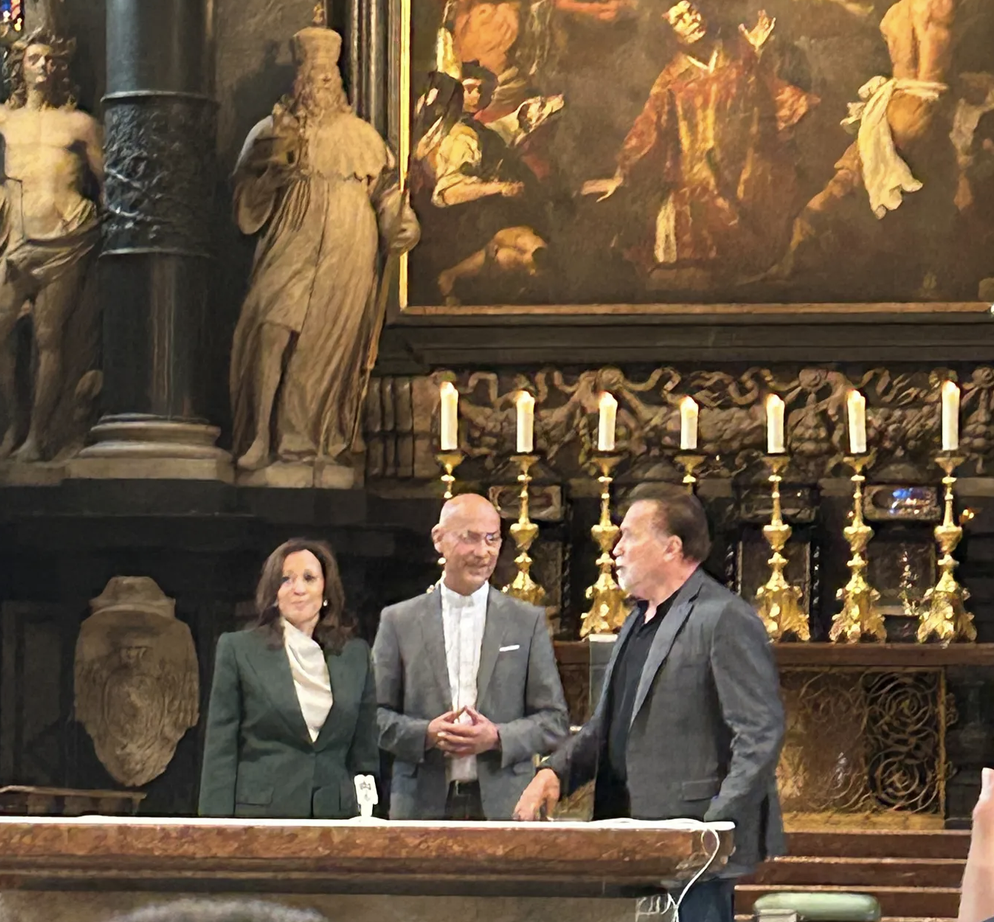
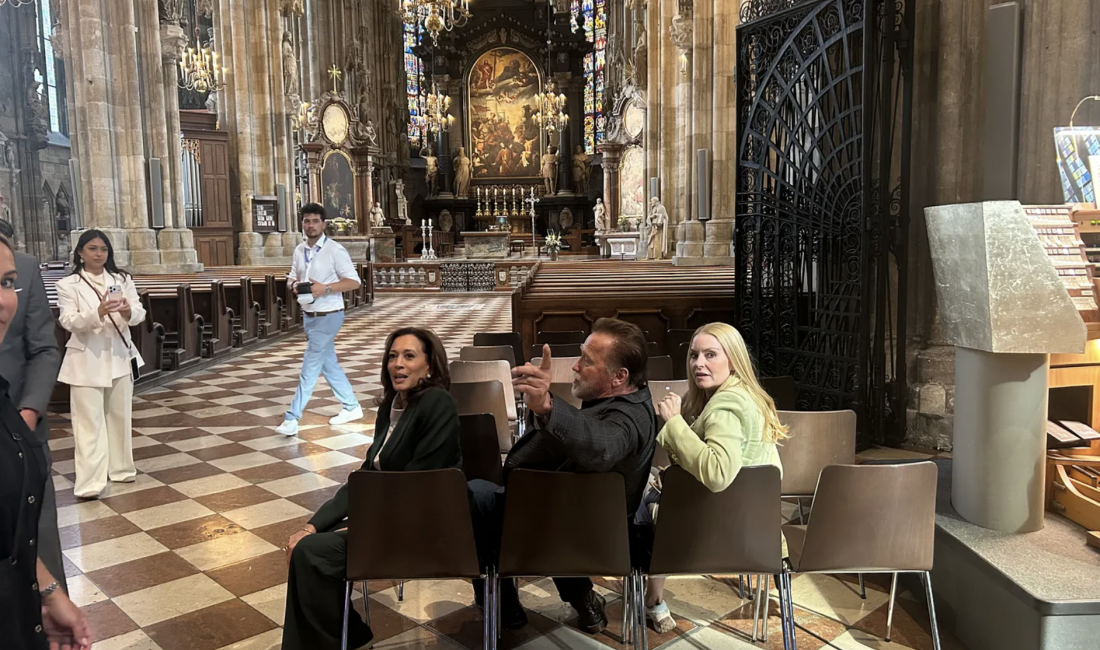
Weary of body but not of spirit, I headed over. Schwarzenegger and his longtime partner Heather Milligan were sitting in the middle of the church, next to organ player Ernst Wally. Minutes later, Harris joined them.
As everyone sat quietly, Wally climbed up onto the organ seat and began to play Bach’s classic “Fugue in D Minor.” The sound and vibration of the massive and recently restored cathedral organ seemed to move your entire body, reaching inside your chest. It woke me up and knocked the jet lag out of me.
The organist asked for requests. A Schwarzenegger aide’s suggestion of “Don’t Stop Believing,” by the 1970s San Francisco band Journey, was deemed too secular. Harris then asked for Mozart, Austria’s own, and soon “A Little Night Music” filled the huge cathedral. Harris listened, holding Schwarzenegger’s arm and looking moved. “So much more than I expected,” she said as she departed.
I asked Schwarzenegger later whether the field trip had religious motives. “No, I’m just a huge fan of organ music,” he said, launching into a story involving a giant Wurlitzer organ in Seattle in 1977. Then he got to the point.
“Organ music gets to your heart and your soul. It changes your perspective. We all need that.”
Joe Mathews writes the Connecting California column for Zocalo Public Square, and is founder-publisher of Democracy Local.