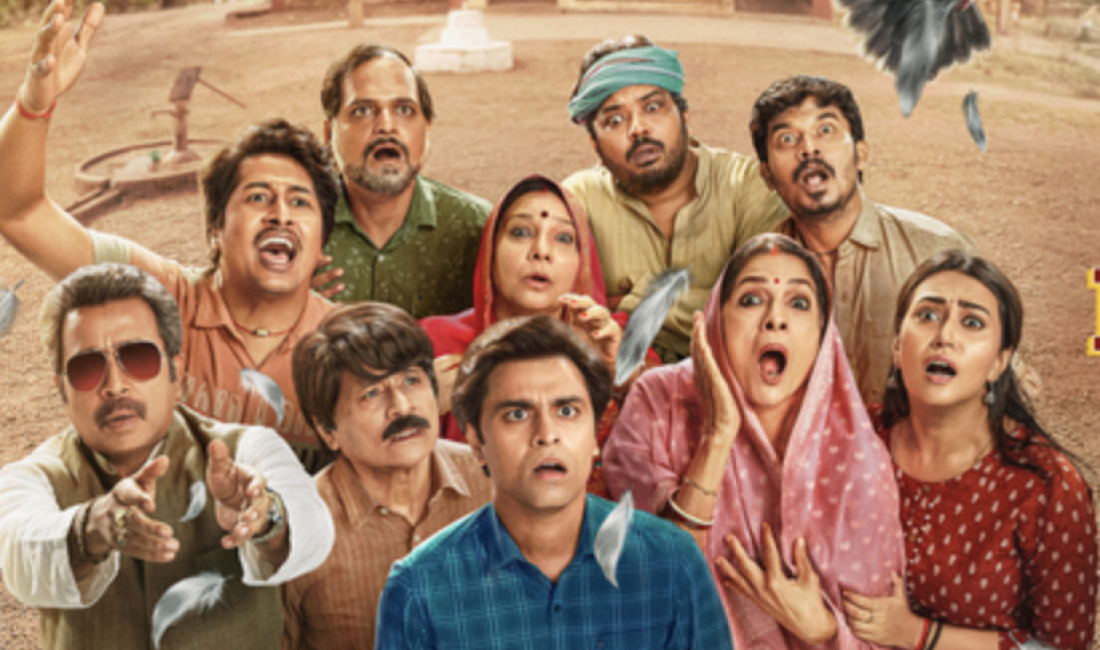
A Hindi-Language Portrait of a Village Panchayat Gets It Right
This column is co-published with Zócalo Public Square. Image via Amazon Prime press kit.
How do you stop a tree from chasing after people?
It’s not a riddle. It’s a workplace challenge facing Abhishek Tripathi. Having scored only 92% on his business school entrance exams, not high enough to get into an MBA program in India, he reluctantly takes a job as village secretary in Phulera, a small town in Uttar Pradesh.
He soon faces his first local government crisis, involving the aforementioned tree and the question of where to position 13 new solar-powered street lights.
The town suffers from nightly blackouts, and Abhishek wants to install the lights in the darkest areas of Phulera. But 12 elected officials—including the village pradhan (council leader) and his deputy—instead put lights in front of their personal residences.
Abhishek claims the 13th and final light for the village hall, where he works, sleeps, and studies for the MBA exams that could return him to the city. But the pradhan orders the light instead be placed in front of a haunted banyan tree that villagers claim is chasing after them.
After Abhishek protests, the pradhan tells him that he may take the light if he can rid the tree of the ghost.
“Why did I come to this village?” Abhishek asks himself, despairing.
The predicament may seem fantastical, but confounding conundrums are the stuff of village democracy everywhere—and perfect fodder for the best and most accurate show about local governance ever made.
Abhishek is the leading character of the Hindi-language comedy Panchayat, which has more brains and heart than South Korea’s Into the Ring or the U.S. hit Parks and Recreation. A hit in India, the show’s fifth season is expected to arrive on Amazon Prime Video later this year. Panchayat has attracted a strong following across the Global South, especially among local officials. If you find yourself in an unfamiliar city hall far from home—as I often do—bringing up the show can be a good ice-breaker.
Mahatma Gandhi famously envisioned India as a collection of village republics, self-sufficient and non-hierarchical, and argued that individual freedom could only be maintained in autonomous communities where everyone participated. In 1992, India sought to realize Gandhi’s vision by amending its constitution to create 250,000 village democracies.
Panchayat, literally meaning “assembly of five,” refers to the small council that runs a village, the most basic unit of governance in India. Panchayat the show, in its funny way, suggests that Gandhi was right about the importance of empowering the village, but too optimistic about the non-hierarchical part. Those in power reap the solar lights and other rewards. Small courtesies convey status. It matters whom you thank with even a small gift, especially if it’s a Phulera farm-grown bottle gourd.
Panchayat creator and screenwriter Chandan Kumar, who grew up in a village, has said that while the show is not preachy, it is meant to explore the realities and possibilities of local politics.
“How power is distributed in a village makes me curious,” Kumar told an interviewer. “The personal and professional boundaries are quite blurred.”
That blurring, a recurring theme of the show, can turn trivial moments into big drama.
In one episode, after Abhishek gets CCTV cameras installed around Phulera, a farmer uses the recordings to find a missing goat, and inadvertently exposes a possible crime by a local political insider. In another, Abhishek buys a comfy rotating office chair that makes the radhan feel diminished. The chair stands out, more like a throne than furniture. If the secretary has a better chair than his elected boss, who is really in charge?
Panchayat doesn’t shy from ugly real-life issues, especially concerning public health and sanitation (toilets and defecation are favorite motifs). And the show also ably [EB1] explores the gap between policy and implementation.
A car promoting an anti-drinking campaign comes to the village, but runs into trouble when Phulera officials realize the driver is very drunk. A district higher-up orders a family planning slogan painted on a village wall (“two children are as sweet as pudding, more than that can be as painful as piles”). Predictably, the family with six children living next to the sign gets insulted and organizes political revenge against the pradhan and Abhishek.
“In a democracy, the public is the boss,” one outraged villager tells the secretary, as the screw-up deepens. “And the boss has every right to get angry.”
The show’s most profound social commentary lies in its portrayal of the “pradhan-pati” system, through which men lay claim to local government seats reserved for women. In Phulera, Manju Devi is the elected pradhan. But for the first two seasons, she is a rubber stamp. Her husband, Brij Bhushan, runs meetings, signs papers, and wears the title.
But the beauty of the leisurely paced Panchayat is that it tracks the grinding evolution of government, and how structural changes eventually create space for cultural change. Events draw Manju Devi more meaningfully into government, and she proves more politically skillful than her husband. By the fourth season, Manju Devi is expertly defending Phulera from a threatening member of the state legislative assembly, who blocks electricity repairs and sends goons to intimidate village leaders.
In its home country, the show has inspired academic papers and media commentary, especially about how small towns leave people with little choice but to overcome divides and solve problems. “Panchayat teaches us why rural India is possibly more equipped to handle isolation compared to its urban counterparts,” observed India Today. The national Ministry of Panchayat Raj, which supports local governments, is an official cheerleader for the show, using the cast in a campaign to promote e-Gram Swaraj (a digital accounting portal) to real-life village officials.
Season by season, the show has become more politically pointed. The third season touched on conflict with higher levels of government. The fourth season explored polarization, as East Phulera battled West Phulera, with failed attempts at vote-buying and a bitter election.
But Panchayat is most instructive at the local level.
To stop the haunted banyan, Abhishek does the painstaking work of tracing how villagers came to believe that a tree could actually run and chase after people. In the process, he tracks rumor and disinformation to Master Ji, a village science teacher, who claimed 14 years previously that the tree was floating one meter in the air and following him.
The teacher admits that he had been smoking weed the night he saw the running tree and told a friend about it. He never corrected the record for fear of being fired.
Even with this confession in hand, Abhishek can’t quiet the tree rumors. So, he has another local official sleep under the tree for three nights to show that it is safe.
Misinformation dispelled, the village secretary soon has his solar-powered light.