Don't Make the Perfect the Enemy of the Fast
This is co-published with Zócalo Public Square. Photos by Joe Mathews
The automated voice over the loudspeaker is polite, and its English is American-accented.
“For your convenience, we invite you to make your phone calls from the platform between the cars.”
I am sitting in a plush green seat, watching the digital speedometer at the front of the carriage climb. Outside, the landscape blurs into a familiar tapestry of scrub, yellowing grasses, eucalyptus trees, low-slung oaks, and waves from a west-facing seacoast. If I could cover my ears and ignore the French and Arabic conversations on the double-decker railcar, I might think I’m on a California high-speed train cutting through the Inland Empire or the Central Coast.
But this isn’t the Golden State. And I haven’t yet figured out how to travel through time to the distant decade, or century, when California actually has high-speed rail.
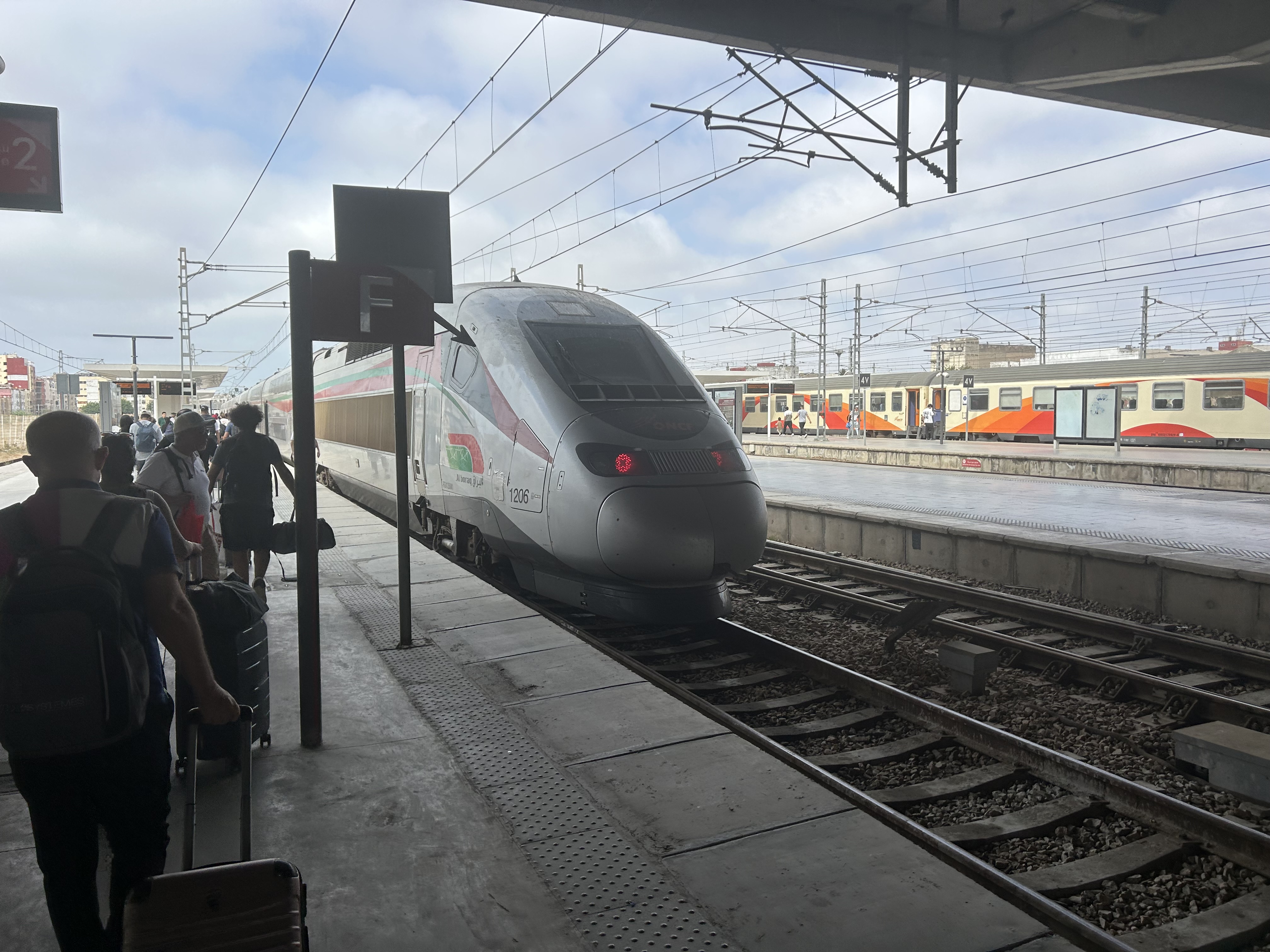
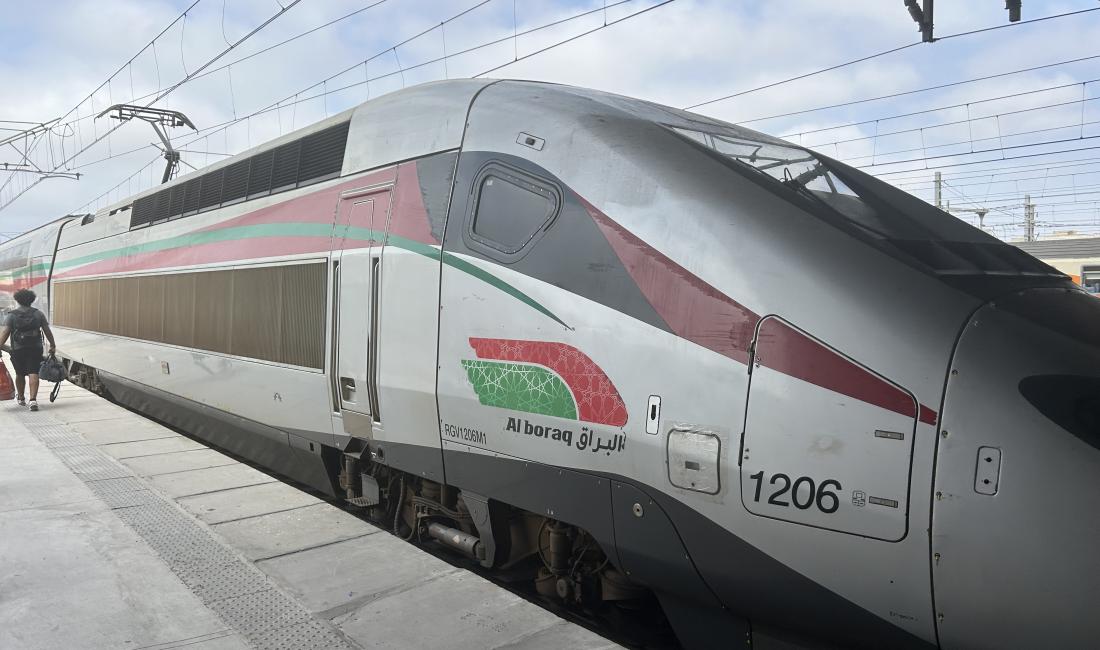
I am riding (early this summer) the first and only high-speed railway on the continent of Africa. It’s called Al Boraq (“The Lightning” in Arabic), and it’s operated by Morocco’s national rail company, ONCF.
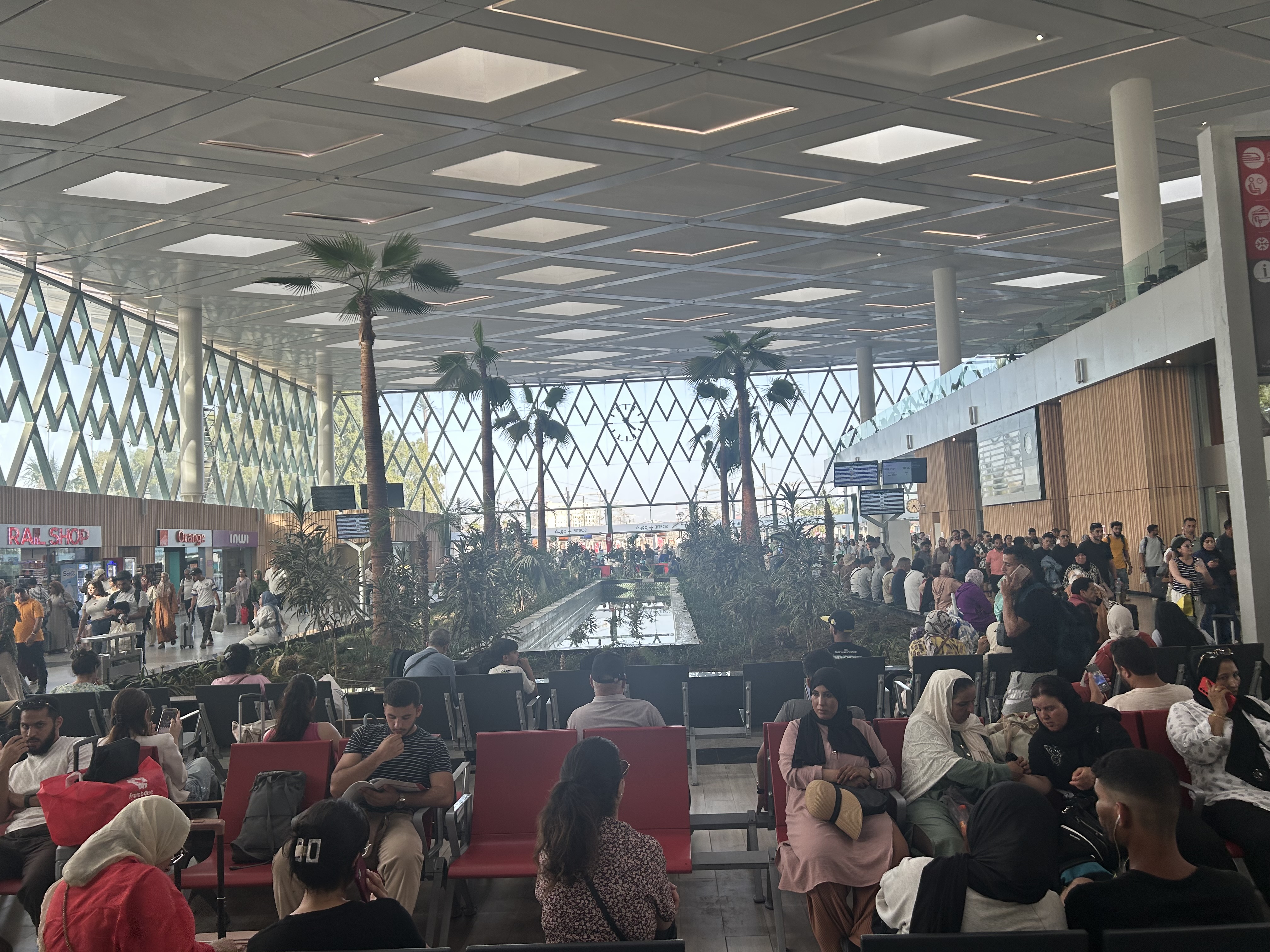
My trek runs the length of the line. I board at Casablanca’s pristine, 10-track station, which has a Starbucks, a McDonald’s, and glowing arrivals screens. I disembark at the terminal in Tangier, a few hundred meters from the mouth of the Mediterranean. The schedule says the train will arrive in 2 hours and 17 minutes. Before Al Boraq first opened service in 2018, the same route took 5 hours.
Yes, you read that right. Morocco has high-speed rail. And California has excuses.
The comparison between these two places might seem random, but it’s revelatory. Morocco and California are remarkably similar in size (Morocco is 172,000 and California is 163,000 square miles) and in population (California has 40 million and Morocco has 37.4 million). Both are long and narrow places on a continent’s edge, with strings of coastal cities, lovely beaches, interior deserts, and heavily irrigated agriculture.
The big difference is that California is more than 20 times richer. Morocco is a lower-middle-income country (96th in the world rankings) with a nominal GDP of roughly $150 billion. California’s economy is creeping toward $4 trillion.
Yet California claims it doesn’t have enough money for high-speed rail, while Morocco built a 323-kilometer (201-mile) line across floodplains, requiring 286 separate engineering structures and 13 massive viaducts—including the stunning, 3.5-kilometer Hachef viaduct south of Tangier.
How did a country with a fraction of California’s wealth pull this off? The answer lies in international partnership, structural simplicity, and raw political will.
Morocco’s Al Boraq line cost a mere €9 million per kilometer to build, which—to put it in terms Californians can understand—comes to $15 million per mile. It is one of the lowest high-speed rail construction costs in the world. For context, the first, 171-mile Bakersfield-to-Merced segment of California’s evolving line is currently projected to cost nearly $35 billion, approximately $200 million per mile.
Morocco achieved this efficiency through partnership. In 2009, Morocco’s ONCF called in France’s national railway, SNCF, and the engineering giant Alstom. Together, they paired French high-speed rail experts hand-in-hand with Moroccan teams for every major task. They even co-created a dedicated training center to ensure local workers gained the technical know-how to maintain the double-deck Avelia Euroduplex trains long into the future.
California, by contrast, has hired a rotating cast of executives and outside consultants who have bloated the project’s budget to more than $125 billion, while missing deadlines, and delaying its expected opening until 2033.
Wisely, Morocco did not try to build a perfect, sprawling, multi-thousand-mile system overnight. They began with a highly strategic Phase 1 that used four existing stations rather than building new depots.
You can quibble with just how “high-speed” Al Boraq is—unless you’re a Californian. The train runs on conventional, shared slower tracks from its southern starting point at Casa Voyageurs, in central Casablanca, as it navigates the dense urban sprawl of the country’s largest city and of its first stop, Rabat. Slowing the train in that segment was a pragmatic compromise that allowed the line to open quickly—at a station with links to local rail and a train to the Casablanca airport—and start generating revenue and public adoration.
Which it has.
Trains are full (both of my Al Boraq trips were packed) with very young crowds, and transportation officials told me the money borrowed for the project may be paid back early.
As the train reaches Kenitra, 45 minutes north of Rabat, tracks become dedicated, high-speed only. The train races first to 269 kilometers per hour, then accelerates to above 320 kilometers per hour (like going from 161 miles per hour to 192 miles per hour) on the journey north to Tangier.[SR1]
And this single coastal line is merely the first phase of a projected 1,500-kilometer high-speed network slated for completion by 2030.
The timeline isn’t arbitrary. Morocco is co-hosting the 2030 FIFA World Cup alongside Spain and Portugal. To prepare for the global stage, the government has launched a massive $14.3 billion rail development project.
The next steps are already underway, including extending dedicated high-speed service between Rabat and Kenitra (construction I saw in progress), and launching a commuter rail system for Casablanca and its sprawling suburbs, now home to more than 4 million people.
But the pièce de résistance is the building of a brand-new high-speed line extending south from Casablanca to Marrakech and onward to Agadir, with the goal of slashing the cross-country transit time from Tangier to Angadier, a 9-hour drive, to under four hours. That’s the equivalent of a trip from San Diego to San Francisco.
It’s worth noting how much more Morocco has done on the same timeline as California. Voters in the Golden State approved high-speed rail in 2008, while Morocco started its project with feasibility studies in 2006. Construction began in 2011.
For the next two decades, while California debates whether it will ever finish a segment connecting Bakersfield to Merced, Morocco is actively laying the groundwork to connect its entire kingdom in time for the World Cup. (Note that L.A. couldn’t even open its airport People Mover in time for this year’s Cup.)
Yes, Morocco has a highly centralized government. When King Mohammed VI—the wealthiest individual in the country, with a personal fortune invested heavily in infrastructure—decides a train will be built, it gets built. Nor does Morocco have to contend with California’s labyrinth of local zoning, environmental lawsuits, and YIMBY-NIMBY political contests.
But attributing Morocco’s triumph to autocracy misses the point. Morocco’s success is rooted in things California desperately lacks: a willingness to adopt proven foreign technology without trying to reinvent the wheel, a reliance on institutional expertise rather than predatory contractors and consultants, and a refusal to let the perfect be the enemy of the fast.
As my train glides into the Tangier station right on schedule—yes, exactly 2 hours and 17 minutes—I feel respect and frustration in equal measure. The North African kingdom has lessons to teach our state, if only Californians are willing to listen.