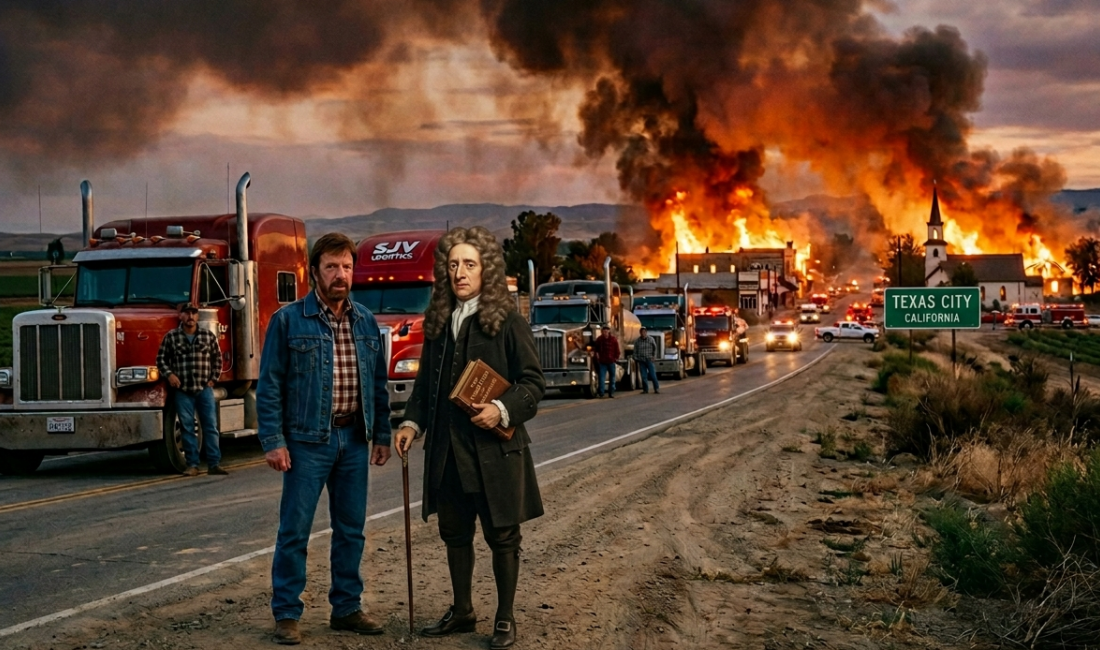
Why a Low-Budget 1977 Film About Trucking, Local Government, and Revolt Keeps Getting Better
This column is edited and co-published by Zócalo Public Square. Image by Joe Mathews using Google Gemini.
In 1979, the newly opened U.S. Embassy in China hosted its first Friday movie night, screening Breaker! Breaker!, a film about California truckers, starring Chuck Norris.
I was 6, and it was the first movie I ever saw. My parents, both foreign correspondents, took me despite the film’s violence, because there were no other American movies showing in the Chinese capital.
I so loved “Breaker! Breaker!”—the trucker humor, Norris’ hand-to-hand combat with the bad guys—that I announced it must be the best movie ever made. Today, I still stubbornly hold to that verdict.
Mine is not a mainstream view. When Norris died last month at age 86, obituaries focused on his early years as a world karate champion, internet memes about his toughness, and his well-known roles in TV’s Walker, Texas Ranger and the Delta Force movies. When Breaker! Breaker! did come up, writers noted that it was his first starring role in an American film (after years playing a secondary player in Hong Kong martial arts cinema) and that it drew terrible reviews. “A shoddy amalgam” with “wooden direction” and a “sophomoric cast,” declared the original 1977 New York Times review.
After Norris’ death, I located it on the streaming service Tubi and revisited its 85 minutes of low-budget genius. Watching it for the first time since before the pandmeic, I marveled how Breaker! Breaker! plays better, and feels more urgent, with every viewing.
Breaker! Breaker! was a low-budget feature that piggybacked off the 1970s citizens band (CB) radio craze, which saw everyone from Betty Ford to your next-door neighbor hopping on the trend. That’s where the title comes from—it’s CB user shorthand to announce you’re “breaking into” a radio conversation.
The movie was filmed in just 11 days, and Norris later said he made just $5,000 for the shoot. But Breaker! Breaker! is much deeper than it looks, cleverly blending genres (the classic Western with the East Asian karate film) and drawing on archetypes, from the samurai legend of the 47 rōnin to Abraham’s rescue of Lot from the city of Sodom in the Book of Genesis.
Even better, the film still has relevant things to say about California, local government, and the duty of citizens to fight corrupt systems. To that last point, it’s a bright and brilliant Golden State rebuttal to that ugly and fatalistic East Coast lie—told from Tammany Hall to the Trump White House—that you can’t fight city hall.
The story begins with a speech from Shakespeare-quoting judge Joshua Trimmings (character actor and L.A. theater pillar George Murdock) announcing the formation of a new municipality somewhere near the intersection of California Highways 99 and 120, in the San Joaquin Valley outside Manteca.
“The state of California—in spite of its obstructions, red tape, and pig-headedness—has granted us a city charter!” he announces. A new sign goes up proclaiming, “Texas City: Friendliest Town in the West.”
But Texas City doesn’t draw much business. Soon, Judge Trimmings is drinking heavily every morning—presumably because he started a city in late 1970s California, just as Prop 13 stripped local governments of most of their taxing authority.
So, Texas City does what struggling governments often do—abuse its power to produce revenues to survive. The judge has two brutal police officers set up a speed trap, beat up drivers who resist, collect illegally expensive fines, and impound cars on behalf of the city’s junkyard, which crushes them into metal Texas City can sell to pay the bills.
“You can’t run a box lunch through that town without everyone taking a bite,” complains one driver on CB.
In the movie, Norris plays the trucker John David “J.D.” Daws. With his long blond hair, Southern California (Torrance) suntan, and huge smile, his star quality is already apparent on camera here. He’s headed to Texas City on a rescue mission: his brother, Billy, has gotten caught up in Trimmings’ dragnet.
When J.D. arrives in town, the mechanic tries to cheat him. A waitress takes away the first menu he grabs. “Prices are higher for out-of-towners,” she says. When J.D. attempts to call for help, another local informs him the payphone is out of order.
“This town is out of order,” Norris sneers.
“We’re going to kick your butt all the way back to Highway 99,” the local volleys back.
Finally, J.D. makes his way to city hall, for perhaps the best local public meeting scene in cinema history. After listening quietly during reports on the town’s illegal junkyard and moonshine operations, he steps forward to ask about his brother’s whereabouts. When he doesn’t get answers, he refuses to leave.
At that point, Texas City officials and citizens surround ad attack J.D.. Daws fights them off with martial arts skills few truckers possess. Municipal staffs all over the world, take note: Civic engagement surges when you let the people exchange flying kicks.
J.D. escapes city hall—but then he makes his first big mistake. He attempts to rescue his brother all by himself, foolishly violating the wisdom of the German philosopher Jurgen Habermas, who, incidentally, died the same week as Norris at age 96. Democratic resistance, as Habermas used to say, requires citizens to come together to forge a public sphere and a political will.
J.D. gets locked up in the Texas City jail for his efforts. Fortunately, Arlene, a Texas City woman whose heart J.D. has won (they connect romantically under a California oak), alerts California’s truckers on a CB radio that their colleagues needs help.
Thus begins the film’s unforgettable third act, a perfect expression of John Locke’s philosophical foundation for the right to revolution in the late 17th century.
“Revolt is the right of the people,” wrote Locke, adding, “whosoever in authority exceeds the power given him by the law ... may be opposed, as any other man, who by force invades the right of another.”
At the city limits, the trucks who have responded to Arlene’s SOS call, split up, with each driving into, then demolishing, a different building. With their help, J.D. escapes from prison, frees his brother, and, after a bit of meditation (democracy requires reflection), slays a corrupt police officer with a roundhouse kick.
In the movie’s final frames, we see the entire town is on fire. With this ending, Breaker! Breaker!, and Chuck Norris, remind us that no government has an inalienable right to exist. And that when the system becomes thoroughly corrupt, we have every right to join together and burn it all down.