A New Kind of Government, the Climate Resilience District, Can Bring Focus—and Money
This column is co-published with Zócalo Public Square.
Is there a government that L.A.’s fire victims can depend upon?
Probably not. Which is why they should demand the creation of a government of their own.
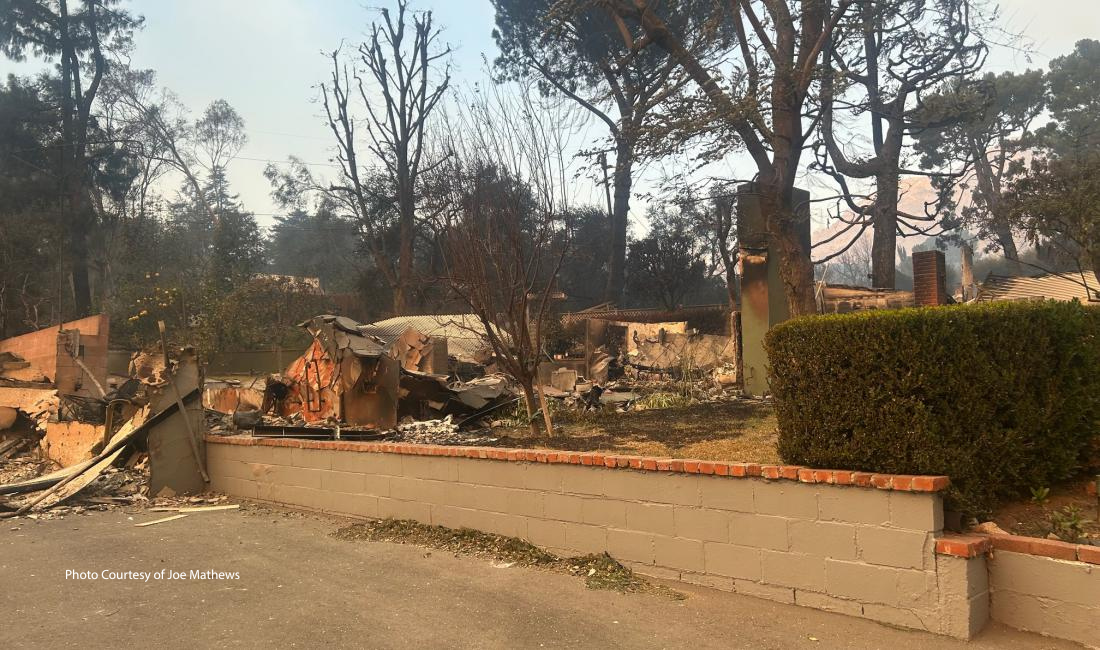
It has been a year since the Palisades and Eaton fires changed Southern California forever.
While the fires are out, L.A. is still burning—with frustration and anger. At revelations about the failures to prevent fires. And at the myriad problems of the fire recovery.
To be fair, all levels of government have done extraordinary things in the fires’ aftermath, including fast clean-ups of lots, emergency financial supports for the displaced, and the streamlining of permits to try to ease rebuilding. Yet it hasn’t been enough. In conversations I’ve had, fire victims say they feel fundamentally on their own—to deal with silos within L.A.’s feuding city and county governments, to find the right assistance from a large menu of state programs, to handle unscrupulous lawyers and contractors, and to battle with an insurance industry that offers uneven service and low-ball reimbursements.
It’s enough to make you wish there were some sort of government that might represent all the communities and people affected by the fires, and could focus 24/7 on nothing else but post-fire recovery and repair.
Good news: There may well be. It’s a new and largely untested type of government called the climate resilience district (CRD).
CRDs are designed to do two big things. First, as planning entities, these climate districts can create and implement climate-related projects across multiple jurisdictions. And second, as governments, they can levy taxes, conduct referenda, sell bonds, and apply for grants to fund such projects.
CRDs are local governments that can be created by other local governments. A city, a county, or one of California’s nearly 3,400 special districts (handling issues from water to transit) can decide to create a CRD.
Just like fires and floods, CRDS can cross political boundaries. Districts may include multiple municipalities or counties. As climate change and its impacts worsen, this flexibility could make CRDs a particularly useful method of designing, funding, and managing environmental risks and disasters.
To be sure, the idea of delineating new districts or areas for climate projects is not a California invention. Localities in other countries have done this, more or less formally, for a decade or more. China has its “sponge cities” (in Wuhan, Xiamen, Shenzhen, and other metro areas). Germany has its eco-districts (Freiburg-Vauban) and carbon-neutral zones (Heidelberg-Bahnstadt). The Netherlands has its “climate-proof” neighborhoods or “water squares.”
California, however, was the first place to empower local communities through the law to authorize such climate governments for themselves. This came after years of advocacy by the Sacramento nonprofit CivicWell (and Roger Dickinson, now a Sacramento city councilmember), and after slow local recoveries from major Northern California wildfires like 2017’s Tubbs fire (in Sonoma County), 2018’s Camp fire (which destroyed Paradise), and 2021’s Dixie fire (which leveled multiple North State communities).
In 2022, state Sen. Bill Dodd, who represented parts of wine country, sponsored SB 852, groundbreaking legislation that established rules for creating and running CRDs. The law authorized these districts to pursue various revenue sources, including tax-increment financing, benefit assessmens fees, voter-approved supplemental property taxes, state and federal grants, and private donations. The bill also defined “eligible projects” for CRDs as any efforts addressing sea-level rise, extreme heat, extreme cold, drought, flooding, and, of course, wildfire.
Dodd’s legislation also made the Sonoma County Regional Climate Protection Authority, a pre-existing body, the state’s first CRD. Officials say the district already has successfully fostered collaboration, since it includes the Sonoma County government, eight cities, and the town of Windsor on its governing board. The CRD has made plans for climate adaptation and mitigation projects involving building design, transportation, and water. The collaboration also makes the district more competitive in seeking government and private grants.
But the CRD has been slower to produce revenues. The district has explored various tax plans, but polling, and California’s requirement of a two-thirds majority vote for many local taxes, has so far discouraged the district form asking voters to approve funding them.
Other California communities have discussed establishing CRDs, but Sonoma’s district remained the only one in the state—until the fires swept through L.A.
The complexity and frustrations of recovery have made CRDs appealing for Southern Californians, Los Angeles County’s government, and state Sen. Sasha Renee Perez, who sponsored legislation to ease the creation of new fire recovery district.
L.A. County has taken steps to set up CRDs in two places. In November, the Board of Supervisors approved the creation of the Unincorporated Santa Monica Mountains Wildfire Disaster Recovery Financing District to cover county areas burned in the Palisades fire. It’s also expected to cover Malibu. An Altadena climate district received preliminary approval in October.
Unfortunately, neither county-authorized district includes the neighborhood of Pacific Palisades, which is part of the city of Los Angeles, but a third CRD could be created there. (The L.A. city council is considering a study of a CRD).
Dividing up the fire areas into three districts is not ideal. One larger CRD would offer L.A.’s fire recovery efforts more capacity, more coordination, and potentially more money. A combined district might also have more political leverage to demand better performance from insurance companies and the state’s ineffective insurance commissioner.
But the real test will be whether residents and fire victims can take charge of these new climate districts themselves, instead of deferring to powerful local elected or appointed officials. People will need to be unified and unapologetically aggressive in using all of the authority of CRDS to raise revenues and carry out plans.
It’s the best chance for those most affected by the L.A. fires to determine the future of their communities for themselves.