The Lemperts Love Door-Knocking and Complicated Issues
This column is edited and co-published by Zócalo Public Square.
Two years ago, at a crowded gathering in San Francisco, Gavin Newsom was introduced to a young, local campaign strategist. Clocking her name tag— “Veronica Lempert”—the governor of California groaned in mock exasperation.
“Oh my gosh! Not another one!”
Newsom’s reaction was not rude. Your columnist has had the same feeling for years. As I make my way around California politics, I can’t escape the Lemperts.
The family is not a conventional American dynasty. They are nothing like the Kennedys, with their wealth, entitlement, national ambitions, and love of touch football (the Lemperts prefer tennis). They don’t desire statewide office, like Pat, Jerry and Kathleen Brown. Nor are they big-city machine types, like the Aliotos of San Francisco.
Instead, the Lemperts might be California’s most earnest, nerdy, and locally oriented family. That makes them a rare breed, in a cynical age dominated by national politics and flashy social media.
The Lemperts have a strange, honestly acquired taste for complicated problems—climate, transit, children’s health and education, and municipal reorganization. When it comes to campaigning, the family clings to old-fashioned canvassing.
“The thing we most love to do together is knock on doors,” says Ted Lempert, Veronica’s father, and a former state legislator and San Mateo County supervisor.
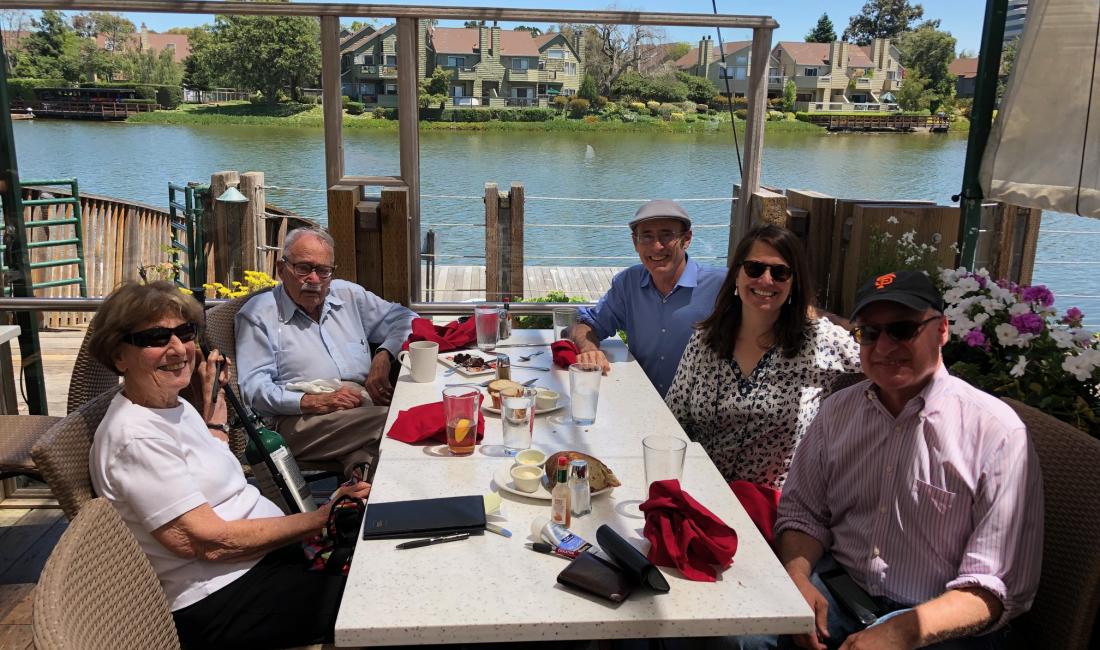
After years of running into Lemperts, I recently visited their family headquarters: the San Mateo home of materfamilias Sue Lempert, 94.
She’s the Lempert I trust most, because—despite a long and legendary career in Bay Area local and regional government—she was first and last a blunt journalist. She only gave up her must-read column in The Daily Journal last year. Our relationship is primarily online—for years, she’s written to me with comments on my columns, California gossip, and ideas about various local matters.
Sitting at her dining room table, with her brood joining us in-person and by Zoom, I pressed her on the baffling paradox:
How is it possible that a Silicon Valley family stacked with elite degrees from Stanford, Princeton, and Yale devoted itself to local governance and made no real money along the way?
Sue Lempert stared at me directly and responded firmly: “Every child and grandchild is doing good. They’re not making money. That’s what I love about them.”
Born and raised in New York, Lempert recalls that when she was 8, an eccentric visiting relative made a bizarre offer. “If you ever come to California, I’ll buy you a horse.” In 1950, ignoring her high school counselors’ advice that she go to a women’s college like Smith or Holyoke, she enrolled at Stanford, though admission didn’t come with a horse.
Lempert was the first woman ever elected managing editor of the Stanford Daily, but she couldn’t get a job in the sexist newsrooms of the day. (A Time magazine editor propositioned her during an interview.) So she took a public relations gig at General Electric and freelanced for newspapers.
She returned to New York to earn a master’s in international relations in Columbia. At a Stanford alumni event there, she flirted with Art Lempert, a poor Bronx kid-turned-lawyer.
Her opening line: “Say, are you John Maynard Keynes?”
She later accepted his marriage offer on one condition: They would return to California.
After a year in an ant-infested apartment in San Francisco’s Richmond District, Art and Sue, pregnant with their first child, Robert, found a home in San Mateo. As their family grew—Ted was the middle child and Liz the baby—Sue’s activism in the League of Women Voters brought her face-to-face with a deeply conservative school board that she felt ignored non-white children from less affluent families.
A local coalition drafted Sue to run for San Mateo’s elementary school district board in 1977. To her astonishment, she faced little serious opposition—a feature of all her future elections, too. During her tenure on that board and later on San Mateo’s high school district board—both of which she chaired—she fought for greater support for the lowest-performing students and for the gifted. She expanded early childhood education workshops for parents and introduced Montessori to the district. But she often felt frustrated, as the board laid off teachers and closed schools because of the local and statewide tax limits of Prop 13.
So, in 1993 she won a seat on the San Mateo City Council, where she felt less inhibited. Lempert became a fierce champion for urban planning, open space (she’s the mother of bay-fronting family-friendly Shoreline Parks), and transit-oriented development that made her city more prosperous and urban.
Lempert helped lead an epic fight against a developer’s plan for a 24/7 casino card room at the historic Bay Meadows racetrack. By attending even the smallest community meetings and building a grassroots army, she defeated the proposal and laid the groundwork for transforming the racetrack property into a large and popular mixed-use development.
While on the city council she was appointed to the Bay Area Metropolitan Transportation Commission and became its longest-serving member. Her relentless defense of Caltrain funding (her husband Art rode the train to work in the city every day, she notes) and the extension of BART to San Francisco International Airport earned her the nickname, “The Queen of Transit.”
Her governance philosophy remains brilliantly simple: “Stop talking so much. Just get something done. If you can’t look back and say, ‘I held elected office and I did this for the people,’ then what the hell were you doing there?”
She conveyed to her children—who were often by her side at meetings and campaigning—that public service was a duty, not a choice. When Ted Lempert was nominated for student government at Baywood Elementary and declined out of shyness, Sue reprimanded him: “You don’t decline! You get involved! When someone asks you to serve, you do it!”
Ted got the message. He didn’t just follow in his mother’s footsteps—he overlapped with her in office. He won his first assembly seat in 1988, in an enormous upset against a Republican incumbent, with considerable precinct walking help from his mother. In the California State Assembly and on the San Mateo County Board of Supervisors and the county board of education, Ted became known for developing expertise on hard issues, including education and children’s health, which he continues to advocate for as president of the nonprofit Children Now. He also teaches a class on California politics and policy at UC Berkeley, at which I’m a guest speaker.
Ted’s younger sister, Liz Lempert, took a path similar to her mother’s—going to Stanford and then building a journalism career as a producer at National Public Radio. When her family relocated to Princeton, New Jersey for her husband’s academic job, Liz got involved in local politics and ran the county campaign for Barack Obama.
Before she knew it, she had been recruited to run for local office in Princeton Township. From that perch, she helped engineer a historic and controversial merge of Princeton’s two local governments, the township and the borough, in 2013. She then served eight years as the first mayor of the consolidated Princeton, cutting local administration costs significantly and championing climate resilience. While interviewing her for this column, I realized we had crossed paths in global meetings of climate-oriented mayors.
“It’s sort of the golden age of local government,” Liz Lempert told me, echoing her mother. “There’s a lot you can get done at the local level.”
Sue’s oldest child, Rob Lempert, seemed to have avoided local government. He became a world-renowned climate scientist at the RAND Corporation in Santa Monica, and worked on national and global policy with Congress, the Clinton White House, and the World Bank. I met him while looking for writers and speakers for Zócalo Public Square (which publishes this column).
In January 2025, the Palisades Fire destroyed Rob’s L.A. home. Since then, he’s been working with his neighbors on rebuilding, including the possible creation of a local disaster recovery district.
This spring, he organized civic assemblies of Palisades residents to chart their neighborhood’s future, and he is examining participatory processes for deciding how to spend money to build more resilient infrastructure. His relatives are not surprised by this turn. They say Rob is the family’s best political canvasser, skilled at knocking on doors and chatting people up.
He sees more local progress than national or international on climate, in part because “you can get the people who are involved in the solution in the same room,” he told me.
The next generation is continuing the family’s civic work. Veronica and Julianne are working in politics in San Francisco. Madi is a public defender in Contra Costa County. Ben is an attorney in the natural resources division of the state attorney general’s office. Ella is in medical school, and Caroline is teaching music.
The family still gathers every summer at Pajaro Dunes, an unpretentious coastal refuge in southern Santa Cruz County. Sue and Art, who died in 2020, first read of the area in a KQED magazine in the 1960s. There, the Lemperts eat burritos and engage in ferocious political debates, though there hasn’t been a really big fight since Obama-Clinton divided the family back in 2008.
Sue wins most of these debates, with directness and humor on display in San Mateo, where she offers me (like her, a parent of three) some advice: Only one hour of TV for the kids a week, and that must come on the weekend. With such strong opinions, I suggest, she must have enemies.
“Jerry Hill is on the list,” she says, though I’m not sure if she’s kidding; I’d told her earlier that grandparents considered Hill, a former San Mateo mayor, a friend.
“Speaking of Jerrys, there’s that rascal Jerry Brown,” she says, adding that she still questions the wisdom of his popular pro-union legislation.
“No, Mom!” interjects Ted. “You’re wrong about that.”
The conversation accelerates. There really is no stopping the Lemperts.