WW2 Concentration Camps Fit ICE's Needs Tody
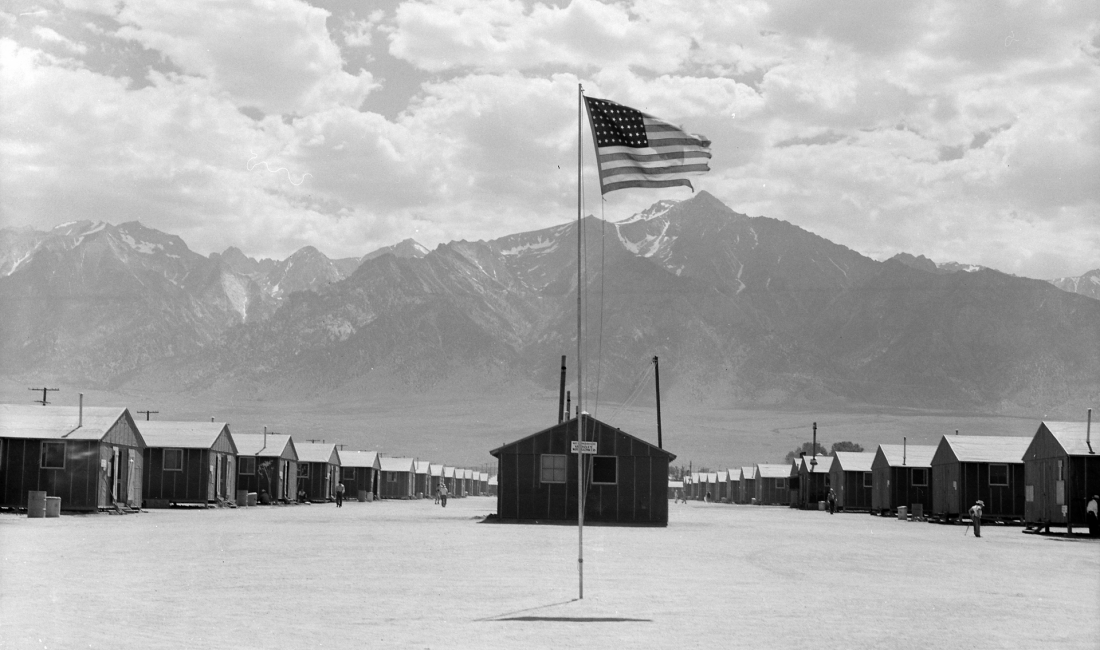
This column is published by Zócalo Public Square. Image via Wikimedia Commons
Now, as the federal government continues its unprecedented campaign of mass deportation and migrant detention, our patriotic state faces another housing crisis.
The Trump administration wants desperately to detain hundreds of thousands more of our undocumented neighbors as well as legal immigrants whose status it has lawlessly canceled. But it keeps tripping itself up.
Existing migration detention centers are overcrowded, can’t find staff, and offer conditions so poor (lack of bathrooms and healthcare, excessive heat or cold, unhealthy food) that courts and localities try to shut them down. Using old jails, near downtowns, makes detention centers easy targets for protestors. Attempts to convert old warehouses or build new facilities, as in Gilroy, violate zoning codes and local laws.
Even more expensive is the latest Trump strategy—having the federal government buy and own private detention facilities so that it has more control. The Department of Homeland Security’s recent purchase of the Otay Mesa Detention Center in San Diego and the California City Detention Facility in the Mojave Desert from the private prison company CoreCivic cost $1.5 billion, more than four times the assessed value of these properties. For anyone whose ethical compass doesn’t register at Trump’s level, those purchases might look like a corrupt payoff to CoreCivic, a longtime supporter of the president. Or it might appear another case of California fraud, which Vice President Vance is so righteously stamping out.
Why does the U.S. government keep trying these failed strategies, when the most elegant, cost-effective, and historically sound solution is staring us right in the face?
All the Trump administration needs to do is reopen California’s incarceration camps, used to warehouse Japanese Americans during World War II.
This very modest proposal might sound shocking. But it is merely an exercise in pragmatism.
From a purely managerial perspective, the advantages are overwhelming. Places like Manzanar in Inyo County and Tule Lake in Modoc County are already under federal jurisdiction—sitting there, preserved as historical monuments, waiting to be adapted for our new golden era of racist American fearmongering around national security.
Furthermore, let us be honest: Modern migrant detention centers operating across the United States are, in scale and function, the logical evolution of 1940s relocation centers. CalMatters recently noted that ICE’s 2026 Detention Re-engineering Initiative imagines 10,000-person detention centers larger than any correctional facility built in this country since the Japanese wartime incarceration.
Why spend billions of taxpayers’ dollars on brand-new detention centers when the blueprints—and the very physical foundations—already exist?
Plus, the aesthetics are better. Where mid-century camps were visually open about their carceral nature, today’s facilities masquerade as bland, windowless, tilt-up concrete logistics parks. They are Amazon fulfillment centers where the inventory is human beings.
What’s more, if we examine the historical record objectively, a return to the wartime camp model would represent a significant humanitarian upgrade. Our privately managed, corporate-run facilities are isolating places. Detainees are processed like bulk freight and kept in states of suspended legal animation.
California’s Japanese incarceration camps were godawful in reality and indefensible morally. But compared to ICE detention centers, they possessed a robust civic infrastructure! At Manzanar and at Tule Lake, the federal government let incarcerated populations have schools, churches, Buddhist temples, camp newspapers, community councils, agricultural cooperatives, theater groups, even baseball leagues. If the federal government insists on mass confinement for millions of people who have committed no crimes, it should at least do so with the dignity of a baseball diamond.
The geography of wartime incarceration also supports this path. Today’s migrant detention system favors cheaper facilities in California’s Central Valley, and inland deserts. ICE and its private contractors are in Adelanto, California City, McFarland, Bakersfield and Calexico; World War II incarceration often began in assembly centers in Fresno, Merced, or Tulare, not so far away. Manzanar sits isolated in the high desert of the Owens Valley, flanked by the unforgiving peaks of the Sierra Nevada. Tule Lake is just below the Oregon border on a dry, wind-swept lakebed.
Placing newly detained populations in remote corners of the state would let the federal government achieve its ultimate administrative goal: out of sight, out of mind. Coastal progressives, who love to sign online petitions and hold candlelight vigils outside urban ICE offices, wouldn’t drive six hours into the high desert, where it can be hard to recharge your EV. It’s much easier to hold another “No Kings” rally in a charming downtown with good coffee options.
Some will object on moral grounds, invoking the dark stains of our past and the lessons of history. But this ignores the reality of how Americans view their own misdeeds—we don’t. Yes, the government apologized and offered reparations for the World War II camps in the 1980s. But, as a nation, we never truly recognized these places as the concentration camps they actually were.
Hence the moral barrier to reusing them today is remarkably low. If the American public didn’t rise up in rebellion when their fellow citizens were locked away in the desert in 1942, why would they do so for non-citizens today? We long ago normalized the concept of remote, barbed-wire containment. What’s new now is changing the demographic target to fit Supreme Court prejudices and the MAGA imagination.
In the interest of full disclosure, I must confess that there are critics who argue for a different approach to this ballooning detention crisis. They believe that instead of acquiescing, Californians should organize and liberate the people inside.
Some want to use legal approaches. National coalitions, including Detention Watch Network, Immigrant Legal Resource Center, American Friends Service Committee, and the National Immigrant Justice Center are trying different strategies for closing down detention centers, ending private detention contracts, and defunding ICE enforcement, or shuttering the agency. Since civil immigrant processing does not legally or practically require physical incarceration some Democrats in Congress and activists have proposed non-carceral alternatives and community-supported services.
But those strategies face bipartisan opposition and will take years, while migrants languish in detention. A few radicals—activists, antifa, the occasional rogue California columnist—dream of local and state law enforcement agencies, acting under the emergency directives of a defiant governor, teaming up with thousands of civilian protestors to surround federal detention facilities. They would cut the fences, bypass federal agents, and physically remove detainees, integrating them safely into local sanctuary cities and subterranean support networks.
It is a dramatic, cinematic thought, perhaps drawn from the opening scene of One Battle After Another. It is also a powerful moral vision, a real-life expression of the Holocaust lesson “never again.” But it’s totally unrealistic.
Our law enforcement agencies are incapable of coordinated, ideological defiance. Half of California’s elected county sheriffs and police chiefs agree with the federal administration’s mass deportation goals, and flout sanctuary laws. The other half quietly cooperate with mass deportation and refuse to stop the feds who abuse Californians for daring to stop their immigrant neighbors.
And the idea of California leaders who can’t even finish a high-speed rail system from Bakersfield to Merced organizing an underground railroad across the Mojave is laughable.
Ultimately, we Californians must see clearly who we really are. We lack the courage and competence for real resistance to concentration camps. Reopening Manzanar and Tule Lake honors our carceral history, utilizes existing public lands, and streamlines our federal law enforcement infrastructure. It is a solution born of pure pragmatism, now so prized in politics now.
Let us stop pretending we are better than our past.