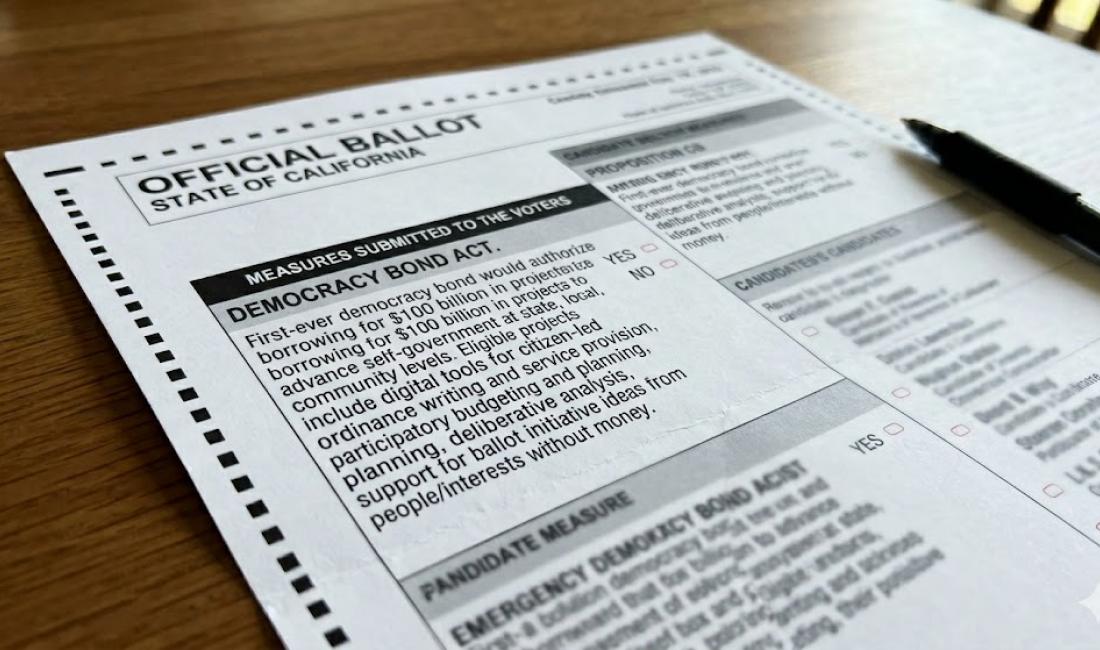
If We're Serious About Building Democracy, We Must Borrow
This column is co-published with Zócalo Public Square. Image by Joe Mathews using Google Gemini.
Talk is cheap. Which is why you can dismiss all the rhetoric from California leaders about championing or saving democracy.
If they were serious about building 21st century democracy statewide and in local communities, they’d have governments borrow money to do it.
How? By creating a new type of financial instrument: the democracy bond.
Our elections are open sewers of big money, donated by oligarchs who use voting to reinforce their power. Meanwhile, real democracy—in which we govern ourselves, our cities, our states, and the world—barely exists, because it is starved to funds.
Creative the institutions for self-government will require billions. We will need: permanent bodies for citizens to deliberate and implement policies; participatory processes that allow everyday people to make land use plans and budgets; AI-enabled tools for government experts to co-create policies with the people they serve.
In California, we also need billions to replace institutions of democratic government, from financial regulators to health and safety agencies, that Trump is corrupting or dismantling.
If all that sounds sensible, you might ask: Why don’t we have democracy bonds already?
Two answers: tradition and law.
In the U.S., we have long used state and municipal bonds—through which governments borrow money from investors and pay it back (plus interest) over years or decades—to build schools, bridges, tunnels, parks, housing, and (maybe someday) high-speed rail.
Laws typically allow bonds to be used for “tangible capital assets,” like infrastructure or buildings. The logic is: if a city builds a wastewater treatment plant to last three decades, then it’s fair to issue a 30-year bond so that residents help pay for the infrastructure they will use.
But personnel, maintenance, and even democratic processes have been considered less tangible and more short term. The government is supposed to pay for these things via annual budgets rather than through long-term borrowing.
Changes in society should shift this calculus.
In a world built on ideas and technology, democracy is public infrastructure, as much as any school or sewer, because you can’t build the future without it. Democracy allows people to decide for themselves what gets built, and ensure policies addresses real needs. Democratic oversight, from the public and elected officials, prevents corruption. As democracy declines, we are seeing just how tangible democracy can be. Authoritarians from Viktor Orban to Donald Trump have used their autocratic power to break contracts and laws, thus underining. trade, education, and health.
If California and its governments redefine democracy as infrastructure—which would require changing local laws and the state constitution—then democracy bonds will make sense.
The government could structure democracy bonds many different ways. They could be general obligation bonds, backed by states and cities and their general funds. They could be revenue bonds, attached to a dedicated funding source for paying bondholders back. I’d suggest a tax on large donations to election campaigns. Call it the oligarchy tax.
Or if you prefer a more avant-garde approach, democracy bonds could work like social impact bonds, in which investors provide capital and the government pays them back with interest after meeting specific performance milestones. In other words, you could sell a bond for which the paybck depends on whether the city lets residents decide the local budget through participatory processes, or if surveys show greater trust in government, or if local governments create digital tools to let citizens propose their own laws.
There are already measures that resemble democracy bonds. In India, from 2018 to 2024, citizens could anonymously buy “election bonds” that funded the activities of the political party of their choice. [EB1] India’s courts eventually blocked the bonds on the grounds that anonymous bond purchases violated transparency rules.
Also, Chinese cities use borrowed money to fund participatory processes and public consultation. When a municipality issues a bond for a project, the bond also pays for the hiring of community planners, the deployment of digital feedback platforms, and the execution of participatory workshops where residents debate and vote on how project money might be spent.
From those roots, international development agencies have floated ideas for “democracy bonds” or “outcome bonds.” One concept, now promoted by the World Bank, allows developing nations to issue bonds with interest rates or prepayment terms indexed to the country’s progress in democratic governance, human rights, or sustainable development.
My own idea would be to put democracy bond dollars in a democracy community trust[EB2] . This trust would allow local people, perhaps chosen by lottery, to decide what to do with the money. Through the trust, the community would also own the assets created by the bonds.
You may object on the grounds that the world’s peoples, governments and corporations all carry too much debt already. That’s a fair point, but so is this: We use debt to pay for the things that matter most, including our homes and our children’s educations. Paying with debt demonstrates long-term commitment—which is exactly what democracy needs.
A bond, after all, is a binding financial contract. When a city issues a 30-year democracy bond to fund democratic infrastructure, it’s putting that money where a frustrated mayor or hostile city council can’t touch it to satisfy narrow short-term aims.
Democracy bonds, more directly controlled by people, also might act as a counterweight to bureaucracy, forcing collaboration and weakening government silos.
So the next time you see a public official vaguely promise to protect democracy, get in their face and say:
Show me the bond money.