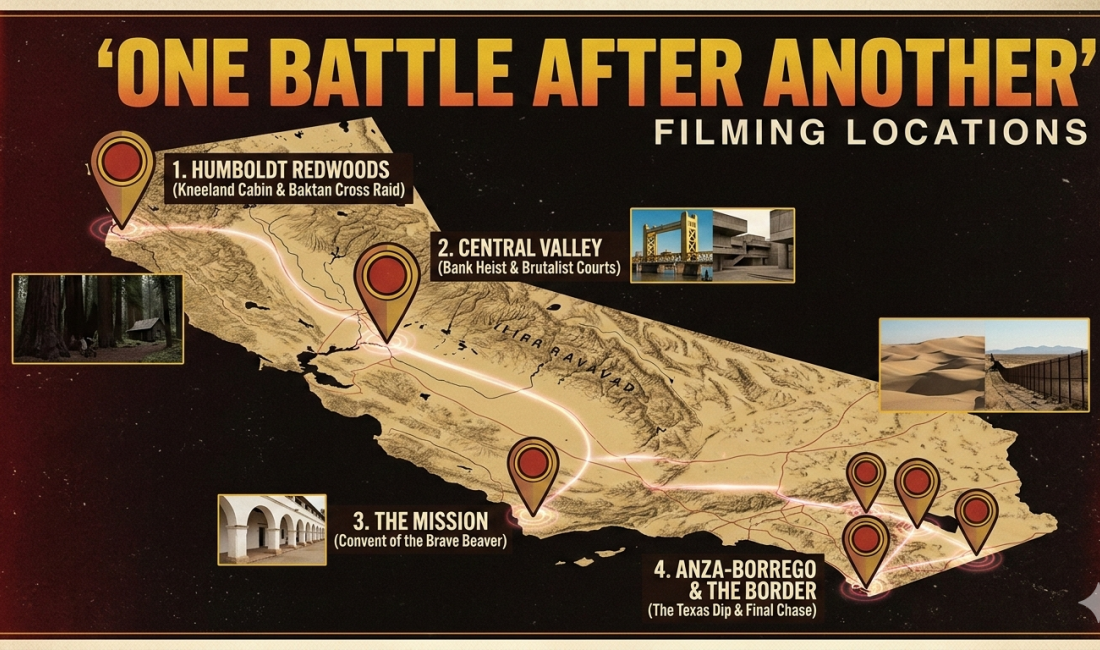
A Prize-Winning Film Gets Local Geography Wrong—And Grabs Tax Credits
This column is co-published with Zócalo Public Square. Graphic by Joe Mathews using Google Gemini.
Paul Thomas Anderson’s One Battle After Another is favored to win the Academy Award for best picture.
But the film is also at war with California geography—and the state treasury.
I am sad to say this. Your columnist, a convert to the cause of California independence, badly wanted to love a movie about a generation-long civil war waged by everyday Californians against an anti-immigrant, white supremacist U.S. regime.
But as someone who makes a living in part by visiting all corners of this state, I found myself utterly confused midway through—precisely because I recognized every single California setting.
Put simply, One Battle After Another only makes geographic sense if you watch it on hallucinogenic drugs that are not yet legal California.
This is a movie where characters make turns in the San Diego suburbs and are suddenly in Sacramento, 600 miles north. Or they run from military occupation in Humboldt County in the North State and seconds later show up 10 hours south at La Purisima Mission in Santa Barbara County. Or they start a car chase on the Central Coast that swiftly twists its way to desert roads somewhere between Borrego Springs and the Salton Sea.
With such dizzying geography, the movie would have been more accurately titled, One California Place After Another.
Why did the production team do this? Evidence abounds that the choice was mercenary, not artistic. The film seems to be naked attempt to maximize the amount of money it could take from the California Film and Television Tax Credit program.
That attempt has been successful. Governor Newsom and the California Film Commission have celebrated the movie’s awards-season success and the fact that $8.4 million in tax credits covered part of its $57.7 million budget. That’s a gallingly high number of credits for a feature film (multi-episode series can take even more of our money), especially since we taxpayers don’t get to walk the red carpet or share in the profits.
More evidence that the project is a tax credit grab comes from where the movie is does not go: Anderson, surprisingly, avoids Los Angeles County, where he routinely sets his California movies, since he’s a famously proud partisan of his native San Fernando Valley.
That decision is relevant because state tax credits are 5% to 10% higher for productions that shoot outside Los Angeles. Those higher tax credits were politically necessary to convince legislators from the rest of the state to approve, and more recently expand, the program—from $330 million to $750 million.
That expansion has benefits for politicians—it’s good to keep yourHollywood donors happy—but the policy case for the tax credits is weak. Independent studies, including by the state’s own nonpartisan legislative analyst, have founded no clear economic benefit to California, or most Californians, in subsidizing production.
Sure, the program gives Hollywood a little boost, but not one big enough to rescue a struggling industry. And the money might be more productively invested elsewhere. Plus, it’s morally questionable to send $750 million to the business when the state budget is in deficit and the Trump administration is targeting California for cuts to programs like Medicaid and food stamps.
This reality puts the financing of One Battle After Another at odds with its revolutionary spirit. And the jarring geography, driven by those tax credits, makes parts of the film seem unreal and implausible, which undermines its power.
For your columnist, among the false notes are a robbery and speedy chase scene through downtown Sacramento. As a frequent visitor to those sleepy blocks around the state Capitol, I can testify that nothing moves fast, especially the state employees who walk even slower than they govern California. Also, a subplot involving an Underground Railroad transporting immigrant families to the North State was entertaining but ludicrous, given the difficulties of trying to hide Latino immigrants in one of California’s whitest regions.
One Battle After Another can be exhilarating, but only when it squares with reality, geographic and otherwise. The film’s best scene is its opener, in which a group of California revolutionaries break into a federal immigration center and free the people held there. The scene was filmed in 2024 in Otay Mesa, right on the U.S.-Mexico border, at an actual federal detention facility, with the Biden administration’s assent. It ought to be repurposed into a training film, given the need to liberate detainees from the concentration camps the Trump administration is building across the nation.
The movie’s other great scene is an extended phone call and argument between the film’s lead character, a former revolutionary bomb expert turned Gen X burnout played by Leonardo DiCaprio, and a younger revolutionary answering the phone on a secret hotline for rebels.
Before he can gain the help of his former comrades to rescue his daughter, who has been targeted by the U.S. regime, DiCaprio must answer a series of questions about rebel ideology that function as a password. But, after years of booze and weed, he has forgotten the correct answer to the question, “What time is it?”
DiCaprio begs for an exception (don’t “nitpick over passwords” in a family emergency!) but the Millennial-aged revolutionary, sounding like a government bureaucrat or corporate call-center employee, is unyielding.
“‘What time is it?’ is a key question of the underground movement,” he tells DiCaprio. “Maybe you should have studied the rebellion text a little harder.” Then, he hangs up.
A character later provides the correct answer: “Time doesn’t exist, yet it controls us anyway.” But, as the film races around the Golden State, it never bothers to answer a similarly fundamental question: “Where are we now?”
Which is why One Battle After Another lost me.