The Ancient Struggle for Democratic Leadership Is Internal
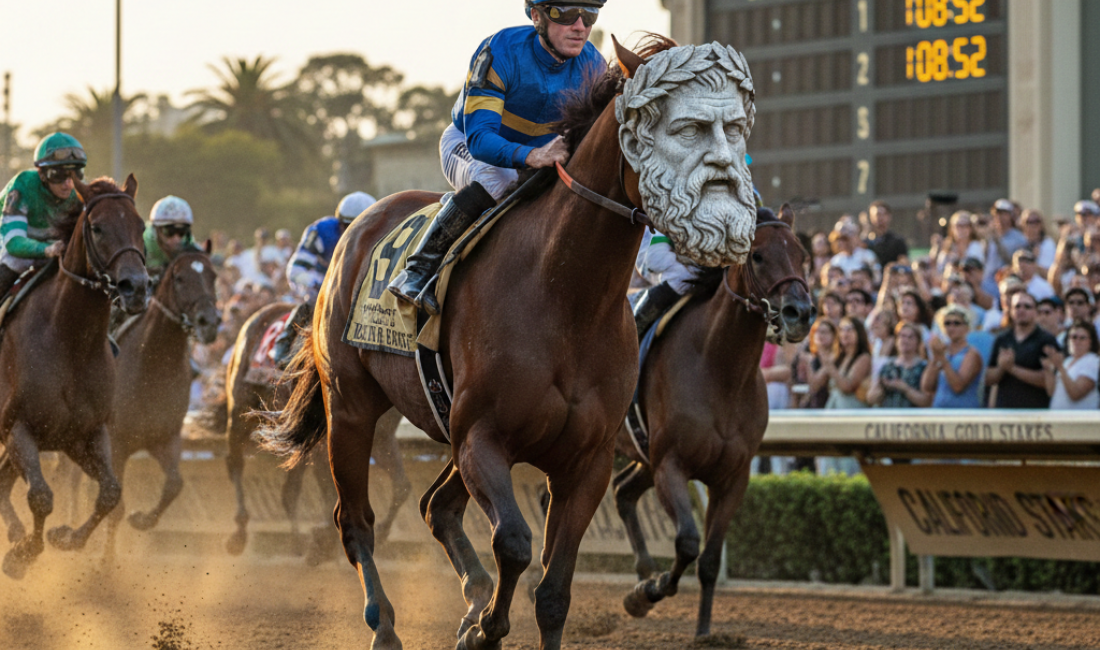
This column is co-published with Zócalo Public Square. Image created by Joe Mathews with Google Gemini.
Desert Gate, California’s leading 3-year-old horse, was the favorite in the seventh race at Santa Anita Park on Feb. 7. Secured Freedom was the second choice.
But Plutarch, an unheralded colt who had never before won a stakes race, blew past them both to win by three-quarters of a length. The dominant victory transformed Plutarch into a top contender to win the 2026 Kentucky Derby, surprising his trainer Bob Baffert.
“We put in so much time with this horse—he was so immature,” Baffert said. “But he's getting better every week. He's got a great mind. He'll figure it out.”
The Arcadia-based thoroughbred colt isn’t the only Plutarch to catapult into the California consciousness. The ancient Greek historian and philosopher Plutarch, for whom the horse is named, has also vaulted into the spotlight.
That Plutarch, while dead, might be the defining figure of other horse races, including the 2028 Democratic presidential primary, and the 2026 contest for California governor.
Plutarch, who lived from around 50 to around 120 C.E., used to require no introduction; his biographies of Greek and Roman figures (Alexander the Great, Julius Caesar) were standard school assignments STEM, ethnic studies, and never-ending lectures on kindness took over.
This writer, whom James Boswell called the “prince of ancient biographers,” was famous for moving history away from recitation of events into the realm of personal narrative, where leaders’ character and interior struggles took precedence. Great leaders, Plutarch argued, are not perfect or even good. They are people who overcome their flaws and demons and tame their own ambitions in order to serve the people.
That vision of humanity and its leaders, offered 2,000 years ago, feels very modern.
“To make no mistakes is not in the power of man,” Plutarch wrote, “but from their errors and mistakes the wise and good learn wisdom for the future.”
So, it is no wonder that Gavin Newsom, a man with more than his share of both ambition and flaws, is a major fan. The governor has a longtime habit of quoting Plutarch in private—so much so that aides asked him to cut back.
Instead, the governor is now making his Plutarch preoccupation in public plain, including in this year’s State of the State speech.
Newsom specifically invoked Plutarch in criticizing President Trump’s Big Beautiful Bill for putting millions of Californians at risk of losing health insurance and food aid.
“All to benefit the top 10% of this country,” Newsom said, “people who already own two-thirds of the household wealth. Plutarch was right when he warned us 2,000 years ago that this imbalance of the rich and the poor ‘is the oldest and most fatal ailment of all republics.’”
Newsom followed that speech with an autobiography, Young Man in a Hurry, brilliantly ghostwritten by my former L.A. Times colleague Mark Arax, that owes a considerable debt to Plutarch’s classic, Parallel Lives.
In that work, Plutarch compares 46 figures—pairing 23 Greeks and 23 Romans—on how they balanced personal ambition and service. Plutarch, who spent much of his life in his Greek hometown of Chaeronea, even serving as mayor, often favors the Greeks, and their devotion to their own city-states, in contrast to the more imperially ambitious Romans.
Newsom’s book, in this Plutarchian tradition, pairs two different Gavins in his self study. There are two children: one Gavin spent weekdays with his single, working-class mother in Marin, and the other spent weekends with the obscenely wealthy Gettys, for whom his father was friend and fixer. Then there are the two adult politician Gavins: the ambitious leader who wants to reach the top in San Francisco and California politics, and the risktaker who pursues unpopular or even illegal policies (like marrying same-sex couples in 2004) to serve the people and the cause of justice.
Now, outside the book, which ends with Newsom’s election as governor in 2018, there’s an internationally famous politician who tries reconcile his duties to defend his home state with his all-but-declared campaign to win America’s authoritarian presidency, with all its terrible and imperial power.
Plutarch’s warnings about leaders quite obviously apply in this age of Trump. “Cracked souls cannot contain political power, but they leak with desire, anger, boasting and vulgarity,” Plutarch wrote in his classic essay, “To an Uneducated Ruler.”
What’s striking about Newsom’s invocation of Plutarch is how it telegraphs the governor’s willingness to reckon publicly with his inner conflict. In a recent text exchange, after I congratulated Newsom on bringing Plutarch back to prominence and asked whether we should expect more, he replied: “We could all use a reminder about Civic virtue over personal ambition!”
Among those who could use the reminder are the many politicians running to succeed Newsom. The candidates constantly talk about their resumes and repeat the same tired lines about “affordability,” but offer few thoughts on civic life, democracy, or California’s future.
After sitting through a dull gubernatorial debate in the Bay Area, I found myself thinking this bit of heresy: As much as we Californians like to complain about Gavin Christopher Newsom, we sure are going to miss him, and his torrent of ideas and programs, when he’s gone.
For all his flaws, he is maturing—not unlike Plutarch the California colt. Failures, after all, are reliable teachers for politicians and other race horses. Just as Newsom’s first two years in office were full of mistakes and relied too much on outside committees and task forces, Plutarch lost his first four races, as his trainer tried different jockeys and strategies. The problem for the horse, as it was for Newsom, was that he often lost focus mid-race, distracted by all the other things happening at the track.
Facing recall in 2021 made Newsom tougher and more resilient, while switching Plutarch temporarily from dirt tracks to turf finally produced a breakthrough race at Del Mar last November. Now, the horse has the top trainer and deep-pocketed owners to take a real run at the Triple Crown.
I wouldn’t bet on Newsom winning the presidency—his mix of flaws and strengths are too Californian for a deranged America.
But give me $20 on Plutarch to win the Derby.