Existential Threats Require New Boundaries, New Finance, New Civil Defense
This column is co-published with Zócalo Public Square.
Charter reform in the city of Los Angeles is off to a promising start. An appointed commission, despite limited resources and time, made 64 recommendations to adjust the city’s constitution. Their suggested tweaks address familiar parochial problems: city council expansion, infrastructure, personnel, and elections. The city council is now deciding whether to send the recommendations to voters for approval in this November’s elections.
That may sound like a lot. But it’s nowhere near enough. Los Angeles faces existential threats that can’t be met by reforming the existing system. How much longer can a local government survive without the capacity to house its people, prevent public corruption, defend its residents against federal assaults and AI slop, finance economic transformation, and protect itself against fires and ecosystem collapse?
This moment requires a massive shift in focus, away from near-term topics like this year’s mayor’s race or the 2028 Olympics, and toward a fundamental remaking of Los Angeles so that it survives into the 22nd century.
Such a remaking really a re-founding must answer huge, broad questions that aren’t on the current political agenda.
What sort of rights, responsibilities, and services do Angelenos require in this era of multiple crises? How should we rethink boundaries and jurisdictions to better mitigate and survive the threats from disasters or drone attacks? What sort of financial structures do we need to replace our crumbling buildings with infrastructure that can serve us into the 22nd century?
And what relationships and collaborations must L.A. undertake to address planetary problems, from climate to disease, that the United States and other nations refuse to solve?
Meeting this existential moment starts with thinking anew about not just the city of L.A. but the structure of government in greater Los Angeles.
Los Angeles County is home to a complicated web of small governments 88 city governments, 140-plus unincorporated communities and dozens of special districts divide up the land, which is why historian Robert Fogelson called it “The Fragmented Metropolis.” These civic divisions often originated in racism and greed, rather than any serious effort to create rationally shaped governing districts.
As my Berggruen Institute colleague Nils Gilman has pointed out, L.A.’s fragmentation has defeated attempts at regional planning for heat waves, drought, street-cleaning, infrastructure, and economic investment. Jurisdictional feuding broke up the joint city-county agency on homelessness, made a disappointment of our costly expansion of the Metro system, and threatens to turn the 2028 Olympics into a bankruptcy-inducing fiasco.
L.A. needs to amalgamate and re-organize its governments to create a regional authority with the power, finance, and technical capacity to bring people together to defend our lives and interests, and to build a better future.
This is not an academic exercise. Official negligence fueled the Palisades Fire. Firefighters left burning an arsonist’s small fire that became an inferno and blazed through multiple jurisdictions city of L.A., city of Malibu, L.A. County, state park, and federal land. Authorities in all those places failed to prevent, fight, or even imagine a fire of such intensity. Narrow vision is deadly.
Thinking small also hinders civil defense in an era when ordinary people, like our immigrant neighbours, are targets. ICE and Border Patrol exploit our divisions, scampering between jurisdictions to avoid tracking.
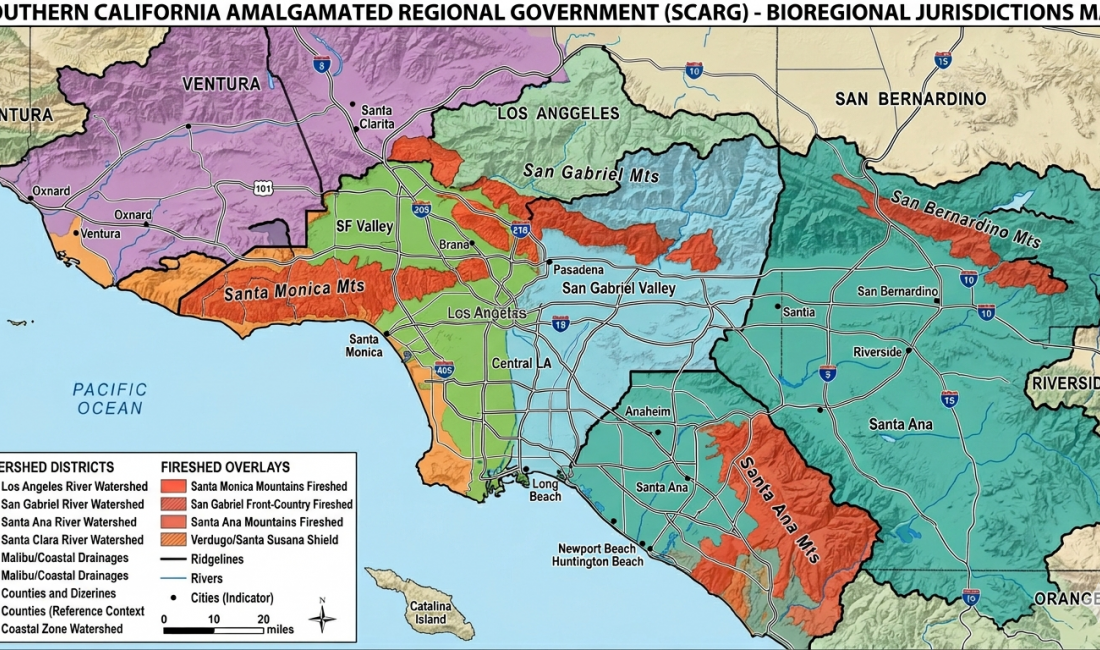
In the short term, the best way to unify Southern California would be to form a sophisticated, high-capacity regional government, of the sort that govern our sprawling East Asian sisters, Tokyo and Seoul, built after wars.
Over the long term, Los Angeles, a place defined by its natural beauty, should re-organize around ecological lines. Our struggles to manage earth, wind, fire, and water would be easier if our communities and governments had boundaries matching those of our ecosystems, firesheds, and watersheds. Such new authorities should find more horizontal and democratic ways of organizing themselves, abandoning the corporate-bureaucratic model of siloed departments now standard in cities.
Such a re-organization would allow us to re-organize, as another Berggruen colleague, Jonathan Blake, points out, that we can only thrive if the ecosystems that clean our air, filter our water, and pollinate our crops also thrive. Such a shift in consciousness requires a charter that protects plants and animals as fellow Angelenos.
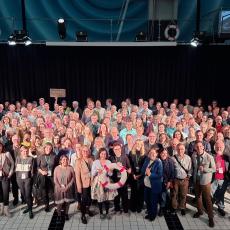
One sign of progress: A January civic assembly of everyday Angelenos, convened by this columnist and others, called on L.A. to re-ognize the rights of its animals as “sentient beings,” as Mexico City’s constitution also does.
Of course, Los Angeles can’t address planetary threats on its own. That’s why our metro region needs a charter, and a structure, to govern the earth together with the world’s other local governments.
Nation states including the U.S. are destroying themselves through political conflict, corruption, and culture wars, so the responsibilities of governance are falling to localities. A greater L.A. regional authority could commit resources, personnel, technology, and democratic energy to integrating local governance with planet-scale policymaking.
L.A.’s natural allies in this work are not the dictatorial regime in Washington, nor “progressive” know-it-alls in Sacramento who extract tax dollars from our local economies to fund ill-considered statewide schemes. Rather, L.A.’s true friends are metro regions worldwide that share L.A.’s predicament and values ecologically vulnerable coastal metropolises devoted to inclusion and creativity.
The most obvious partner for this work is Barcelona. Like Los Angeles, it’s a seaside Spanish-speaking region with a Mediterranean climate and profound housing problems. We’re both idiosyncratically local places that regularly beat the world in sports, culture, and food. And we’re both home to independent-minded people who want to abandon their national governments.
The difference is that Barcelona is one of the world’s best-governed cities, with a flexible, experimental structure that L.A., with a city government still stuck in the 1980s, desperately needs. We could model our collaboration on that of Helsinki and Amsterdam, which are jointly regulating artificial intelligence, or on that of Rotterdam and Jakarta, which work together on sea-level rise.
It’s too late to bring Barcelona know-how into this year’s speedy charter revision process. But we could classify the current commission’s narrow recommendations as Phase One and extend the charter review for another four years, including L.A. County, its other 87 cities, and neighbouring counties in the rethink.
We might ask the World Series champion L.A. Dodgers to add former Barcelona mayor Ada Colau, widely seen as one of the world’s best urban chief executives, to their limitless payroll. Under Colau, Barcelona was branded a “fearless city” a quality we Angelenos need now more than ever.
Such a process would give L.A. the time, space, and global knowledge to reimagine itself. And reinvent what a city could be.