The University of California Is Its State's Brilliant, Frustrating Child
This column is published by Zócalo Public Square.
Do you have a brilliant child who makes you proud—but is also a pain in the butt?
So does the Golden State. Its great, infuriating child is the University of California.
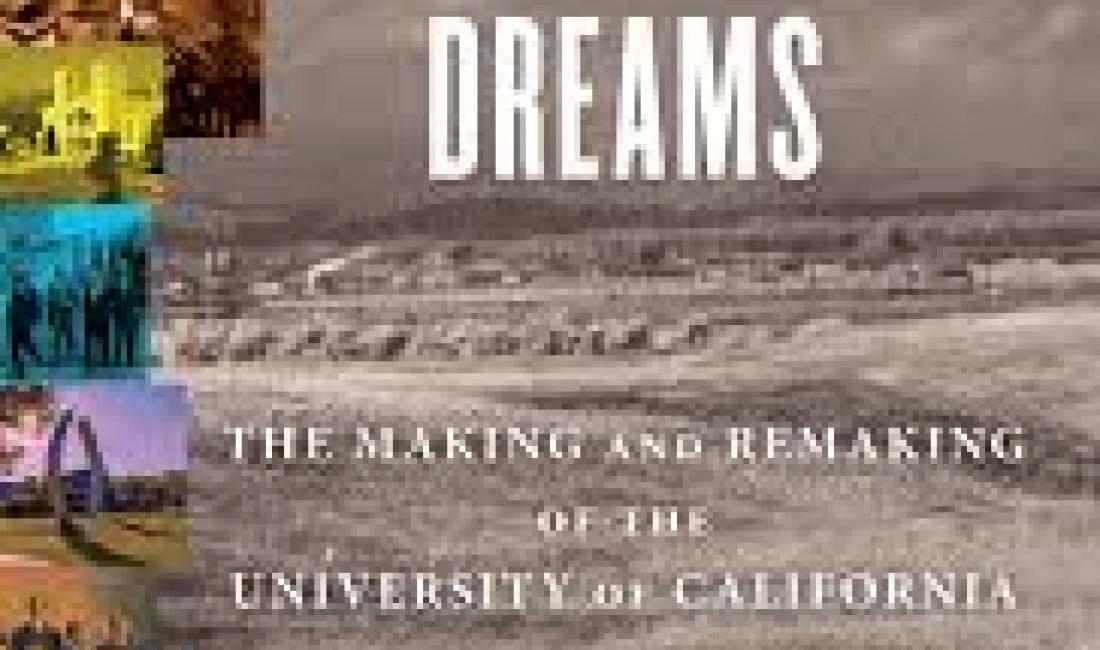
In her terrific new book, California Dreams: The Making and Remaking of the University of California, journalist and author Miriam Pawel (my former LA Times colleague) tags all the bases of UC history, from the university’s 1868 founding in the Berkeley Hills through its expansion into a $60 billion educational and economic engine encompassing 10 campuses, six health systems, and three national laboratories.
But the book is really something more intimate: an examination of the fraught, familial relationship between our state and its world-class university system.
Pawel tells the stories of university graduates, including UC system presidents Robert Sproul and Clark Kerr and (most wonderfully, for this reader) Kenneth Bailey, a pioneer in teacher education who was an important figure in the history of two different UC campuses. She also conveys the stories of its campuses, with heavy emphasis on Berkeley and, unexpectedly, UC Irvine, to which this book is an extended love letter.
California Dreams is often quite moving, as it shows how the university shaped the ideas, ambitions, and people of California. Among the book’s stars are the acclaimed farmer and writer David Mas Masumoto, who has become an important civic figure in the Central Valley. Many of Pawel’s most memorable stories are told through the life of Milicent Washburn Shinn, a pioneer in the field of child psychology. She was one of 43 members of Berkeley’s undergraduate Class of 1880, and became the first woman to receive a PhD from the university.
The book chronologically charts the shifting arguments that Californians have had with each other about what they want their university to be. As the UC grew into arguably the world’s finest public university system, each new generation of institutional leaders feared that something has been lost. Each new generation of politicians fought with the university. And each new generation of students complained that the university is lacking.
All the arguing is the result of this fact: the UC is one of the few institutions important and interesting enough to connect all of California’s places and people. “In a state larger and more diverse in all aspects than many countries,” Pawel writes, “the University remained one of the few forces that transcended disparate regions and groups. It was perhaps the only public institution that inspired widespread loyalty and admiration, even among those who were rejected.”
In this context, present-day Californians’ constant disputes about the UC are reassuring—proof that the university still matters. Today’s fights—over “woke” politics, diversity, and the current ban on using SAT scores in admissions—seem familiar, and less divisive, when compared to the past.
Pawel recounts how, during the Red Scare of the 1950s, the UC and its Board of Regents engaged in brutal ideological purges that make 21st-century cancellations look tame. At one point, all faculty were required to sign an anti-communist loyalty oath. World-renowned scholars who refused were fired or walked away in protest, fracturing the faculty until courts intervened.
Long before current debates over campus free speech or political interference, the UC found itself in a vise, squeezed between Free Speech Movement student radicals and a conservative public outraged by campus disruption. The anti-UC fury propelled Ronald Reagan into the governor’s mansion in 1967, where he engineered the firing of the university’s president, Clark Kerr, creator of California’s 1960 Master Plan for Higher Education.
And in the 1990s, the UC was the central front in a statewide battle over affirmative action that ran even hotter than the DEI debates of today. That battle included a voter-approved measure in 1996 to ban the practice. That ban, in turn, reduced diversity throughout a system that was nowhere close to reflecting California demographics back then, and still lags in diversity today.
One reason why the UC has remained so controversial is that it is expected to do two contradictory things.
First, it’s supposed to be exclusive. The UC screens the population of California (and the rest of the world) to identify, admit, and educate the most promising students: what Kerr called an “aristocracy of talent.” At the same time, the university is supposed to be inclusive, equity-producing engine of social mobility in a very unequal state of 40 million people.
The distance between UC exclusion and inclusion is illustrated every spring, when Berkeley forms a freshman class of less than 7,000 students from a pool of more than 130,000 applications.
The book suggests that the UC’s true superpower is its resilience—its ability to survive, absorb conflict, and adapt. At least so far. Pawel does not reckon with how the UC’s success has made it the target of multiple threats from a hostile Trump administration, which uses the leverage of federal funding to demand the reversal of more progressive policies.
Near the book’s end, Pawel recounts a speech that writer Joan Didion, Berkeley Class of 1956, gave at the university’s 125th anniversary celebration in 1993. Didion talked about growing up in the once-small town of Sacramento, when the state was less rich, less educated, and less global.
“That California doesn’t exist anymore,” Didion said. “We joined the rest of the country, the rest of the world. We wrenched ourselves from our provincial Eden into history, and as we did so, some of us kicking and screaming, this university did what it has been doing for 125 years now. It provided the bridge. It provided the forum. It provided the safe house in which old and new California could be seen to be not irreconcilable.”
Indeed, California, old and new, has grown together with its university. Today, the state and the campuses, paradoxically, are growing more open and diverse at the same time they grow more expensive and exclusive.
Perhaps California and the UC fight for the same reason parents fight with children: because they’re related, they’re too much alike.