A Top Two System and a Strange Governor's Race Create Peril
This column is published by Zócalo Public Square.
This Christmas, let’s gift California an insurance policy.
No, not an insurance policy for our homes—those are too expensive, if you can find a company to sell you one in the first place. (Mine has nearly tripled in cost in three years, but let’s save that complaint for another column.)
Instead, let’s get an insurance policy to protect California and its democracy against Trump and his acolytes.
This insurance policy is cheap and easy. All it will take is the legislature passing a bill to allow write-in candidates to run in our November elections.
That may seem like a small thing. But it could be huge next year, thanks to the volatile combination of California’s top-two election system and a wide-open 2026 race for governor.
Since 2011, California has had a voter-approved, nonpartisan system that puts all candidates of all parties (and of no party) on the same ballot in a first-round election. It’s sometimes called a “jungle primary” because dozens of people can appear on the ballot. Next year’s first-round election will be in June.
Then the top two candidates, regardless of party, advance to a runoff (the so-called “general” election) in November. And it’s only two candidates. While other states allow write-in candidates in November elections, California bans them at that time.
This top-two system was adopted on the theory that eliminating partisan primaries would produce more moderate officials. Opinions differ on whether it’s worked. But it definitely has produced some perverse, anti-democratic results.
Particularly when the majority party has too many candidates in a race, and the minority party has just two. In these cases, the majority party candidates can take such small shares of the vote that the two minority party candidates finish first and second, thus locking the party most people support out of the runoff. Such a “lockout” of the majority party has happened four times, most recently in 2022 in a very Republican state Senate district, where two Democrats squeezed through in a field with six Republicans.
Frighteningly, the 2026 governor’s race is starting to shape up the same way.
At this moment, seven Democrats with professional, resourced campaigns are running for governor. Only two Republicans with professional, resourced campaigns are running: broadcaster Steve Hilton and Riverside County Sheriff Chad Bianco.
Both are strong supporters of Donald Trump.
That fact constitutes a political emergency, especially in light of recent polling showing a real chance that the two Republicans could finish first and second.
How? Hilton and Bianco could evenly divide the 40% of the vote that is Republican, ending up with about 20% each. Meanwhile, the little-known Democrats, none of whom is a strong candidate, divide the 60% of the vote that goes Democratic in seven ways, with the leading contenders only registering in the teens.
Four polls taken this fall have shown one of the Republicans in the lead, with the other Republican within a few points of second place.
Which is why California needs that insurance policy to prevent our next governor from enabling a tyrant hellbent on hurting the state in every way possible.
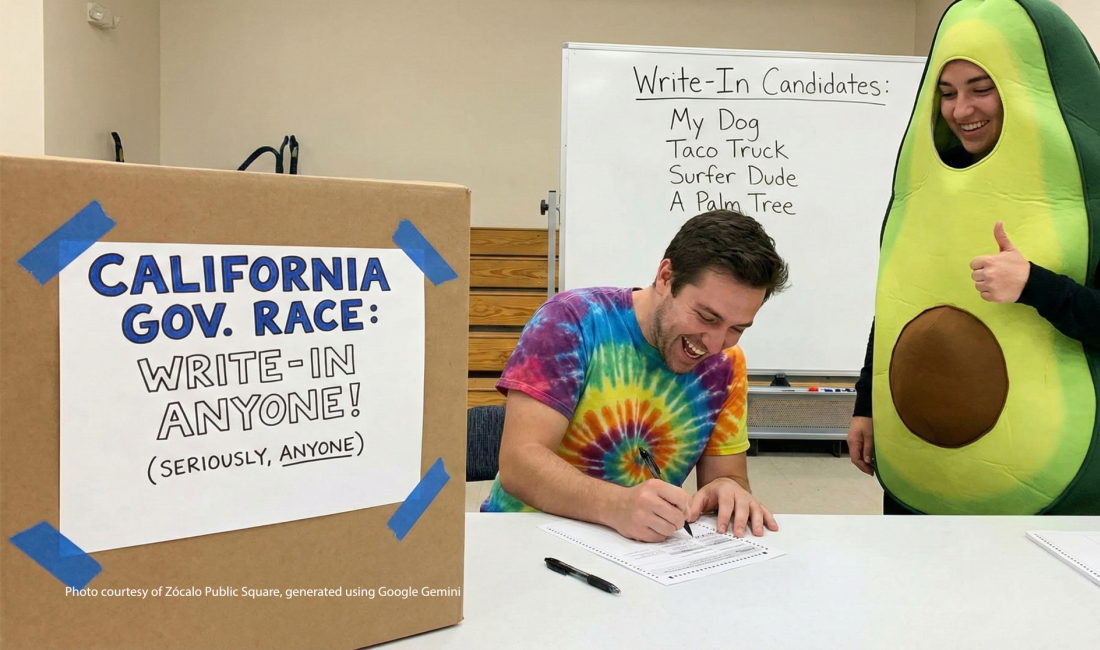
Allowing write-in candidates in the November election is the obvious solution. If the two Trumpists advance, Democrats and independents could back a write-in candidate as an alternative.
This isn’t a wild and crazy idea. More than 40 states permit write-in candidates in some form. California allows them for all elections other than November “general” elections. And, as noted by Ballot Access News, Washington state, the only other state with top-two primaries, has write-in space on all ballots.
All it would take to make this insurance policy a reality would be for Democrats in the legislature to introduce a bill and pass it with a very attainable two-thirds majority in both chambers—which would allow it to take effect immediately. Should the Republicans take the top two spots in June, I’d expect Democrats and independents to choose either a unifying figure (like Sen. Alex Padilla, who declined to join the governor’s race) or whichever Democrat places third as the write-in candidate in November.
Republicans would cry foul—they always do—but they’d be wrong. Write-in candidates exist precisely as insurance policies against election systems that produce perverse results. Take, for example, Alaska U.S. Sen. Lisa Murkowski, a moderate Republican who was her state’s most popular politician but lost the 2010 Republican primary to a right-winger. She ran as a write-in in November—and won the seat she still holds.
Democrats in the legislature shouldn’t be bashful about pushing for write-ins. After all, they just passed Prop 50, a partisan intervention that was also anti-democratic, since it used a gerrymander to limit the power of voters. Installing write-ins would also be a partisan intervention, but a more democratic one, since it increases voter choice.
Allowing write-ins would offer nice insurance for now. But a smarter long-term plan would be to eliminate the top-two system altogether. That would require a constitutional amendment and another vote of the people.
I should end the column here. But—sorry—I can’t resist adding one more (obnoxious but proud) personal note, aimed at Democrats and political elites starting to panic about the governor’s race.
I told you so. Your columnist has been the state’s loudest and loneliest critic of top-two since its beginnings, over 13 years ago. I warned that the system was full of risks. Now, it’s an existential threat to the state.
If we want to protect democracy, if we want all our votes to count, and if we want our government to be more representative, we must adopt a system of proportional representation, giving parties seats matching their percentage of the vote.
That would be an insurance policy even State Farm couldn’t cancel.