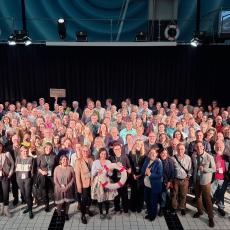
We are more than 150 people from five continents and over 30 countries. We are scholars, journalists, civil servants, and activists whose lives and work center on democracy.
We have met in Gaborone at the 13th Global Forum on Modern Direct Democracy.
We acknowledge the long way, great risks and difficulties some of us had to overcome to be here and take part in the discussion.
Over four days, we discussed direct, deliberative and participatory democracy at a forum that was free and open to anyone in the world who wished to attend. This is our declaration.
We meet in Botswana, where the tradition of the kgotla reminds us that democracy is not simply a system of government, but a living practice of gathering, listening, speaking and deciding together. Long before modern democratic institutions took their present form, communities across Africa and beyond developed their own ways of deliberating, resolving differences and governing collectively. There is value in removing our political colours and coming as we are.
We take with us its lessons:
-
Mafoko a kgotla a mantle otlhe, ebile mmualebe o bua la gagwe - All contributions to the discussion are welcome, and every opinion is valued.
-
Kgosi ke kgosi ka batho - a chief is a chief because of the people, or derives legitimacy from them.
-
Ntwa kgolo ke ya molomo - differences should be resolved through discussion rather than violence.
This tradition, and others like it across the globe, remind us that democracy does not have a single origin, nor does it have a single form. It must be rooted in the experiences, aspirations and realities of the people it serves.
Yet we gather at a time when democracy faces dark times. Around the world, democratic institutions are under attack and inequalities of wealth and power exclude more and more people from decisions that shape their lives. Climate change, the governance of natural resources and growing uncertainty about the future demand responses that are not only effective, but involve all affected.
We acknowledge the parallels between the colonialism that has seen sovereign corporate entities exploit the people of this continent and our current time in which large corporations dictate rules that exploit and damage human life across the world.
Our only defense is in real democracy. We recognise that elections alone are not enough. Democracy must reach beyond abstract and limited processes and into our communities, institutions and everyday lives. Real democracy means that people have the power to shape policies, to govern resources and to determine their collective future.
We also recognise that democracy cannot stand still. It must learn from its past, confront its shortcomings and continually renew itself. Indigenous traditions and modern democratic innovations are not opposing forces. Together, they can help us imagine institutions that are more inclusive, accountable and resilient.
Here in Africa, the world's youngest continent, we are reminded that democracy's future depends on the voices and leadership of young people. Decisions made today will shape generations to come. Those generations must have a meaningful say in the choices that determine their future.
We have discussed the rights of young people to shape the world they live in :
Youth involvement in direct democratic participation should not be optional, or simply encouraged or spoken about how important it is.
It needs to be built upon. It needs practical tools that facilitate the involvement of young people.
This is done via education, volunteering, in formal and non formal settings and NGO work that connects youth with political stakeholders and makes them the decision-makers.
Youth empowerment is built with transparency, accountability, dialogue and willingness to get involved and make a change in the community. Give the young a space to talk, to brainstorm and to find solutions themselves through a collaborative approach, because this is what we, as youth, need to feel heard and needed in a democratic society.
Youth and children should be given a chance to influence their local environment. Young people want to have a say in decisions related to the management of resources.
Youth have power though their opinions, voices, education. They need to be provided methods, clarity, and involvement.
We are calling on the world to stop treating young people as the leaders of tomorrow and start trusting us as the partners in shaping today. Because democracy is not truly alive until the people have a voice, choice and a say. If sovereignty belongs to the people, why should their voice stop at the ballot box?
On the right of every human being to live in a healthy environment and to govern the resources this planet offers us as commons
May Botswana’s experience remind the world that the wisdom of traditional communities is not a legacy of the past, but a compass for our shared future.
From the kgotla to community gatherings across the globe, may those closest to the land stand at the heart of the decisions that govern our resources, protect our planet, and shape our common democratic destiny.
On building strong institutions to make democracy more democratic, from the local level to the global
We believe that the best outcomes emerge when people are empowered to shape the decisions that affect them. We value collaboration over hierarchy, transparency over control, and collective learning over unquestioned authority. We recognise that no individual or institution holds all the answers, and that progress requires openness, accountability, and the willingness to challenge assumptions. Through continuous participation, feedback, and adaptation, we build systems that serve people, rather than expecting people to serve systems.
Today, purely representative systems are vulnerable to backsliding and lack of legitimacy. Enlarging political rights is, today as in the past, the right answer.
In particular we think that the right to initiate a legislative process and the right to vote laws should be enlarged to the whole citizenry. This enlargement of political rights has proven to produce high democratic stability and foster legitimacy.
Allowing citizens to initiate and vote constitutional amendments is the right way to institutionalise a stronger democracy in the long term.
A fundamental principle in democracy is to be able to express dissent. Voters should have the choice to vote either YES or NO in the election of candidates or decisions on substantive issues.
We want to have more instruments of deliberation and we support combinations between direct and deliberative democratic instruments.
We are paying attention to the increasing reach of artificial intelligence in the public sphere and its effect on the integrity of our democracy. AI can be helpful to assist democratic processes, but it should be monitored and the final decision should always be made by humans.
The United Nations serves as a government-to-government Forum. Yet real freedom, democracy and peace require that the people of the world have a Forum where they can communicate with each other. We cannot allow the world to be governed simply in the name of the people, it should be governed for the people.
This Global Forum was an important step toward such a people-to-people communication, but we will need many more steps towards democracy, freedom and peace - and these initiatives need support and funding.
In closing
Democracy is done by all of us, not individually or alone, but in cooperation - together. This togetherness needs to be supported and sustained: principally, procedurally and practically.
The 2026 Global Forum on Modern Direct Democracy is a practical example of such a cooperation geared to strengthening and protecting democracy at all levels. But we also offer model procedures to make democracy more democratic, through our organisations, networks and initiatives.
We call on the world to principally enshrine the common effort to support democracy, and specifically direct democracy in laws, constitutions and conventions. The Swiss constitutional obligation to support democracy around the world can work as an example for other countries and international organisations.
We recognise the need for stable financing to keep developing these forums, democratic support and the network.