For a generation of young people in Türkiye, democracy has never been something settled. It has been something negotiated, questioned and, at times, defended in the streets.
Born into an era of expanding executive authority, tightening media regulation and increasing pressure on civil society, today’s youth did not inherit democratic consolidation. They inherited democratic strain.
Yet they continue to organise.
The persistence of protest in Türkiye is not evidence of instability alone. It reflects adaptation. When formal pathways into political decision-making narrow, participation does not disappear. It, instead, evolves.
Growing Up in Democratic Backsliding
Over the past decade, Türkiye’s political trajectory has been widely described as democratic backsliding: the gradual weakening of institutional independence through legal and constitutional mechanisms.
The 2017 constitutional referendum marked a significant structural shift, transforming the country into a presidential system and expanding executive authority while reducing parliamentary oversight.
For young people, these changes were not abstract constitutional adjustments. They reshaped daily realities. Universities became more politically sensitive environments. Independent media space narrowed. Public assembly carried higher risks. Digital expression faced increased scrutiny.
Yet disengagement did not follow.
According to one academic observer, the youth response to political constraint must be understood psychologically as well as institutionally.
“Prior to Gezi, there was a pervasive sense of hopelessness among Turkish citizens, particularly young people,” he explains. “The belief that nothing could change created passivity.”
That perception, however, shifted in 2013.
Gezi: The Moment of Political Self-Recognition
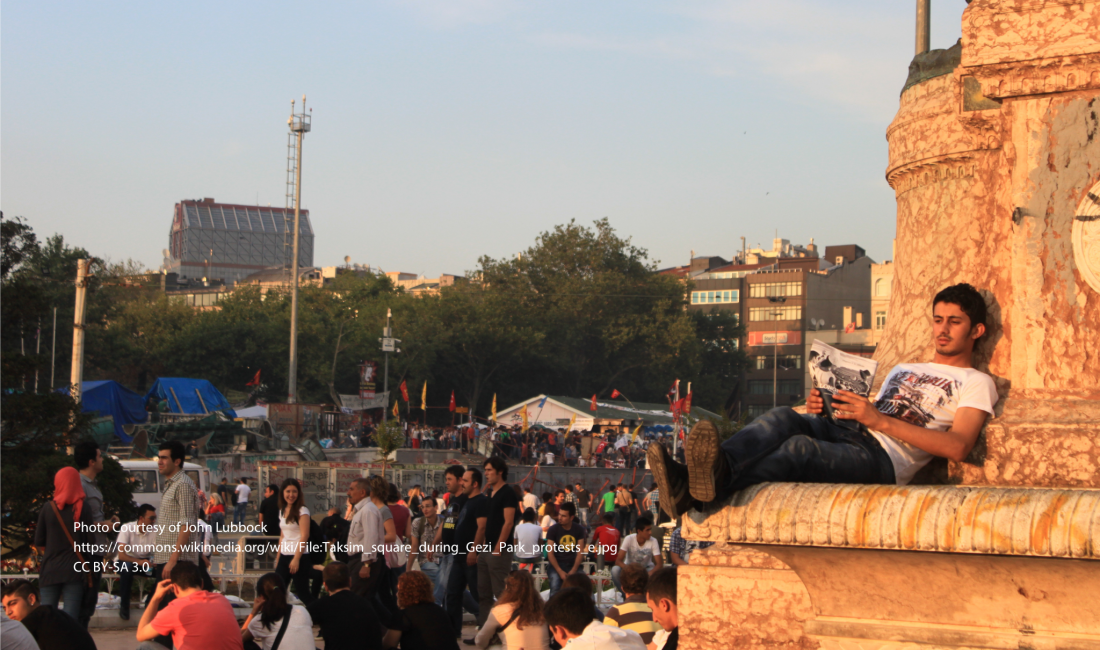
The Gezi Park protests began as a small environmental sit-in in central Istanbul. Within days, they escalated into nationwide mobilisation involving millions across the country. Participants represented diverse ideological and social backgrounds, united less by party alignment than by concerns about police violence, accountability and shrinking civic space.
For many young people, Gezi was formative.
“The Gezi movement shattered the perception of powerlessness,” he continues. “It demonstrated that collective action could have impact.”
Gezi did not produce a single political programme. It reintroduced agency.
Dr Halil Ecer, youth policy expert and head of the Capital Youth Assembly in Ankara, describes the protests as a turning point in youth political awareness.
“Young people, previously politically passive, found a space to act. It gave them confidence to re-enter public life.”
The protests also exposed social divisions. University campuses became polarised spaces. Protesters faced stigmatisation from some quarters, while others criticised those who abstained. Participation became identity.
But the more enduring outcome was generational. Young people began to see themselves as political actors rather than observers.
Repression and Adaptation
Following Gezi, and particularly after the failed coup attempt in 2016, restrictions on civil society intensified. More than 160,000 public employees were dismissed under emergency decrees. Numerous NGOs and media outlets were closed. High-profile civil society figures, including Osman Kavala, remain imprisoned.
Civic engagement did not disappear. It adjusted.
“What emerged post-Gezi was a new wave of decentralised activism,” he explains. “Neighbourhood forums, citizen journalism, online campaigns. People adapted.”
Rather than relying solely on large-scale demonstrations, youth increasingly turned to dispersed, network-based forms of participation. Digital platforms became critical tools.
Street interviews conducted by independent content creators now capture public sentiment in ways that bypass traditional media structures. Satire circulates rapidly online. Humour has become both coping mechanism and political commentary.
“Young people are highly adaptive,” he adds. “When formal structures narrow, they find alternative formats.”
Institutional Pathways: The Capital Youth Assembly
Alongside decentralised activism, structured youth engagement has developed in specific local contexts.
The Capital Youth Assembly, based in Ankara, describes itself as a non-partisan youth empowerment platform designed to include young people in local decision-making processes. According to its organisers, it connects a network of more than 10,000 young participants from diverse ideological and cultural backgrounds.
“We created a structure that works with young people for the youth,” Ecer explains, “so that young people are not shaped solely by political polarisation.”
Through initiatives such as “Youth-Friendly Elections”, which offers political guidance to young candidates across party lines, and the “Youth Corridor for Participatory Democracy” model, the Assembly states that it prepares young people to engage in neighbourhood, university and municipal governance processes.
Ecer argues that youth participation can soften entrenched divisions:
“With the political participation of young people, the level of polarisation can decrease in both the political and social spheres.”
He also notes that youth technological literacy reshapes institutional interaction. As younger generations bring digital fluency into political spaces, traditional actors are compelled to adapt.
In this sense, participation is not only about voice. It is about negotiation between generations.
Global Context, Local Agency
Ecer situates youth activism within a broader global environment where democratic strain is visible across regions. While methods differ, he argues that young people are more interconnected than ever before.
“Young people living all over the world have more common demands and goals than at any other time,” he observes.
Digital ecosystems enable the rapid exchange of ideas. Even where internet regulation increases, cross-border interaction continues. Youth adapt global models to local contexts, translating international debates into domestic action.
At the same time, uncertainty shapes political consciousness.
“Today’s youth do not feel safe like previous generations,” Ecer explains. “They question the democratic legacy they are meant to inherit.”
Economic instability, regional conflict and global volatility reinforce this sense of fragility. The future feels less predictable than it once did. Yet uncertainty does not eliminate engagement. It reframes it.
Persistence Without Illusion
Recent protests surrounding economic pressures, university governance and judicial decisions, including the 2022 conviction and political ban issued against Istanbul Mayor Ekrem İmamoğlu, which remains under appeal, reflect continued mobilisation. Pride events and LGBTQI+ gatherings have also faced bans and detentions in recent years.
Participation persists, but under pressure.
If Gezi was the spark, today’s activism is not nostalgia for 2013. It is continuity under constraint.
Young people in Türkiye navigate limits strategically. They blend formal engagement with informal digital expression. They build networks across ideological lines while remaining conscious of risk.
The narrative of youth apathy does not hold in this context.
The more relevant question is whether institutions are prepared to respond meaningfully to sustained youth engagement before participation is pushed further outside formal democratic channels.
In a global climate where democratic backsliding is increasingly discussed across continents, Türkiye offers a complex lesson. Institutional erosion does not automatically extinguish civic agency.
From Gezi to today, a generation continues to participate. Not always loudly. Not without caution. But persistently.
And in constrained political environments, persistence is not minor. It is structural.