Answers questions on costs, transition, other changes from a council expansion
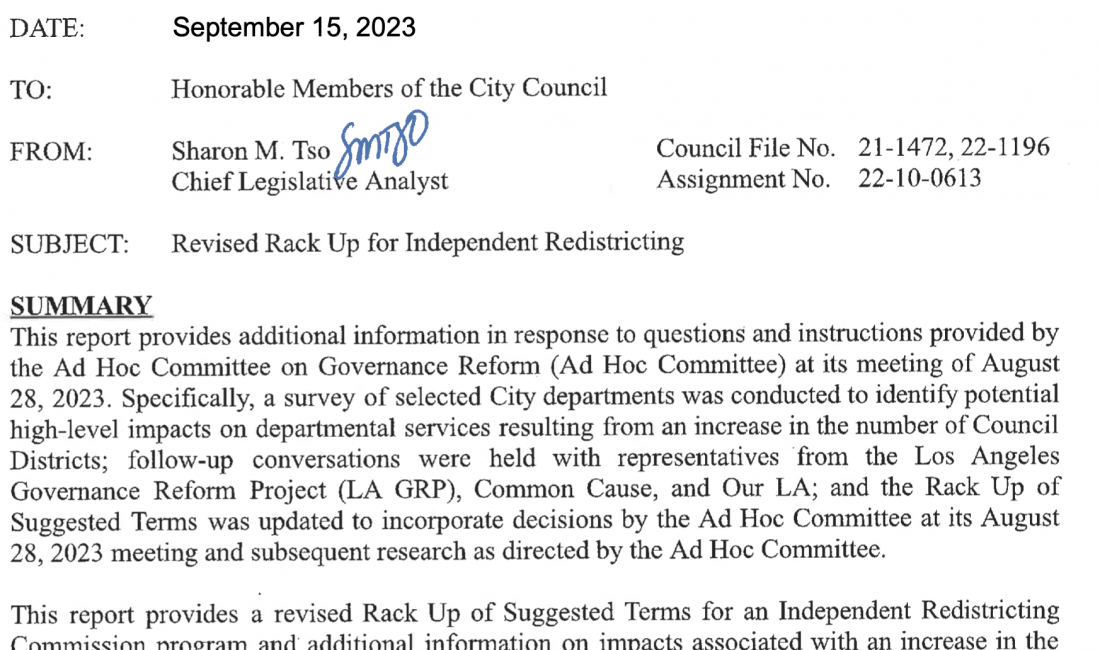
Below is from September 2023 city report, from the city’s Chief Legislative Analyst to the City Clerk, examining the possibility of increasing the number of council districts as part of a creating a redistricting commission. In this process, the redistricting commission was created but the number of districts was not expanded.
CHANGE THE NUMBER OF CITY COUNCIL DISTRICTS
Motion (O'Farrell - Raman, Krekorian, Price, Koretz, C.F. 22-1196) initiated consideration of a Charter amendment to increase the number of Council Districts. Since the redistricting process requires a determination of the number of Council Districts that will be drawn, this Motion has been included in this report to ensure the issues are addressed concurrently. The March 2023 CLA Report includes background information on the history of the size of the Council as well as identification of issues associated with increasing the size of the City Council. Discussions in the Ad Hoc Committee have focused on options to increase the number of Council Districts by a fixed number, to between 21 and 31 Districts. The Ad Hoc Committee also instructed the CLA tofurther examine impacts on departmental operations and services associated with an increase.
Designated Number of Council Districts
The Ad Hoc Committee expressed a preference for increasing the number of Council Districts to a specific number, and instructed the CLA to provide additional analysis of impacts associated with an increase ranging from 21 to 31 Council Districts. Past efforts to increase the Council's size used this approach. For example, in 1925 the Council increased from nine members to 15 members in an effort to enhance representation for the City's growing constituency at the time.
Similarly, during the 1999 Charter Reform movement, there were two ballot measures that proposed to increase the size of the City Council to either 21 or 25 members; however, these measures did not pass.
At the Council's current size of 15 members, each Councilmember represents approximately 264,885 residents. Should the City choose to increase the size of the Council by a specific number, the share of residents that are represented per district would decrease. For example, if the City used the proposal from 1999 to increase the size of the Council to 21 or 25 members, each member would represent approximately 189,204 residents and 158,931 residents, respectively (Figure 1). In this example, increasing the Council to 21 or 25 members would bring the number of residents represented per district in Los Angeles in closer parity to the amount of residents represented per district in other major U.S. cities, such as New York City (172,631 residents) and San Diego (153,991 residents).
Cost Impacts Related to Increased Council Districts
The funding available to Council Districts is a budgetary decision made by the Mayor and the Council each year. This would remain the case if the number of Council Districts increased. The budgetary decisions would depend on several factors, including but not limited to, the number of Councilmembers, size of their staff, office space, and office expenses.
It should be noted that the cost of expanding the size of the Council could vary widely depending on whether the Council decides to redistribute its existing allocation of funds equally amongst the new members, or to appropriate additional funds. Decisions related to how the funds would be allocated for an expanded Council would significantly impact the level of staffing within the Council Offices. For example, if the Council chose to redistribute its existing allocation of funds, the amount of staff in each office would need to be reduced due to reduced funding. So while each Councilmember would represent fewer residents with the intention of providing a higher level of service, the allocation of limited resources may ultimately result in a negative impact on service levels. It should also be noted that Councilmember compensation is established by the Charter.
In addition to the operational cost for each Council Office, the incidental costs associated with creating a new Council Office are a factor that should be considered. These incidental costs include City Hall office space and field offices, fleet cost for transportation, security, computers and information technology, and costs associated with modifications to the Council Chambers to accommodate additional members. Alternatively, a new location could be established to accommodate an increase in the number of Councilmembers.
For 2023-24, each Council Office has been allocated approximately $2.1M for the annual operating budget which includes salaries and office expenses. Should the number of Council Districts increase and the overall Council budget remain relatively the same (approximately $31.5M in 2023-24), funds would be divided according to the number of districts, decreasing each office's share of operating funds. Additional funding would be required if the amount per Council Office remains intact, with the increased amount dependent on the number of additional Council Districts.
Special funds include Charter Bus allocations ($52,500 per Council District), Real Property and Pipeline (vary per Council District), Street Furniture, and AB 1290 (amounts dependent on the location of former-Community Redevelopment Agency project areas) funds. Each Council Office administers these discretionary funds throughout the fiscal year.
For some discretionary funds, a policy decision would need to be made to redistribute the existing amounts or provide new allocations for additional Councilmembers.
Aside from the cost impacts associated with the Council itself, an expanded City Council would also affect City departments that support the Council with their day-to-day operations. These departments may include, but are not limited to, the City Clerk, General Services, Information Technology Agency, Public Works Bureaus, Planning Department, City Administrative Officer,and the Chief Legislative Analyst. Increasing the staffing for City Departments along with the Council would help ensure that the Council's requests continue to be addressed in a timely manner.
Departmental Impacts
The CLA conducted a limited survey (due to time constraints) of selected City departments to identify potential impacts on their operations, including administrative impacts and program and service impacts. Departments contacted provided an initial, high level response. It is anticipated that additional impacts could be identified with a more complete survey. The following provides an overview of issues identified by surveyed departments, as well as some impacts specific to individual departments.
Response to Council Requests
All departments surveyed commented that an increase in the number of Council Districts would result in an increase in the number of requests from Council Offices for services. There would an increase in responses to requests to assist in the preparation of Motions and that there would be an increase in the number of written and verbal reports to Council and its Committees. An increased number of Council Districts would increase work associated with project management and reduce efficiencies as the number of projects to coordinate within a single Council District would diminish, being distributed among more Council Districts. Departments noted that they meet often with Council staff, including field staff, and that the number of such meetings would increase.
Special Funds, Discretionary Funds
\Departments commented that Special Funds, Discretionary Funds, and other types of funds would be distributed differently and could limit and delay the ability to fully fund projects. Federal funds allocated through the Consolidated Plan, for example, would be shared among more Districts, thereby reducing the amount of funding available for any single project. A similar result would be encountered with Quimby Funds. As a result, it may take longer to achieve full funding for park improvements, transit and street projects, and other facility improvements unless different allocation policies are developed.
Specific Departmental Impacts
Among the departments contacted, the following department-specific issues were identified.
• The Ethics Commission reports that they will require additional staff to process filings associated with elections related to campaign finance, matching funds, and independent spenders. With more Council Districts, there will be more candidates for office.
• The CAO reports that providing additional offices for six to 16 new Council Offices in City Hall could result in the relocation of other departments currently located in City Hall, with associated costs for obtaining real estate, building out offices, and moving.
• The Information Technology Agency (ITA) noted a number of impacts that would result from Council expansion. These include: increased costs for hardware, software, and annual software subscription costs; one-time infrastructure costs resulting from thereconfiguration of Council Chambers at City Hall and Van Nuys to accommodate more members; new equipment and connectivity for Committee rooms; and internet costs for new field offices. In addition, ITA noted they would require additional staff and equipment for desktop support, network support, voice network services support, server infrastructure support, staff for application and website development and support, and for Council audio. ITA also noted that there may be impacts to Channel 35 resulting from. increased requests for programming and support.
• The General Services Department (GSD) indicated that additional funding would be required for leases for Council District field offices. Currently, there are significant variables in cost, such as size and location, or if the field office is in a City-ownedfacility. However, the average annual cost for rent and custodial services for a field office is approximately $150,000. It should be noted that if Council is expanded, it may be difficult for GSD to identify suitable space and negotiate leases for multiple field offices at the same time with current staffing.
GSD also indicated that the City spends approximately $425,000 per each Council office on vehicles. This is a one-time cost that includes a vehicle for the elected member and seven staff members; however, replacement costs will be incurred in future years as vehicles meet and/or exceed their useful life.
• The City Clerk indicated that additional funding would be needed for Legislative Assistants to staff City Council and Committee meetings, as well as additional staff to assist with public services and the administrative needs of the Council, such as contract processing, accounting, payroll, and personnel administration. Furthermore, with an increased Council, the City Clerk would also need increased funding for elections staff and related expenses due to additional Council races, as well as funding for costs stemming from the County's administration of City elections.
• For the CLA specifically, a Council District expansion would result in the need for additional legislative analysts, management, and administrative support staff, as well as an increase in the number of photographers and calligraphers.
Non-fiscal Legislative Impacts
An increase in the number of Councilmembers will likely result in changes to Council operations, organization, and deliberations.
As noted in the March 2023 CLA report, increasing the size of the Council would increase the number of members required to meet quorum of a meeting, as well as the number of votes required to make a majority or supermajority decision. Additionally, a higher threshold would be set to override a Mayoral veto. This could slow or hinder the passage of legislation or policy, as well as shift the balance of authority toward the executive branch. Voting thresholds to maintain the balance of authority and to address logistical issues should be considered as part of this process.
With a larger Council, the deliberation of issues may change relative to the size of the increase. With more Councilmembers, this could result in limits to the amount of time that may be available to each member to raise questions and debate issues on the agenda.
The Charter currently requires that every member of the Council be assigned to at least one Council Committee. With an increase in the number of Council Districts, several adjustments would be required to the Committee structure as well as changes to the deliberative process.
Conclusion Determination of the number of Council Districts to be presented in a ballot measure is a policy matter for Council that is informed by the purpose of such a change and alternatives that may be available to address that purpose, as well as the manner in which services are provided to residents and businesses. Funding decisions by the Council and Mayor would determine the services that could be offered by the Council Offices. Further, City departments have indicated\ that there are one-time, ongoing, and recurring costs that would result from an increase in the number of Council Districts.
Transition Elections
One of the main issues with an increase in the number of Council Districts is how elections would be conducted to transition to a higher number of districts. The 1999 Charter Reform proposal included Charter Section 120, provided below, which addressed an increase in the number of Council Districts and impacts on term limits:
If Section 241 of this Charter concerning Council size is amended through approval by the voters of a separate ballot measure at the same election at which this Charter appears on the ballot, Section 204(g) shall read as follows, rather than as stated in Section 204(g)
in Article II of this Charter: "(g) Effective Date of Redistricting; Terms. The Council members elected in the election held in 2001 shall serve two-year terms. The Council districts adopted by ordinance in 2002 shall first become effective beginning with the election held in 2003, at which time, the entire Council shall be elected. The Council members elected in 2003 from the even-numbered districts shall initially serve two-year terms and the members elected in 2003 from odd-numbered districts shall serve four-year terms. Members of the Council elected in 2005 from the even-numbered districts shall serve four-year terms, and thereafter all Council members shall serve four-year terms.
The two-year terms contained in this section shall not constitute a term of office for purposes of the term limits contained in Section 206 unless a member serves two two-year terms or the member has served two terms of office prior to initiation of the
two-year term."
Two measures to increase the number of Council Districts were presented to voters in 1999 concurrently with Charter Reform. Both measures failed: the measure for 21 Council Districts received 80,937 aye votes (37 percent) and 140,542 noe votes (63 percent); the measure for 25 Council Districts received 77,638 ayes (35 percent) and 146,617 noe votes (65 percent). Since the voters did not approve an increase in the number of Council Districts, this section was notactivated.
During discussion in the Ad Hoc Committee, questions were raised about the New York City election model, which incorporates two-year terms every 20 years. In addition, proposals were presented to implement a six-year transition term as an alternative to the two-year transition term. The following addresses these questions.
New York Model
New York City Council members serve four-year terms. But since 2001, the City of New York has incorporated a requirement that City Council candidates run for two consecutive two-year terms every 20 years. This periodic adjustment to the length of their Councilmembers' terms every two decades is intended to better align elections with new district boundaries following aredistricting cycle, and allow for candidates to run for districts under the newly drawn district lines. Although redistricting occurs every 10 years, the two-year term provision in New York applies every 20 years because it better coincides with the election cycles. If a candidate runs and serves for both of the two-year terms, the sum of both terms is considered to be equivalent to a single four-year term with regard to term-limit provisions. Following the two consecutive two-year terms, elections return to the four-year term cycle. Note that all 51 City Council offices are on the ballot at the same time when Council Offices elections are held.
When this provision was first proposed by the New York City Charter Revision Commission, the intent was to ensure that constituents would not be living "out of proportion" in districts for an additional two years following a redistricting cycle. The two-year term aligns both timing of both the election cycle and the redistricting cycle and gives candidates the opportunity to run for districts with newly drawn boundaries, which allows them to provide direct representation to the constituents in their new Council Districts.
In the context of the City of Los Angeles, the concept of a one-time adjustment with two-year terms could help address the complications associated with transitioning to a higher number of Council Districts, including alignment of communities of interest and District numbering.
Additionally, incorporating a two-year term helps preserve the City's current electoral structure of a staggered election cycle. A two-year term also allows communities to more immediately elect candidates that are representative of their new district boundaries following a redistricting cycle, which prevents them from being represented by a Councilmember from a previous= election cycle based on the former district boundaries.
Because the City has a staggered election cycle for Council Districts and City elections are held concurrently with State elections, the New York model would not be an ideal fit. Some form of periodic two-year elections could be implemented, but it would be similar to the Transition Plan described below rather than the model used in New York.
Transition Plan
If the voters approve a measure to increase the number of Council Districts, a transition plan is needed to effectuate the adjustment such as Charter Section 120. Expansion is proposed to be effective in 2032, at which time all Council Districts would appear on the ballot. Charter Reform in 1999 included a provision that there would be 2-year terms for both even and odd number districts so that al Council Districts would appear on the same ballot in 2001. A similar method was proposed by Common Cause in their presentation to the Ad Hoc Committee on August 28, 2023. During consideration of the matter, an alternative proposal was introduced to consider 6-year transition terms instead of 2-year transition terms....