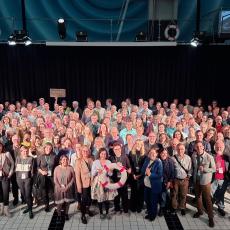
Stephen Erickson’s Responses to Questions Asked at the March 1 Meeting of the Los Angeles Charter Review Commission’s Citizen Assembly
Q1: What city is similar to economic resources as LA, and what is the structure of their city council? (Trillion dollar economy, rail hub transferring billion, ports, entertainment complex, aerospace & defense manufacturing)
Copenhagen might be a little like LA, though not as big; it is a port, and features hi tech and education. Cape Town is more equal in size to LA and faces social issues like LA. I am not an expert on the economies of global cities, and I have only studied the most democratic models. Many cities globally are run with top-down political structures. I am trying to show that there is another way, and that in fact some of the most successful cities are also the most democratic. That, I believe, is no accident.
Q2 for Stephen: What are subsidiarity and deliberative democracy?
“Deliberative democracy” is what you at the LA Citizens Assembly are doing. It’s when a representative group of people is chosen by lottery to deliberate and decide something. Personally, I favor using deliberative democracy when elected representatives have inherent conflicts of interests, like when it comes to setting their own financial\ compensation or in the hiring of election officials and supervising elections. I think it also can be used, with careful planning, to create a new city charter. Ask AI how Iceland tried to create a new Constitution. That process was not perfect, but it suggests the way forward.
“Subsidiarity” is when power, resources and/or administration is devolved into sub-regions of the city, like boroughs. This practice is normal in many successful global cities. Each of Berlin’s city boroughs, for example, has its own sub-mayor and council. Subsidiarity means bringing government as close to the people it is supposed to serve as is practical.
Question for both: What best practices can we glean from cities with larger city councils as far as retaining agility with decision making?
The only time that “agility” should be wanted is in an emergency situation. In that case, temporary powers can be given to a mayor, assuming those powers do not currently exist. Dictatorship and small groups of people can be agile, but they seldom make wise decisions
that are in the interest of the broad community
.
Switzerland is arguably the most successful nation in the world. It is top ten across a broad range of livability metrics, yet its government is the most democratic and slow of any nation on earth. Just to get a bike path between two cantons requires a constitutional amendment, which is very laborious. Counterintuitively, “unwieldiness” in democratic government is not a bug; it’s a feature. Slowness in democracy usually means that a decision has been thoroughly considered and debated before a policy is enacted.
I recommend a book called The Wisdom of Crowds, which shows how large groups usually make better decisions than small ones, and always do over time.
Another question for Stephen: How can we actually go about implementing change in our governing bodies with regard to getting money our of politics because it is in my opinion the main factor underpinning corruption and a lack of ethics within our governing bodies..
Thank you! You are absolutely right and this is a great question!
Currently, your city councilors are known to spend as much as $2 million (including outside spending on the candidate’s behalf) on a single political campaign. Obviously, most of this money comes from special interests, like developers, who as you say, corrupt city government. In fact, the system looks much like institutionalized bribery and extortion.
Adding a few seats to your city council will do nothing to change this corrupt system. So what if elections now cost $1.5 million instead of $2 million because 19 districts are a little smaller each than 15? What will have been accomplished? You will have created opportunities for a few more career politicians. That is all.
But now imagine that you increase the city council to 200 everyday citizens, who would serve part time and keep their day jobs. That would mean electoral districts that are nearly neighborhood-sized, and that could be walked on foot. It would mean that elections could be won with inexpensive fliers, yard signs and shoe leathers. So, what might the cost be? Maybe 10K? Or even less.
In such a neighborhood setting, elections are more about reputations and relationships, instead of money and marketing. It changes everything. Your 200-member city council can appoint an executive committee, that would be full-time (consider term limits for this group). The Executive Committee would oversee the government. This is how many successful foreign cities operate.
Your 200-member council, formed into small committees, would provide resident- oversight of city government like never before.
If you have not done so, please check out my article in the National Civic Review, which features many of the issues raised here and focuses on the LA city council. Please do not underestimate your own power as an assembly. You can recommend a continuation of the current system, by adding a few seats to the LA City Council, or you can demand change.
Good luck!
Respectfully,
Stephen Erickson
603-502-4861