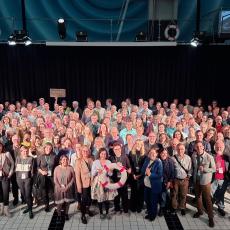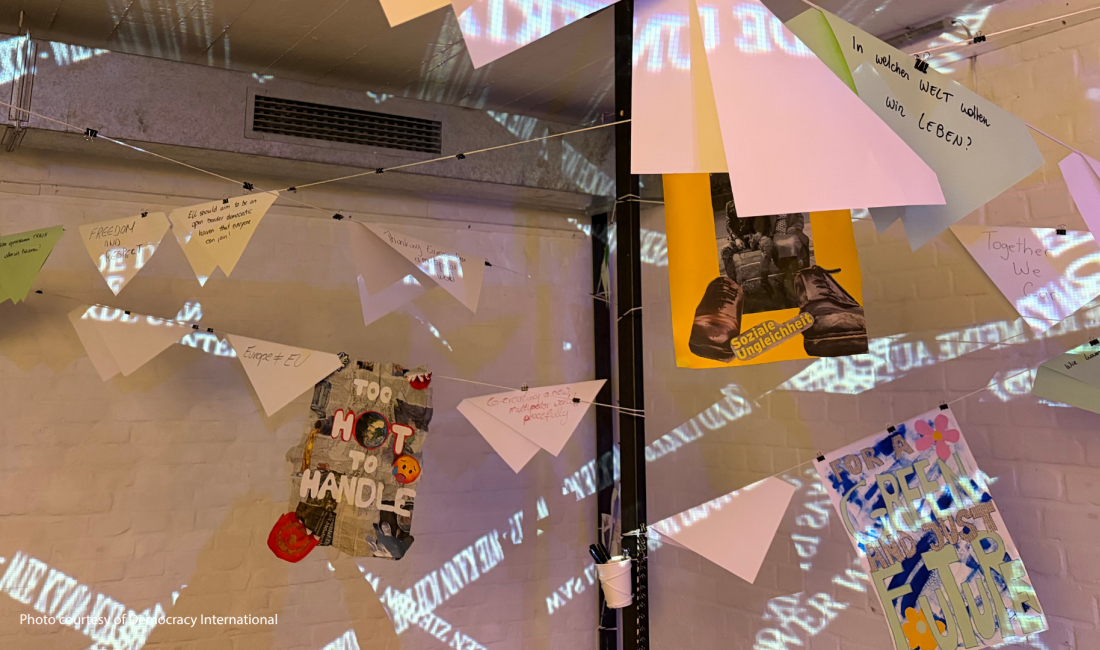
From 15 to 19 April 2026, we brought together 137 participants, including guests from ten countries, at the Kulturbunker Köln-Mülheim for LichtLabor Demokratie: Europas Rolle in der Welt.
This was not just the closing event of EU for Global. It was our attempt to move beyond summarising a project — and instead create a space where its ideas could be experienced.
From 665 voices to one shared question
LichtLabor Demokratie marked the closing moment of the EU for Global project, which engaged 665 citizens across eight EU Member States - Germany, Romania, Malta, Greece, Denmark, Spain, Latvia and Bulgaria - through sixteen Citizens’ Panels.
Across these panels, participants grappled with fundamental and often difficult questions: What does the European Union stand for? Who gets to shape it? And what responsibility does it carry in a world marked by conflict, inequality and democratic backsliding?
It is not lost on us that, over the course of this project, these questions have only become more urgent. Continued attacks on multilateralism, the rule of law and the rules-based international order have increasingly become part of the political landscape. Against this backdrop, the role of the EU as a global actor is no longer an abstract debat, it is a lived concern.
Despite the diversity of contexts and theme, from migration and climate to disinformation, justice and youth participation, a clear message emerged: citizens expect a more inclusive, participatory and values-driven European Union, both at home and on the global stage.
Travelling across the Union over the past years, we have seen how strongly people feel connected to the European project. There is a clear belief that the EU stands for something - for human rights, for cooperation, for democracy - but also a sense that these values must be more consistently protected and more visibly represented by its institutions and leaders.
Citizens are stepping up. They believe in collaboration between states, and they believe in participation. But they are also clear in their expectations: decision-making must become more accessible, more responsive to the speed and complexity of global challenges, and more meaningfully open to those it affects.
They called for an EU that defends human rights consistently, strengthens democratic participation, invests in education and civic engagement, and builds fairer partnerships beyond its borders. Above all, they asked for a Union that not only speaks about values, but lives them.
Beyond reports: creating an experience
Faced with the breadth of these recommendations, we made a deliberate choice: not to conclude with a traditional presentation of findings.
Instead, LichtLabor Demokratie set out to answer a different question - how can people feel these ideas?
Together with artist Edda Dietrich, we translated the themes of the project into an immersive light and sound installation. Dietrich’s work, shaped by her background in journalism and her artistic practice, operates at the intersection of political education and public discourse. Her installations, shown in places such as Hambach Castle and silent green in Berlin, are designed to make democratic questions tangible, to create spaces where people can encounter them not just intellectually, but physically and emotionally.
In Cologne, this became a participatory exhibition space that evolved over time. Visitors did not simply walk through the installation, they interacted with it, contributed to it, and saw their perspectives reflected back. The space functioned as a laboratory in the truest sense: open, unfinished and shaped by those who entered it. Workshops created shared moments of reflection, while the open exhibition allowed for continuous engagement.
This shift, from explanation to experience, was essential for us. If democracy is, as Dietrich describes it, a process through which we negotiate how we live together, then it needs spaces where that negotiation can be felt.
Working through complexity together
The workshops became the place where this experience was tested, challenged and extended.
Rather than presenting conclusions, we invited participants to work through some of the most pressing tensions that had emerged from the Citizens’ Panels. In a session together with the association Timcheh, participants mapped how global narratives are constructed, tracing the connections between actors, interests and information flows. What initially appeared as isolated news stories quickly revealed themselves as part of complex systems, shaped by power, perspective and omission. The process made visible what is often hidden, and opened up a conversation about how democracy can function in an environment shaped by disinformation and competing narratives.
In another space, the question shifted from analysis to agency. Under guidance of illustrator Maren Trey, participants were invited to imagine themselves in positions of power and to translate their priorities into visual campaign messages. Through drawing, collage and design, abstract political ideas became concrete statements. What emerged was not just creativity, but clarity, a sense that participation becomes meaningful when people can articulate what they stand for and how they want to be heard.
At the same time, other formats created room for more personal and emotional engagement. Through poetry and discussion, participants- particularly younger voices - reflected on their place in democracy, on questions of belonging, representation and voice. These conversations underscored something we had seen throughout the project: that participation is not only about access to institutions, but also about feeling recognised within them.
As the discussions moved towards implementation, a recurring pattern began to emerge. When asked how their ideas could carry forward, participants often turned to examples they already knew: participatory instruments within the EU, spaces where citizens can organise, propose and influence decision-making. From there, the leap to the global level felt less abstract than expected. If these tools can exist in one political system, why not in others?
In a session focused on moving from recommendations to action, this line of thinking unfolded more clearly. Participants explored how their proposals could travel — from local contexts to European processes, and further into global spaces. Ideas such as citizen assemblies or more representative parliamentary structures at the international level did not appear as distant or utopian, but as extensions of existing practices. In this sense, calls for a more democratic United
Nations did not emerge as a separate demand, but as a logical continuation of the belief that participation should not stop at borders.
Across all these moments, one thing became clear again: people are ready to engage locally, Europeanly and globally, but they expect structures to meet them halfway.
An open laboratory for democracy
Throughout the week, the exhibition space remained open, not as a finished product, but as an evolving process. Messages from visitors were continuously integrated, allowing the installation to grow and shift over time.
This openness reflects what we have learned across EU for Global: democracy cannot be reduced to a single format. It needs structured deliberation, but it also needs spaces that are accessible, experimental and responsive to how people actually engage.
There is also a growing expectation that the EU, as a unique democratic project, should take this further. Citizens recognise the progress that has been made in opening up decision-making, but they are asking for more ambitious steps, and for the EU to actively share and defend participatory tools in the international arena.
What remains
The Citizens’ Panels made one thing clear: people want to be involved in shaping Europe’s role in the world meaningfully. They want participation, accountability and a consistent commitment to democratic values .
LichtLabor Demokratie did not attempt to resolve these demands. Instead, it made them tangible and, in doing so, pointed to what comes next.
If the past years have shown anything, it is that citizens across Europe are ready to take responsibility for the future of the Union. They are already doing so. The question is whether institutions and leaders are ready to match that commitment.
For us, this is the lasting insight of the project: democracy must not only be discussed or designed, it must be lived, shared and continuously renegotiated.