'Recyclables for Rice" Offers Food Security, Cleaner Neighborhoods, and a Better Environment
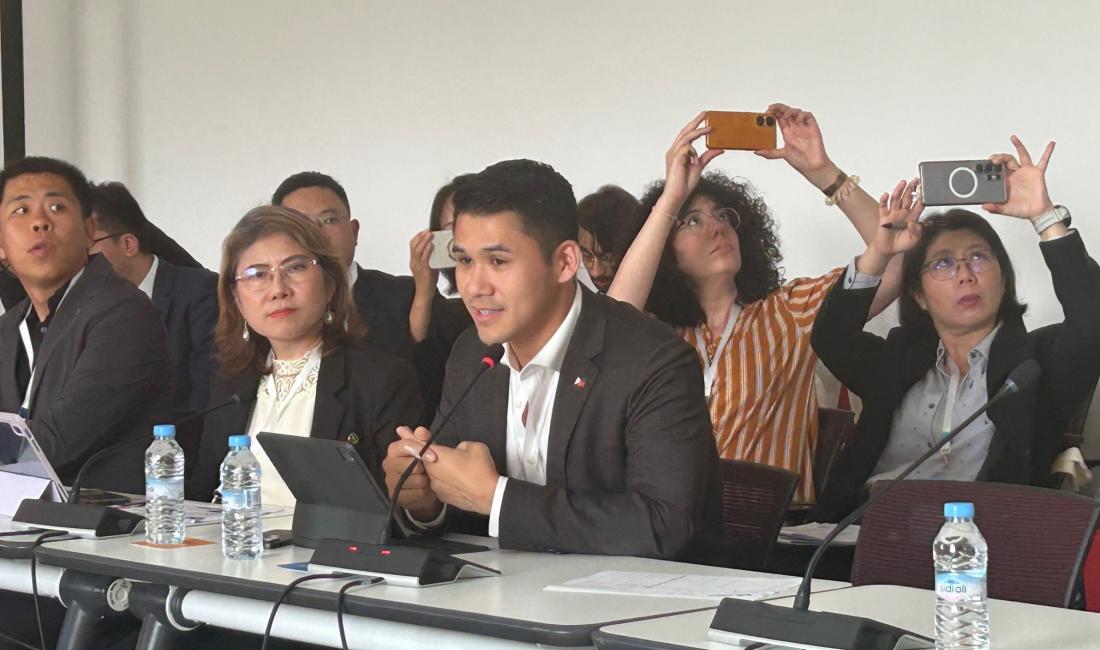
Photo by Joe Mathews
This is a lightly edited version of a talk given by Mayor Faustino “Inno” Dy V, of Echauge, Philippines at the United Cities and Local Governments World Congress in Tangier, Morocco. Mayor Dy is also president of the Philippines League of Municipalities.
Good day, everyone. I represent a municipality in the Philippines. Like all local governments in our country, we are mandated to implement Republic Act 9003: The Ecological Solid Waste Management Act.
Today, I want to discuss how we can use community-driven science and innovation to tackle a challenge that is common to cities all over the world: solid waste management. As local leaders, we know that setting up an efficient garbage collection system is incredibly costly due to logistical hurdles. Furthermore, securing consistent community participation is very difficult; it is a massive challenge to convince households to properly segregate their daily food waste from recyclables.
Faced with limited municipal budgets and the challenge of changing public behavior, we knew we had to come up with an innovative, creative program to incentivize recycling.
Our response was to implement a decentralized, community-based market system. We created the “Recyclables for Rice” program (Bigas Palit Basura).
Under this initiative, community members can bring their sorted recyclables—such as plastic bottles, glass, and cardboard—and exchange them for a corresponding allocation of rice. This program does two vital things at once. It directly addresses food security and inflation by providing a staple food to families. It cleans up our environment by putting a tangible economic value on recyclable waste.
To ensure the long-term sustainability of this vision, we have integrated this program into our local school system. We launched an inter-school recycling competition across all public elementary and high schools in the municipality. By engaging students, our ultimate goal is to make every household and community member an active partner in our green vision, embedding environmental consciousness into the next generation.
Why does localized cooperation matter so much for a program like this? It is because an initiative of this scale cannot succeed without being driven at the barangay (neighborhood) level. The closer you are to the grassroots local government units, the more effectively you can monitor and sustain the program.
Secondly, we have extended this program into a model for inter-municipal cooperation. Many neighboring towns and smaller local government units face a massive hurdle: they are required by law to have proper waste disposal, but they either cannot afford a sanitary landfill or simply do not have the physical space to build one.
To solve this, we have partnered with our neighboring municipalities to share regional infrastructure and recycling machinery. We actively involve civil society, women’s groups, and local schools to oversee and drive these programs forward.
Moving forward, our intention is to share these best practices across our entire network of municipal leaders…. We hope to adopt and scale these localized, zero-waste solid waste management frameworks across more territories in the coming year.
By working together, sharing infrastructure, and incentivizing our citizens, we can turn a costly environmental burden into a powerful tool for community development.