'Peace Is Built at the Level of Government Closest to the People'
Photo by Joe Mathews
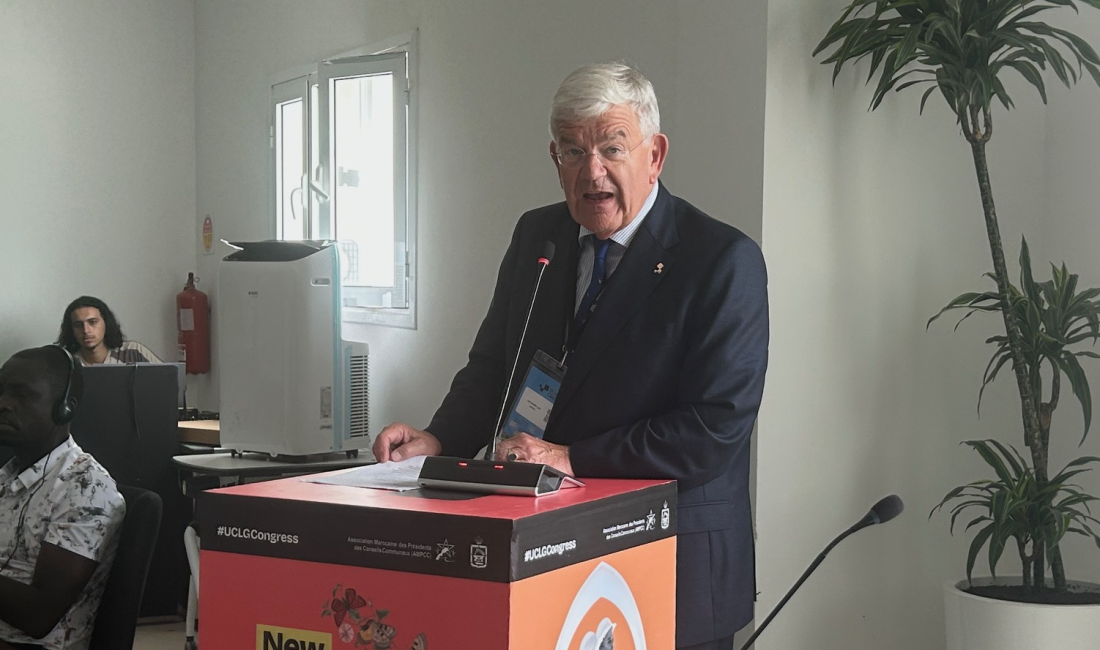
This is a lightly edited version of a short talk that Mayor Jan Van Zanen of The Hague gave during a panel discussion on the roles of local governments in peacemaking during the United Cities and Local Governments World Congress.
Years ago, when I was first starting out and traveling to work with international teams, my uncle asked me, "What are you doing? What exactly is your job?" To this day, I still truly, deeply love this work. That is why I am here, and that is why I support this initiative to develop peace, foster exchange, and build the willingness of communities to grow. As the leadership of global and regional governments gathers here, let us speak plainly: we do so in a time of global crisis. COVID-19 and ongoing violence continue to affect communities worldwide in all shapes and sizes. The sheer diversity of the challenges we face has presented local authorities with a massive global test.
But within this adversity, we also find strength. We find it in the millions of inhabitants who make up our great cities, as well as in our smaller communities.
As local leaders, we must deliver a powerful message of reassurance to our communities on a daily basis. Local and regional governments are the ones addressing the real-world consequences of global conflicts and crises. The solutions we need must be locally owned and built upon the existing strengths of our communities.
Our efforts prove that peace is not merely a matter of international treaties negotiated far away. Peace is built at the level of government closest to the people. It is a continuous work in progress, driven in close proximity to our neighborhoods and citizens.
In our session today, we are witnessing these impactful, locally driven solutions. We are building the very soul of local and regional governance by working to enhance peace within our communities. We achieve this not through a heavy-handed approach. Not through the militarization of local police forces. But by investing in public services that foster trust and focus on community resilience.
These grassroots efforts form the foundational pillars of municipal peace worldwide. Our movement is organized around tools like the UCLG Peace Prize, which serves as an instrument for regional peace and cooperation.
One of my greatest wishes is to see a global network of cities and territories dedicated to peace—rallying around a shared charter, inspiring one another, and expanding collaboration. We are already seeing excellent examples of this. For instance, our new partnership with the Open Society Foundations joins us in this fight, ensuring that emerging national networks are strongly enhanced and our collective impact is magnified. I am deeply grateful for that support.
Through our shared efforts, we must continue to build a library of best practices. This library is built on the firm belief that local and regional governments can learn from and strengthen one another as we face similar challenges. It provides vital potential for the future—allowing us to upscale the power of local government services and share clear learning across entire regions.
Thank you for joining this session today. I am very much looking forward to learning from our distinguished guests.
I want to leave you with one final thought. Back home in the Netherlands, on a typical Saturday or Sunday morning, I frequently ride my bike through my city. I can do so safely and without any fear. I feel incredibly fortunate and grateful to live in an environment where that is possible.
But it is tragically unfair that many of my mayoral colleagues around the world cannot do the same. Every single local leader should be able to do their job without fear. We must invest heavily in creating safe environments, and we must prove that we can turn this talk into action.