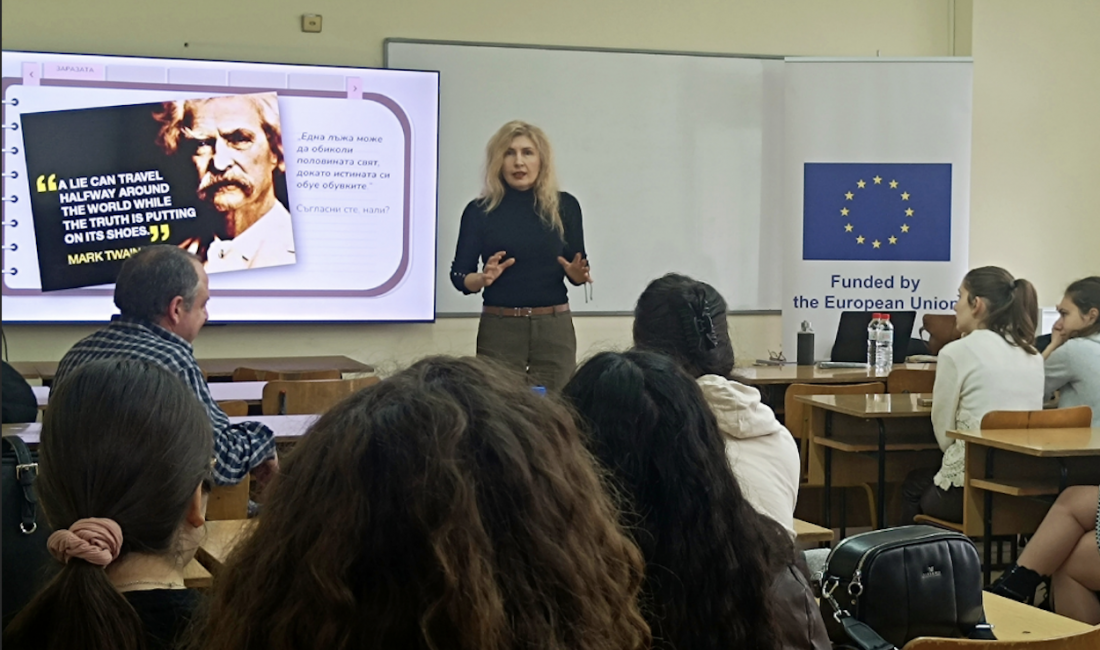
The EU for Global National Citizens Panel took place in Veliko Tarnovo, Bulgaria, on November 28th, 2025, hosted by the European Information Centre (EIC). The Panel entitled "Media Literacy and Democratic Participation – Bulgaria in the EU" explored the rise of disinformation and misinformation in mediascapes specific to Bulgaria and across the European Union. The discussion was moderated by Assoc. Prof. Desislava Eneva, Head of the Department of Journalism and Public Relations.
During the Citizens’ Panel, participants examined the distinctions between different types of misleading information, specifically disinformation, misinformation, and fake news. They reflected on the mechanisms through which they shape public perception. The discussion explored their influence on voting behaviour, attitudes towards institutions, and the overall ability of citizens to evaluate information critically and make well-grounded decisions. Special attention was given to the role of social media platforms, algorithmic amplification, and the increasing difficulty of distinguishing credible sources from manipulated content.
A recurring theme was the low level of trust in traditional media (especially national TV channels) as well as public institutions due to corruption. The young people expressed doubts about the impartiality and transparency of the media in Bulgaria, and some highlighted that this uncertainty makes it difficult to rely on any single source for accurate information, so they chose social media as such. The question of political media manipulation also emerged, and the speed with which false narratives spread online. Many participants described feeling discouraged by the conflicting information, which led them to disengage from news consumption in general.
The lack of digital literacy education in Bulgaria was also highlighted as a significant challenge. Young people expressed a desire for practical tools that would help them assess the credibility of online content and develop stronger critical thinking skills. Some also spoke about their worry when realising they might have unknowingly spread false information.
To read all the recommendations collected throughout Europe during Local and Transnational Citizens’ Panels, click here.