I come from a land where I have always lived among painful stories, and within those very stories I shaped myself.
But my journey to Bosnia brought those narratives back to life once more.
And I cried for my homeland, and for Bosnia.
I am familiar with pain with the words that define it and with the bullets whose echoes still remain in my ears.
The nightmare is not over yet, and the death of my sister stands before my eyes as if it happened yesterday.
In life, we experience moments that cannot be explained with words times when words lose their meaning.
Moments when breathing becomes difficult not because of the heaviness of the air or the wounds of the body, but because of the memories it carries.
I wanted to write about smiles, freedom, and beauty, but in every beautiful scene I saw pain.
Every smile of the people in that land carried a deep sorrow.
I cannot ignore it, because my heart also hurts.
My pen is unable to write about happiness; it has always been used to telling stories of hardship.
The stories of my homeland are painful, and I have built myself within those stories.
We were condemned to suffering, and we still are.
The more I think about these two lands—Bosnia and Afghanistan—the more I feel how close and painful their stories are.
For me, Bosnia became more than a memory and more than a trip.
There, every stone, every photograph, and every moment of silence brought the past back to life within me.
I saw Bosnia similar to my birthplace, Kabul: beautiful domes, houses marked by destruction and bitter memories, a beautiful city full of libraries, beautiful girls with bright dreams, and men with strong posture and a look similar to the look of women and men of my land—a look that has been broken many times but has never given up: not on their children, not on love, not on family, and not on their homeland.
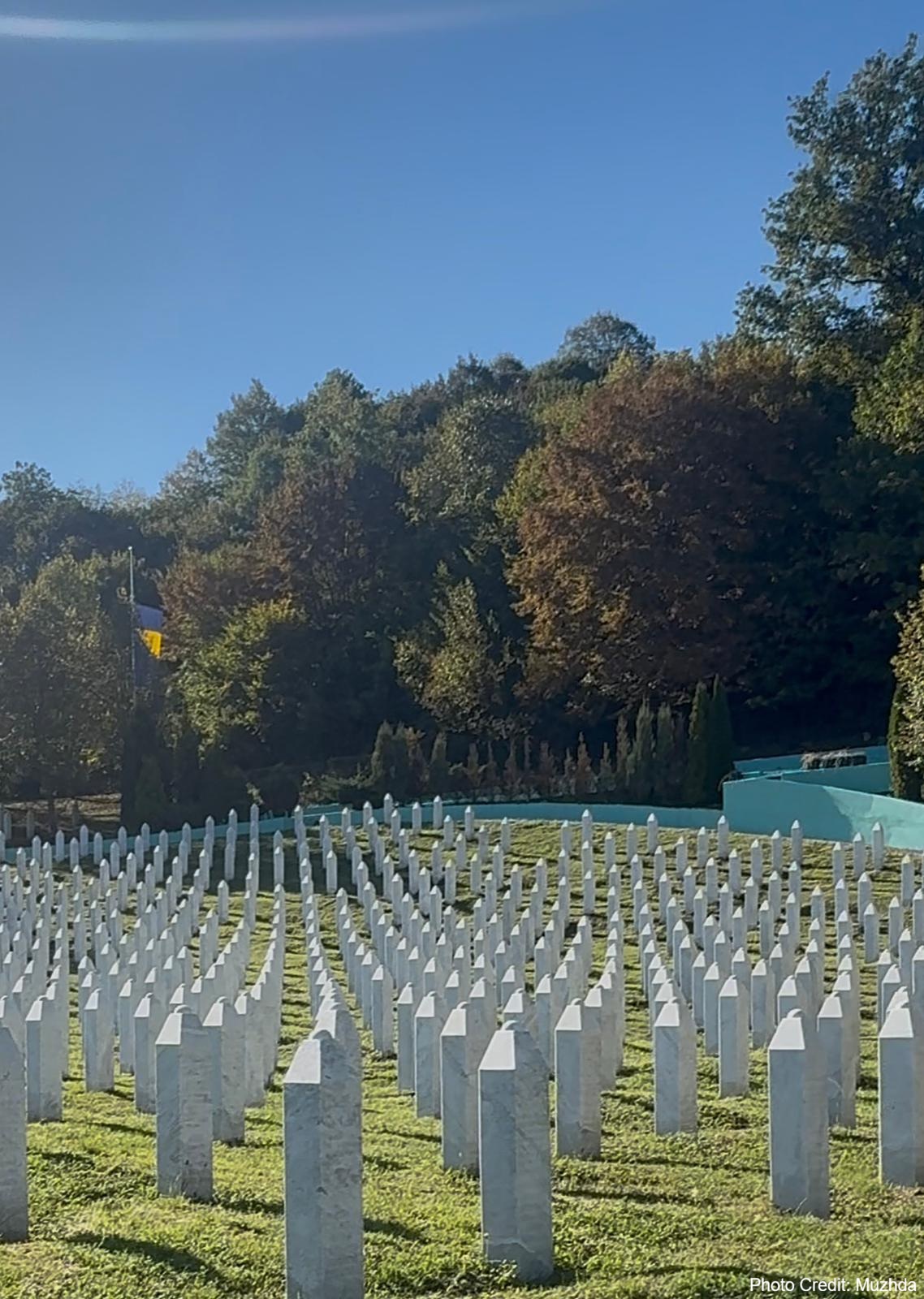
At the Srebrenica cemetery, I saw the great number of those who were killed.
I was shocked, as if I had stepped into another world.
I felt strange numb, or maybe something beyond numbness.
Those many cold pillars, I kept losing count.
The silence told the story of genocide and reminded me that this is not just a historical narrative; it is real pain that takes the breath away from the living who still carry these memories. With every scene I saw and every story I heard from Srebrenica, the sound of bullets echoed in my ears bullets fired without any remorse; the same way the explosion at Kabul’s Zanbaq Square, with a slightly different sound, became the frightening soundtrack of my nights.
I witnessed women and children gathering the pieces of their loved ones.
There, in Bosnia, I found a world similar to my own.
We came from different countries, but in that place our arms were open for comfort, solidarity, and humanity.
Our eyes were full of compassion, and we cried together.
I can still feel the warmth of their embrace and the kindness they showed me.
There, I understood once again how terrifying war is and how kindness still lives within us.
History lives within us, and how we fight against injustice, how we end war, and how we promote kindness is another part of the history of this country.
Remembering difficult days is not a passive act; it is courage, compassion, and the refusal to remain silent.
Carrying the pain of another person with respect and dignity is part of our meaning and part of our humanity.