Public Service Intl and United Cities and Local Governments Strike a Deal
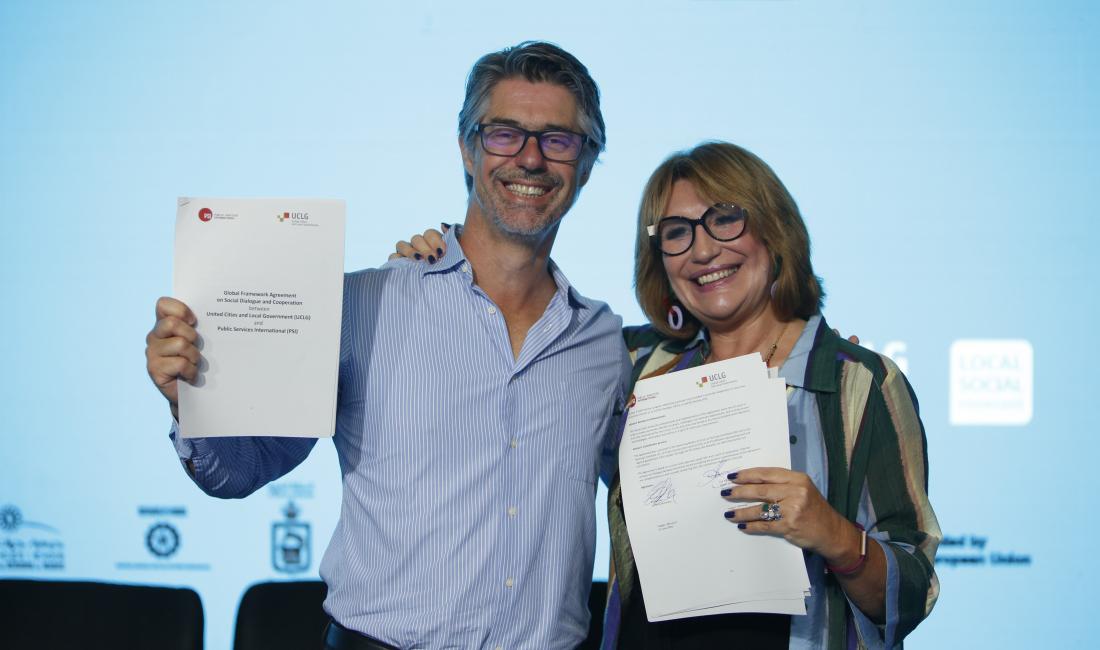
Photo credit: UCLG
Question: What is the meaning of a new agreement between the world’s largest network of cities, and a global trade union federation representing 30 million workers in dozens of countries?
Answer: It remains to be seen. But the world’s local governments and its unions are going to be talking.
Late last month, Public Services International (PSI) and United Cities and Local Governments (UCLG) met in Tangier, Morocco, and signed a first-of-its-kind Global Framework Agreement on Social Dialogue and Cooperation.
Both sides touted the framework agreement as a landmark effort to empower local governments all over the planet, and to set higher standards for public services. The initial goal is to create “a formal, structured global space” (in the words of one UCLG leader) where Local and Regional Government (LRG) employers and public service workers can engage in formal social dialogue and joint action.
The framework is the culmination of more than 10 years of evolving cooperation, joint advocacy, and partnerships between the two organizations. And its core goals go beyond institutionalizing dialogue.
The agreement text expresses hope that the dialogue would secure labor rights for more workers in local governments, by prioritizing better working conditions and the capacity and skills of local government staff. Both UCLG and PSI also agreed to advocqte together for quality local public services, resilient local governance, and equitable access to vital utilities like water, sanitation, health, and emergency services.
Local and regional governments directly or indirectly employ roughly half of PSI’s 30 million members across 154 countries and territories. This agreement directly impacts workers in municipal administration, health and social care, firefighting, water/sanitation, and early education.
To ensure the agreement translates into practical, measurable outcomes, a clear governance structure has been established to operate on the basis of an annual work plan.
This includes a steering committee composed of a maximum of six representatives per party to oversee the strategic direction and general execution of the agreement. There’s also a Global Social Dialogue Committee—a larger, sector-specific body composed of a maximum of 20 representatives per party tasked with driving concrete initiatives, addressing shared issues, and building collective capacity.
The framework includes built-in protocols to adapt the agreement over time to meet new mutual interests, resolve disagreements, or exit the framework flexibly if outcomes are deemed unsatisfactory by either party.
This global framework builds on regional dialogues and agreements that had already been established in various parts of the world. PSI’s Africa and Arab countries and UCLG’s African members have had a cooperation agreement for four years, and last year, PSI’s Latin American members signed a letter of intent with a network of local governments there.
“We’re creating something that’s been missing from the international architecture for more than 100 years,” Daniel Bertossa, PSI’s General Secretary, told UCLG’s executive bureau in Tangier.
Multiple crises in the world are creating “unprecedented demands” on local services, even as austerity policies of national governments have weakened funding for such services, he added.
Emilia Saiz, UCLG’s secretary-general, said that any agreement between local governments and employees would have challenges. “Let us face it, Daniel, this is not going to be an easy ride. It is not an easy relationship. It’s a complex relationship,” she said “Because it is about labor rights, but it’s also about changing the lives of people everywhere, every day. So we are not naive in thinking that this is going to be a very simple kind of relationship.”
But Saiz said there was “a point of inflection” for the PSI-UCLG relationship during the pandemic, “when we all discovered the kind of boldness and creativity that you needed to deliver services.”