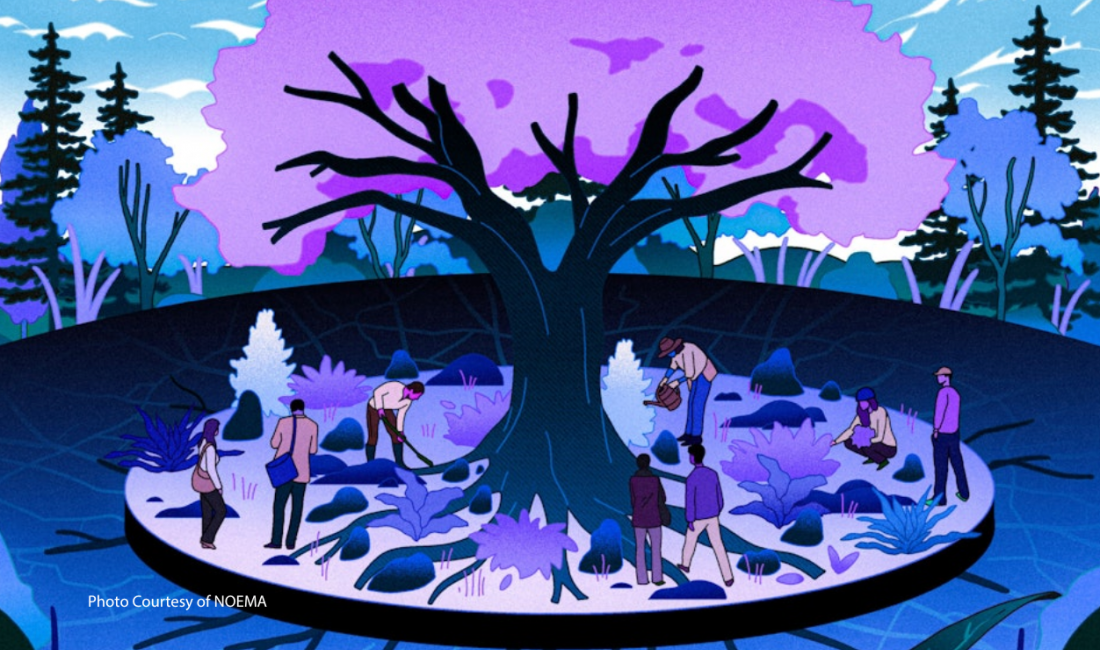
An Old Green Dream Is Returning—With New Tools and Technologies.
This story and art were produced and published by NOEMA. You can read the full story there.
During a meeting with Canadian Prime Minister Mark Carney in May, President Donald Trump commented on the arbitrary nature of their nations’ shared border.
“Somebody drew that line many years ago with, like, a ruler,” he mused. “Just a straight line right across the top of the country.”
Trump was hinting at his desire to annex Canada, an ambition some have dismissed as a joke, but his words were incidentally insightful.
Borders represent a conceptual distinction between the living world as it actually exists and the myriad ways it can be demarcated for particular, often extractive purposes.
Astronauts and astronomers have observed how, from above, one sees no lines around states or territories dividing the Earth, only a majestic, unified whole.
This abstraction of the landscapes upon which we all depend, and of which we are part, has contributed to their systematic destruction. In reaction to the unchecked metabolism of modern industrial civilization, the Earth is reasserting its primacy. Extreme weather, biodiversity loss and other mounting calamities promise to undermine our economic and territorial integrity. Humanity now faces the urgent question of how to operate in a more sustainable, reciprocal relationship with our environments.
A growing ecological movement sees the solution in bioregionalism:
The idea of reorganizing social and economic life around the natural boundaries of the ecosystems that host and sustain us. Rather than accepting the abstract placemaking of property or state, bioregionalists look to watersheds, biodiversity, human culture and other aspects of physical and social geography. Well-known bioregions in North America include Cascadia (reaching roughly from the southern tip of Alaska to northern California) and the Ozarks (primarily encompassing southern Missouri and northern Arkansas).
After emerging some 50 years ago, bioregionalism lost steam around the turn of the century. Today, however, it is in the midst of a resurgence. In light of the escalating pressures of the Anthropocene, many in the movement are now embracing bioregional finance (BioFi) — new financial systems and decentralized technologies to establish the technical, institutional and cultural bases for bioregional forms of economics and governance.
It’s a grand vision with ideas that may sound naively ambitious or even controversial, like using cryptocurrency to tokenize protected forest lands and incentivize their conservation. Proponents argue that such approaches can provide a means of affording visibility and value to ecosystems too often ignored by mainstream economics. The mission is to leverage existing economic systems in ways that prioritize bioregional regeneration over extraction....
“There’s a kind of dual edge to bioregionalism,” Brandon Letsinger, a leader in the Cascadian movement, told me. “One is short-term and pragmatic, working within existing systems, and the other is long-term and utopian — really working to outgrow, overgrow and build institutions that we don’t currently have, but that we need.”
Please continue reading this story at NOEMA.