4 Charter Items in Bangladesh Open Doors to Local Autonomy—and Stronger Finance
Photo by
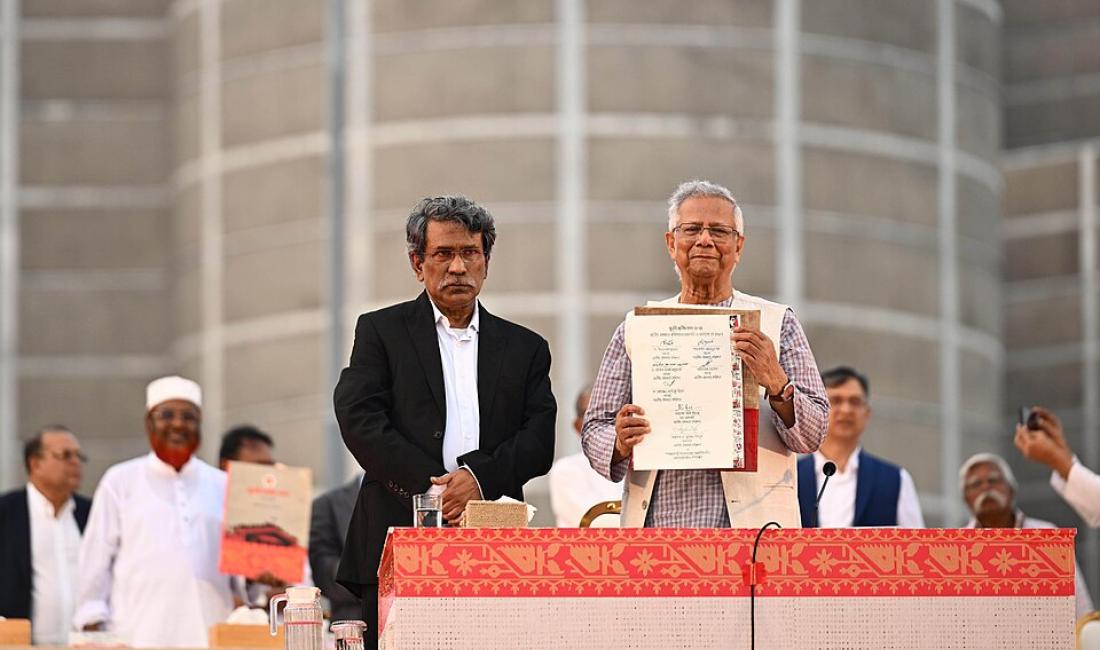
In February, Bangladesh voters approved a new charter for the country, with more than 70 percent of the vote. The document could be pathbreaking for local governments and not just in the South Asian nation.
The "July Charter"—so named because it was produced out of extensive consultations and negotiations with 30 parties in July 2025—consists of 84 different "consensus statements" to guide a new Bangladesh governing system, to replace Sheikh Hasina's authoritarian government.
Four of those "consensus statements", to be found right in the middle of the charter, establish local government as democratic, autonomous, and financially powerful.
Statement 44 establishes local government elections, conducted by the election commission. Statement 46 declares that all public employees working for local government are accountable to that local government—and not the central government. This is an important check on authoritarian national governance.
But the most intriguing local government provisions are numbers 45 and 47. These guarantee"functional autonomy in
the financial management of all local government institutions and in performing all duties prescribed by law." Also promised are "full financial control" and the power to tax—to generate their own funds locally. This comes with one check: if a local government spends more than it raises itself, it has to get its budget approved from the legislature's upper house.
If such charter provisions become a lived reality, it would give Bangladesh one of the strongest systems of local government in Asia—and the world.
One small note: Local governments also must have fully automated service-delivery, under Charter consensus statement 83.
You can read the full text of those provisions below, followed by an official account of the charter's history and drafting.
44. Elections to Local Government Institutions: The Constitution shall include a provision stating that elections to local government institutions shall be conducted under the decision of the Election Commission
45. Financial Management of Local Government Institutions: The Constitution shall include a provision ensuring complete functional autonomy in the financial management of all local government institutions and in performing all duties prescribed by law. Local government institutions shall have full
financial control and authority to implement all development activities at the local level, except where such activities form part of national development programs.
46. Delegation of Government Officials/Employees under Local Government Institutions: The Constitution shall include a provision stating that all officers and employees of the Republic who are directly engaged in the work of local government institutions shall be placed under the authority of elected representatives of those institutions. All government departments involved in implementing development projects within the jurisdiction of local government institutions shall operate under the guidance and direction of those elected representatives
47. Independent Fund Generation by Local Government Institutions: The Constitution shall include a provision allowing local government institutions to generate their own funds locally. However, if the projected funds are expected to fall short of the institution’s budget, the proposed budget must be submitted to the Upper House of the Legislature for consideration.
83. Automation of Service Sector Operations and Information Systems: All government service-providing institutions, particularly police stations,
registry offices, revenue offices, passport offices, and sectors such as education, health, local government, and district and upazila administrations shall be brought under complete (end-to-end) automation for service delivery and information management.
ABOUT THE JULY CHARTER
In the aftermath of the successful mass uprising of students, workers, and citizens in July–August 2024, and in continuation of Bangladesh’s long democratic struggle, a historic opportunity has emerged to reconstruct the state on the foundation of democracy and human dignity. At this critical juncture in our national history, we, the undersigned, have reached the following consensus under the initiative of the National Consensus Commission, formed under the leadership of the Chief Advisor of the Interim Government, Professor Dr. Muhammad Yunus. This consensus, achieved through mutual and collective deliberations among various political parties, alliances, and forces, aims to reform the constitution, electoral system, judiciary, public administration, police administration, and mechanisms for combating corruption:
1. Historical Context
Following nearly two hundred years of British colonial rule and exploitation, the subjugated people’s prolonged resistance culminated in the creation of an independent state named Pakistan in 1947, founded on a Muslim-majority basis within which East Bengal was incorporated. However, the authoritarianism, exploitation, and systemic discrimination by the Pakistani ruling class soon provoked deep resentment among the people of East Bengal. The language movement of 1952, followed by the education movement of 1962, the autonomy movement of 1966, and the mass uprising of 1969; each marked a milestone in this collective awakening. The historic 1970 election embodied the East Pakistani people’s fervent aspiration for self-determination.
When, on the dark night of March 25, 1971, the occupying forces launched a brutal campaign of genocide against the innocent population of then-East Pakistan, Bangladesh’s declaration of independence on March 26 ignited a War of Liberation. The birth of this independent nation was thus rooted in a people’s war, driven by the idealsof equality, human dignity, and social justice enshrined in the Proclamation of Independence.
Yet, even after 53 years, the democratic aspirations that emerged from that war have not been fully realized. The evolution of democratic practices and culture in governance has repeatedly been disrupted. In 1975, the constitution was amended to establish a one- party system known as BAKSAL. That same year, a military coup led to a dramatic political shift and the fall of that system. Through subsequent political developments, a
multi-party political system was reinstated in 1978, and the national parliamentary election of 1979 marked a return to democratic rule.
However, this democratic journey was short-lived. Over the past five decades, the state’s constitutional and democratic institutions have failed to take root on a sustainable foundation, functioning instead in fragile and weakened forms. In 2006, under the leadership of the Awami League, a wave of brutal political killings unfolded through the infamous logi-boitha (poles and oars) attacks. In its aftermath, a state of emergency was declared in 2007, leading to the establishment of an abnormal caretaker regime, widely known as the 1/11 government—which brought electoral processes to a halt. When the Awami League returned to power in 2009, it gradually abandoned democratic principles and adopted an increasingly authoritarian and fascist posture. Under its rule, the state turned into a reign of terror: enforced disappearances, extrajudicial killings, torture, and fabricated charges were used to silence political opponents and critics, all under state patronage. A particularly horrific massacre took place in 2013 at Shapla Chattar in Motijheel of Dhaka.
From 2009 to 2024, the entire state apparatus was co-opted to glorify a single individual, family, and faction. Over a decade and a half, the fascist Awami League regime distorted the constitution through amendments, enacted repressive laws, and orchestrated three consecutive fraudulent elections in 2014, 2018, and 2024, undermining the electoral system entirely. The judiciary, law enforcement, and civil administration were systematically politicized and turned into instruments of plunder and repression. In effect, state institutions were stripped of accountability and rendered complicit in the erosion of justice, all to guarantee unchecked power and one-party domination over the
last sixteen years.
In this context, the people’s unbroken democratic resistance, spanning sixteen years, along with significant citizen-led movements such as the anti-quota protests, the road safety movement led by students in 2018, and finally the single-point mass movement of July–August 2024, culminated in an unprecedented popular uprising. Students, workers, women, professionals, opposition parties, and citizens from all walks of life rose in collective defiance of fascism. Expatriate Bangladeshis, too, played a critical role by suspending remittances and supporting the movement from abroad. As the uprising reached its climax, both active and retired members of the armed forces intervened decisively, accelerating the downfall of the authoritarian regime.
In the face of this revolt, the ruling clique retaliated with violent vengeance, killing over a thousand unarmed civilians, including women and children, and leaving more than twenty thousand grievously injured. Yet, it was through their sacrifice and the people’s collective resolve that the fascist Sheikh Hasina and her cohorts were ultimately defeated, many fleeing the country in disgrace.
This momentous backdrop revealed a powerful yearning among the people for structural transformation of the state. A resounding call emerged for sweeping reforms. Particularly to the constitution, the shattered electoral system, the legal and judicial frameworks, administrative and policing institutions, and mechanisms for anti- corruption and public accountability. In response, the government formed through the mass uprising initiated the process by establishing six thematic reform commissions.
2. Formation of the Reform Commissions
Following the mass uprising, the interim government led by Professor Dr. Muhammad Yunus assumed office on 8 August 2024. As its first major initiative, the government issued separate notifications on 3 October 2024 announcing the formation of five reform commissions: the Electoral System Reform Commission, the Judiciary Reform Commission, the Public Administration Reform Commission, the Police Reform Commission, and the Anti-Corruption Commission Reform Commission. Subsequently, on 7 October 2024, another notification established the ConstitutionalReform Commission. These commissions compiled and submitted their reports to the interim government on 31 January 2025. The reports contained detailed recommendations developed through written submissions from political parties and consultations with representatives from various social groups, professions, and stakeholders.
3. Formation of the National Consensus Commission
To implement the overall reform agenda on the basis of national consensus, the National Consensus Commission was formed on 12 February 2025. The Chief Advisor, Professor Dr. Muhammad Yunus, was appointed as Chair; Professor Dr. Ali Riaz, head of the Constitutional Reform Commission, was appointed as Vice-Chair. Other members included the heads of the Electoral, Public Administration, Police, and Anti-Corruption Reform Commissions, as well as a representative from the Judicial Reform Commission. Later, the head of the Public Administration Reform Commission was replaced by another member of that body as part of a minor restructuring. To ensure close coordination with political parties and forces, the Chief Advisor also appointed a Special Assistant for Consensus Building.
The commission was tasked with initiating and facilitating dialogue with political parties and forces in order to build consensus around the adoption of reform proposals concerning the constitution, electoral system, judiciary, public administration, police, and anti-corruption frameworks particularly in preparation for the upcoming election.
Initially, the commission was given a six-month term starting from the date of its formation. This term was later extended three times via government notifications: first on 11 August 2025, then on 15 September 2025 (both one-month extensions), and finally on 16 October 2025 by an additional fifteen days, bringing the total extension to two months and fifteen days, and the new deadline to 31 October 2025.
4. Activities of the Commission
The National Consensus Commission officially commenced its work on 15 February 2025. By 28 February, printed copies of the reports from all six reform commissions were distributed to all political parties. On 5 March 2025, a spreadsheet compiling 166 key recommendations, excluding those from the Police Reform Commission, was sent to 37 political parties and alliances for feedback. These included 70 recommendations on constitutional reform, 27 on electoral reform, 23 on judicial reform, 26 on public administration reform, and 20 on anti-corruption reforms. The recommendations from the Police Reform Commission were excluded from the spreadsheet, as they were deemed directly actionable through administrative decisions. Meanwhile, the immediately actionable recommendations from the other five commissions, excluding
constitutional reform were handed over to the government.
A total of 33 political parties and alliances submitted their feedback, with many offering detailed commentary and analysis. Alongside this feedback, between 20 March and 19 May 2025, the Commission held 44 meetings with 32 political parties and alliances. In some cases, multiple rounds of discussion took place to ensure fruitful dialogue. After concluding this first phase, the Commission initiated a second round of consultations
focused on 20 critical issues identified as central to constitutional reform. This phase ran from 3 June to 31 July 2025 and brought together representatives from 30 political parties and alliances for in-depth deliberations. During this period, the Commission held
23 meetings with these parties. The perspectives and proposals of these 30 parties and alliances have been integrated into this Charter.
As a result of this extensive consultative process, the following "July National Charter 2025" was adopted by consensus, with a few noted reservations by some parties on certain points.
5. Declaration of Consensus
Based on mutual deliberations between the National Consensus Commission and various political parties and alliances, we, the representatives of the participating parties and alliances, on behalf of our respective organizations:
a) Have reached a consensus on the need for structural, legal, and institutional reforms to the current system of governance; specifically, the constitution, electoral system, judiciary, public administration, police, and anti-corruption
mechanisms;
b) Have agreed to incorporate these issues (with a few noted differences in opinion) into this National Charter; and
c) In solemn remembrance of the heroic martyrs and injured of the democratic anti-fascist movement of the past sixteen years, especially the mass uprising of July– August 2024; in solidarity with those arrested and imprisoned; and in gratitude to all who participated directly or indirectly in the struggle—we hereby declare this document the “July National Charter 2025.