Resident Priorities From the Rewrite LA Mini-Assembly
Table of Contents
Section 1: Mini-Assembly Overview 4
-
Recommendation 1: A 5-to 10-year plan for the city’s infrastructure with a transparent community-driven process that requires input from all city departments. (Score: 32) 8
-
Recommendation 2: Los Angeles City infrastructure and resources should be guided by values that prioritize long-term community well-being, sustainability, and equitable access. (Score 22) 10
-
Recommendation 3: The Planning Department will be responsible for determining criteria for ministerial approval for projects in non-industrial areas, taking into account future demographics. In residential areas, projects under a certain size will be approved ministerially. (Score: 22) 12
-
Recommendation 4: Land-use decision-making in Los Angeles should include more robust and meaningful community oversight and input, alongside clearly defined and timely approval deadlines. (Score 19) 14
-
Recommendation 5: Once zoning approval has been granted through an accessible and equitable process, including community input, the City Charter should require a designated process for expediting permitting to ensure housing for all in the City of LA, while transparency in delivery of projects remains accessible to the public. (Score: 16) 16
-
Recommendation 6: Ensure equitable access to community input processes that center neighborhood expertise and holistic community well-being. Input from those most directly impacted by land-use decisions, such as residents affected through employment, housing stability, displacement risk, or quality of life, should be given greater weight in decision-making. (Score: 14) 16
-
Recommendation 7: Residents should be protected from developers whose goals and norms do not mesh with the community values. (Score: 13) 19
-
Recommendation 8: Change the composition of the Planning Commission to include a mix of elected officials and community members who apply to serve, potentially selected through randomization or another structured method. (Score: 4) 20
-
Recommendation 9: Developers who want to build consistently with community goals and norms should not be burdened with unnecessary legal frictions. (Score: 0) 22
-
Recommendation 10: Move all project by project approval from Council to the various Planning Departments, though City Council may still give input. (Score: -3) 23
Appendix A: Mini Assembly Agenda 24
Appendix B: Expert Biographies 25
Appendix C: Participant Demographics 27
Appendix D: Sample of Small Group Discussions 28
Section 1: Mini-Assembly Overview
Introduction
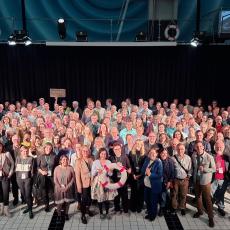
Rewrite LA is a citywide civic initiative designed to create meaningful opportunities for Los Angeles residents to directly inform major decisions related to the City’s Charter Reform process. Grounded in principles of inclusive and participatory democracy, Rewrite LA seeks to ensure that community voices help shape the future of local governance and recognizes that the government derives its authority from the consent of the governed.
Rewrite LA is guided by a blend of practitioners in civic engagement, democracy innovation, journalism, and cultural storytelling. In addition to central leadership, composed of members from the Berggruen Institute and Public Democracy Los Angeles, a broad network of advisors helps shape and support the work. This includes filmmakers and cultural figures like Daniel Kwan, institutional leaders such as Dawn Nakagawa of the Berggruen Institute, and experts in democratic innovations like Liz Barry of Metagov and Linn Davis of Healthy Democracy. These collaborators bring expertise in civic technology, public engagement, governance design, and movement-building.
As part of this effort, Rewrite LA convened a Mini-Assembly on December 13, 2025, designed and implemented by Public Democracy Los Angeles, a volunteer-led coalition promoting civic engagement in Los Angeles, to provide input to the Los Angeles Charter Reform Commission. The Mini-Assembly adapted the model of a larger citywide Civic Assembly in which residents are selected by lottery and convened over an extended period to learn, deliberate, and offer collective recommendations on complex policy issues.
Participants were selected through a democratic lottery from a citywide pool of applicants, ensuring a broad cross-section of residents with varied lived experiences and perspectives. The purpose of the Mini-Assembly was to support the Commission’s work by surfacing resident priorities, values, and considerations related to land use decision-making.
Focus for the Mini- Assembly
In November 2025, Rewrite LA launched an online application inviting Los Angeles residents to vote on priority topics and to enter a lottery for selection to the mini-assembly. Land use emerged as the highest-priority topic.
The remit, or central question, was used to guide the convening and shape the development of recommendations. It asked:
How should the City Charter shape the way land use decisions are made in Los Angeles? What values, principles, or ideas do you think should guide how land use decisions are made in Los Angeles?
Mini-Assembly Process
The mini-assembly followed a structured, full-day deliberative process designed to support informed, values-driven recommendations on how the Los Angeles City Charter should shape land-use decision-making. Participants began with facilitated introductions and a deliberation mindset activity to establish shared expectations and prepare for collaborative discussion. The group then developed common agreements and articulated the values they believed should guide land-use decisions, first in small groups and then collectively.
The learning phase grounded participants in a shared factual foundation, including an overview of the City Charter and presentations from four subject-matter speakers, followed by a question-and-answer session. Building on this shared understanding, participants moved into deliberation, initially brainstorming recommendation ideas before returning after a lunch break to analyze and refine them. The day concluded with a structured drafting process in which participants revised proposed recommendations, conducted a temperature check, and formally voted on final recommendations, followed by closing reflections.
Appendix A features the Mini-Assembly Agenda.
Appendix B features the list of experts and their biographies.
Participant Demographic Breakdown
Participants in the Mini-Assembly were selected through a democratic lottery from a citywide pool of Los Angeles residents who applied to take part. The lottery was designed to seat a group that broadly reflects the diversity of Los Angeles across key demographic dimensions. The selection targets were informed by publicly available demographic data for the City of Los Angeles and included consideration of age, geographic region, gender, race and ethnicity, educational attainment, and political affiliation.
A total of 291 Los Angeles residents applied to participate in the Mini-Assembly. As is typical of voluntary civic engagement processes, the applicant pool did not fully reflect the city’s population. Applicants were disproportionately college-educated and highly civically engaged: 79% held a bachelor’s degree or higher, and more than 95% reported voting in the November 2024 election. White residents were over-represented among applicants (49%), while Latino residents, who make up nearly half of Los Angeles’s adult population, comprised 18.6% of the applicant pool.
From this pool, 32 participants were confirmed using a stratified random selection process that corrected for these imbalances while preserving randomness. The final assembly more closely reflected Los Angeles’s population across key characteristics, including Angelenos from multiple regions of the city, spanning different age brackets, racial and ethnic identities, education levels, and political affiliations. Both voters and non-voters were represented, reflecting differing levels of civic participation. For example, Latino representation increased from 19% of applicants to 41% of seated participants, while White representation declined from 49% of applicants to 31% of participants. Educational attainment also became more balanced, with participants holding a bachelor’s degree or higher declining from 79% of applicants to 56% of the final group. Participants ranged in age from 16 to 74+, included residents from all major regions of the city, including South Los Angeles, and roughly mirrored population benchmarks. Participants also reflected varying levels of civic participation, including both voters and non voters, and identifying with a range of political parties.
Appendix C features a detailed demographic profile of the seated Assembly participants.
Values
At the start of the process, participants completed a values prioritization exercise to establish shared principles to guide land-use deliberations. These values were used throughout the day to evaluate and refine recommendations. Participants indicated their level of agreement with the series of proposed principles, ranging from Strongly Agree to Strongly Disagree. For analysis, agreement responses were scored as +1, disagreement as −1, and neutral responses as 0, with net scores calculated for each principle. Results show strong alignment across all values tested. Every principle received a positive net score, and disagreement was minimal. No category emerged as divisive.
Results showed strong consensus: all principles received positive net scores, with minimal disagreement. The strongest alignment centered on equity, affordability, access, and community participation. Equity and equitable access received the highest support, followed by affordable housing, community investment, and connectivity. Community input into decision-making also ranked highly.
Participants additionally expressed strong support for effective, transparent, and representative governance, as well as safe, streamlined decision-making processes. Principles related to livability and sustainability—such as walkability, access to green spaces, environmental considerations, and community respect—also received consistently strong support.
Mini-Assembly Recommendations
The recommendations generated from the full day Mini-Assembly in the following section reflect the final versions discussed by participants and are ordered by level of support, which were ranked by number of votes, using the following scale: agreement responses were scored as +1, disagreement as −1, and neutral responses as 0, with net scores calculated for each principle. The recommendations include:
Recommendation 1 (Score: 32): A 5- to 10-year plan for the city’s infrastructure with a transparent community-driven process that requires input from all city departments.
Recommendation 2 (Score: 22): Los Angeles City infrastructure and resources should be guided by values that prioritize long-term community well-being, sustainability, and equitable access.
Recommendation 3 (Score: 22): The Planning Department will be responsible for determining criteria for ministerial approval for projects in non-industrial areas, taking into account future demographics. In residential areas, projects under a certain size will be approved ministerially.
Recommendation 4 (Score: 19): Land-use decision-making in Los Angeles should include more robust and meaningful community oversight and input, alongside clearly defined and timely approval deadlines.
Recommendation 5 (Score: 16): Once zoning approval has been granted through an accessible and equitable process, including community input, the City Charter should require a designated process for expediting permitting to ensure housing for all in the City of LA, while transparency in delivery of projects remains accessible to the public.
Recommendation 6 (Score: 14): Ensure equitable access to community input processes that center neighborhood expertise and holistic community well-being. Input from those most directly impacted by land-use decisions, such as residents affected through employment, housing stability, displacement risk, or quality of life, should be given greater weight in decision-making.
Recommendation 7 (Score: 13): Residents should be protected from developers whose goals and norms do not mesh with the community’s values.
Recommendation 8 (Score: 4): Change the composition of the Planning Commission to include a mix of elected officials and community members who apply to serve, potentially selected through randomization or another structured method.
Recommendation 9 (Score: 0): Developers who want to build consistently with community goals and norms should not be burdened with unnecessary legal frictions.
Recommendation 10 (Score: -3): Move all project by project approval from Council to the various Planning Departments, though City Council may still give input.
Given the limited duration of the Mini-Assembly, these recommendations are not intended as definitive conclusions, but rather as informed public input to help inform and enrich the Commission’s ongoing deliberations and priority-setting. Taken together, the recommendations reflect broad agreement on the need for long-term, values-driven planning and clearer, more efficient decision-making.
The highest-ranked recommendations (Recommendations 1 and 2) emphasize a citywide, community-informed planning framework grounded in equity, sustainability, and long-term well-being, suggesting strong consensus around setting shared goals and rules upfront. At the same time, a key tension emerges between recommendations that call for expanded ministerial approvals (Recommendation 3) and those that prioritize robust, meaningful community oversight and weighted input from impacted residents (Recommendations 4, 6, and 7). This tension reflects an unresolved question about where and when community voice should be exercised—primarily during plan- and rule-setting, or through ongoing project-level review.
This dynamic may help explain why structural changes that further limit discretionary, project-by-project decision-making by elected officials (Recommendation 10) ranked lowest. While participants expressed interest in reducing politicization and delay, the lower ranking suggests caution about reforms that could be perceived as weakening accountability or diminishing opportunities for community input if alternative oversight mechanisms are not clearly defined.
Notably, several recommendations are largely aligned: calls for early and equitable community input (Recommendations 4 and 6) sit alongside support for expedited permitting once approvals are granted (Recommendation 5), and proposals to reduce unnecessary legal friction for projects that align with community goals (Recommendation 9). Overall, the recommendations point toward a shared desire for a system that is both more inclusive and more predictable, while highlighting the need for clearer design choices to balance efficiency with democratic accountability.
At the close of the Assembly, Rewrite LA requested participants work on elaborating their proposed recommendations and the following reflects their own views and wording to further elaborate the recommendations they reached during the convening. The Mini-Assembly participants who supported this report are listed here: Jiyoung Park, Jamie York, House Dow, Jonathan Luevano, Lucio Morado, Rudy Melendez, Artem Stafeev, Roman Aytur, Connie Borja, Lionel Mares, Matt Chapman, Ivan Salgado.
Section 2: Recommendations
Recommendation 1: A 5-to 10-year plan for the city’s infrastructure with a transparent community-driven process that requires input from all city departments. (Score: 32)
Rationale for recommendation
The City of Los Angeles spends hundreds of millions on public infrastructure services and construction/repair without a long-term, strategic plan. As a result, City agencies and departments expend funds in a reactive, inefficient manner, and responsibilities are currently apportioned to multiple City agencies and departments.
Los Angeles is the only large city in the country that currently lacks a citywide capital plan. This means that public infrastructure planning, design, and construction is handled separately by different agencies. When communication and consensus breaks down, our city can struggle to provide basic services with an efficient and effective investment of public dollars. The City must take a more unified and holistic approach to planning for infrastructure improvements to ensure equity for all neighborhoods, be more efficient with taxpayer dollars, and reduce liability costs related to unmaintained infrastructure.
Key considerations
A citizen-informed 5-10 year Capital Improvement Plan offers the opportunity for a systemic solution that provides greater equity, accountability, cost savings, and efficiency. It would better prepare the city for recovery after a disaster. It would allow the City to be more intentional about developing projects in traditionally under-resourced neighborhoods with a particular focus in increasing green spaces and reducing heat islands. Los Angeles City Council has adopted several policy objectives that relate to public infrastructure, including the Mobility Plan 2035, the City’s goal to eliminate traffic fatalities, the City’s goal to eliminate greenhouse gas emissions from transportation, and the City’s goal to more equitably deliver services. A capital improvement expenditure plan should reflect these policy objectives and serve as a roadmap for how City departments like the Los Angeles Department of Transportation (LADOT) and the Los Angeles Public Works Department (DPW) coordinate to achieve these outcomes.
The Commission will need to determine who will develop the plan and which Departments will be covered by it as well as an avenue for constituent engagement on long term projects. It is critical the plan be appropriately funded, and the Commission may want to consider some form of protected or minimal budget in order to ensure the plan’s success. Undermining the budget is an easy way for the City to ensure this change fails. It will also present a significant culture change for the City in terms of interdepartmental cooperation and proactivity. Lastly, the Commission should also ensure the plan prioritizes racial, economic, environmental and health justice.
Additional considerations/questions from participants
In practice, this approach should promote coordinated, cross-departmental decision-making that emphasizes preventive investments, long-term cost savings, climate resilience, and disaster preparedness, rather than short-term or siloed solutions.
-
Will the City enforce its own plan? In light of Measure HLA, this is an important question as the City has sought extensive loopholes around municipal enforcement of its own laws.
-
How will the City prevent special interests from capturing the funding to ensure projects are delivered timely and on budget?
-
How will the climate priorities be incorporated into the plan while still prioritizing finished work?
-
How will the plan be assessed and/or modified as necessary in between the 5-10 year plans?
-
How do we equitably gather and incorporate public input into this process?
-
How does the plan prioritize racial, economic, environmental, and health justice?
Recommendation 2: Los Angeles City infrastructure and resources should be guided by values that prioritize long-term community well-being, sustainability, and equitable access. (Score 22)
Rationale for recommendation
City-owned resources, including physical infrastructure (such as buildings, parks, sidewalks, and transit systems) and data assets (such as surveillance and camera footage), ultimately belong to the residents of Los Angeles. As such, the public should have a measured and appropriate right to access and use these resources. This is especially true of city buildings which could offer more multi-functionality purposes.
City leadership acts as a steward of these shared assets and therefore has a responsibility to prioritize long-term sustainability and the well-being of the communities that rely on them. Equitable access should be ensured for members of the general public, while also protecting privacy and security, particularly in cases involving public or city-generated data.
Key considerations
The capital infrastructure of Los Angeles is made up of a variety of examples, including parks, city buildings, transit systems, data and camera footage, and more. As residents of Los Angeles, we have a right to access our city’s infrastructure, and a right to be included and considered in decisions regarding that infrastructure. Specifically, as a city’s priority should be the well being of its residents, decisions should be made using evidence-based processes with regard to those affected.
Additional policy recommendations that build directly on this include:
-
Establish clear public-use guidelines for city-owned buildings to support community events, educational programs, and nonprofit activities.
-
Create a centralized public asset inventory so residents can easily see what city resources exist and how they may be accessed.
-
Implement multi-use design standards for new city buildings to ensure flexibility for future community needs.
-
Expand shared-use agreements between city departments, schools, and community organizations to maximize space utilization.
-
Require equity impact assessments before approving major changes to public asset access or usage.
-
Develop privacy-by-design policies for all city data systems, especially surveillance and sensor technologies.
-
Establish an independent data oversight committee with community representation to review data access and use.
-
Standardize data retention and deletion timelines to prevent unnecessary long-term storage of sensitive information. Increase public transparency reports detailing how city data is collected, shared, and protected.
-
Invest in cybersecurity upgrades to protect public data assets from misuse or breaches.
-
Ensure public infrastructure projects prioritize ADA accessibility and universal design principles.
-
Create pilot programs allowing temporary community activation of underused city properties.
-
Encourage public-private partnerships that align with community benefit standards and accountability measures.
-
Require regular maintenance audits to ensure public infrastructure remains safe and functional.
-
Incorporate climate resilience planning into all long-term asset management decisions. Expand green infrastructure (trees, shade structures, permeable surfaces) within city-owned spaces.
In addition, especially in the case of city data such as that generated by cameras and other surveillance methods, we recognize that there are serious privacy concerns inherent in the public accessibility of data. The city should make good faith, serious efforts to maximize the privacy of affected individuals while making data available for reasonable use.
Additional considerations/questions from participants
Concerns around this proposal include how and to what extent the public should be consulted and brought into planning and decision-making, and how to limit special interests interjecting. Additionally, there must be some medium of enforcement to ensure the city follows this direction.
Specific needs also include defining and measuring success (ongoing and at the end of a process/term) and prioritizing interlinked racial, environmental, environmental, and health justices.
Recommendation 3: The Planning Department will be responsible for determining criteria for ministerial approval for projects in non-industrial areas, taking into account future demographics. In residential areas, projects under a certain size will be approved ministerially. (Score: 21)
Rationale for recommendation
Many housing projects that are denser than a single family home are currently approved on a case by case basis. This leads to delays in building, as each step/stage of government has a certain amount of time to deny or approve the project. Allowing more residential development to be approved by-right/ministerially would avoid this and allow denser housing to be built faster.
Taking into account future demographics ensures that development scales with projected need, especially when buildings take years to build. By the time a project is complete the neighborhood may have changed substantially.
Limiting zoning to two options (industrial and general purpose/nonindustrial) ensures that neighborhoods don’t become industrial free-for-alls, while allowing for the greatest range of development pursuant to community needs. Encouraging mixed-use and alternatives to single-family homes contributes to greater density and a higher quality of life.
Key considerations
There is value in environmental reviews/assessment of environmental impacts; new two-level zoning should take this into account and by-right approval shouldn’t preempt good environmental stewardship. Allowing denser housing would bring in more residents, leading to more tax revenue. Simplifying the approval process would also mean less time and money spent on meetings.
Currently, about three-fourths of LA is zoned exclusively for single family homes. This has led to higher density housing being concentrated disproportionately in small parts of the city, as well as segregation based on income and race. Increasing density in areas currently dominated by single-family homes would mitigate this. The group has concerns that areas that are already dense will be made denser while single family zones are left untouched. We want density to be more evenly spread. There is also concern that allowing higher density by-right will lead to gentrification; people being pushed out of their housing so developers can build denser housing to make more of a profit.
Approval of discretionary projects often involve meetings where public comment can be given. There is usually a large turnout by owners of single family homes who oppose change in their neighborhood, with little representation of potential future residents who are interested in living in the neighborhood but don’t because they cannot afford the type of housing available there currently. New zoning should take into account benefits and desires of future residents, not just current residents.
Additional considerations/questions from participants
Higher density housing is not useful if no one can afford it. There is currently a lot of housing and other properties kept vacant because that’s more profitable than lowering the rent so someone can afford it. We propose a vacancy tax to prevent this.
Additional desires include:
-
Penalties for missed deadlines, both from builders and the agencies processing requests
-
Penalties for after-the-fact approval
-
An additional tax for companies based outside of LA County
-
Special handling for housing built by/for homeless services organizations and non-profits
Recommendation 4: Land-use decision-making in Los Angeles should include more robust and meaningful community oversight and input, alongside clearly defined and timely approval deadlines. (Score 19)
Rationale for recommendation
Community members should have clear, accessible pathways to share insights, raise concerns, and contribute local knowledge before land-use decisions are finalized. Residents, particularly those most affected by proposed developments, should have meaningful opportunities to provide feedback and exercise oversight before projects are approved.
Neighborhood Councils were frequently cited as an underutilized mechanism for community participation. Participants noted that their current advisory-only role is insufficient and limits their influence on outcomes. A stronger, more formalized process is needed to ensure that community perspectives are considered early in the planning process, rather than after decisions have already been made or projects have been streamlined by the City Council, Planning Department, or Planning Commission.
Key considerations
This recommendation offers the potential to significantly improve transparency and public trust in land-use decision-making. Providing real-time access to project information, costs, and analyses can help residents better understand how decisions are made and why, strengthening confidence in both the process and its outcomes. A more consolidated and streamlined approval system may also increase efficiency, reducing delays and lowering costs for developers, which could improve project feasibility and delivery timelines.
Early and structured community input can lead to stronger development outcomes by improving design quality, accessibility, and alignment with neighborhood needs. Incorporating social, ecological, and environmental considerations into land-use decisions supports long-term community well-being and sustainability. Clear timelines, accessible plan checks, and hybrid engagement options that combine online tools with in-person opportunities can further enhance the public’s experience and ability to participate meaningfully.
At the same time, several challenges must be addressed. Establishing and maintaining oversight bodies and digital infrastructure requires sustainable funding, staffing, and administrative capacity. Heavy reliance on online systems may unintentionally exclude residents without reliable internet access or digital literacy, raising concerns about equity and inclusion. In addition, while deadlines are important for accountability and efficiency, enforcing them without undermining thorough review or meaningful public engagement may prove difficult.
Clarifying roles and authority is another key consideration. The responsibilities of Neighborhood Councils and other community representatives need to be clearly defined to ensure input is constructive and representative rather than duplicative or dominated by special interests. Balancing community oversight with the need to move projects forward—particularly housing—will require careful design of processes that are both inclusive and time-bound.
Additional considerations/questions from participants
-
How can timely coordination among city departments, developers, and community stakeholders be ensured?
-
It is also important to ensure that community input informs implementation without overriding the City’s General Plan or a Capital Improvement Plan (CIP). Community engagement should strengthen alignment with citywide goals rather than conflict with them.
Recommendation 5: Once zoning approval has been granted through an accessible and equitable process, including community input, the City Charter should require a designated process for expediting permitting to ensure housing for all in the City of LA, while transparency in delivery of projects remains accessible to the public. (Score: 16)
Rationale for recommendation
Los Angeles faces a severe housing shortage that is worsened by lengthy and unpredictable delays in the permitting process. Even after projects meet all established requirements, extended permit review timelines increase costs, discourage investment, and slow the delivery of much-needed housing without providing corresponding public benefit. Requiring the City Charter to establish a clear and expedited permitting pathway would ensure that compliant housing projects can move efficiently from application to construction, improving certainty for residents, builders, and the City alike.
Key considerations
Supporters of this recommendation emphasize its potential to reduce housing costs, increase overall supply, and provide greater predictability for both small and large projects by eliminating unnecessary administrative delays. They note that faster permitting can help stabilize rents, accelerate construction timelines, and improve the City’s ability to meet housing demand. Others acknowledge these benefits while raising concerns about implementation, including the need to preserve thorough safety and environmental reviews, ensure adequate staffing and resources, and avoid creating a system that prioritizes speed over quality or public confidence.
Additional considerations/questions from participants
Participants also raised several caveats and open questions for the Commission to consider when evaluating this recommendation. These include how “expedited” would be clearly defined in practice, what objective eligibility criteria would apply, and how timelines would be enforced if deadlines are missed by reviewing departments. Some participants suggested exploring tiered or conditional fast-track pathways based on project size or complexity, for example, a designated process for expediting construction permitting in Los Angeles. Others questioned whether existing permitting systems and staffing levels are sufficient to support acceleration without creating new bottlenecks. A minority viewpoint cautioned that without clear safeguards, expedited permitting could reduce opportunities for public scrutiny or lead to inconsistent outcomes across departments.
Recommendation 6: Ensure equitable access to community input processes that center neighborhood expertise and holistic community well-being. Input from those most directly impacted by land-use decisions, such as residents affected through employment, housing stability, displacement risk, or quality of life, should be given greater weight in decision-making. (Score: 14)
Rationale for recommendation
This recommendation emphasizes community expertise as a form of knowledge equal to technical or professional analysis. Those most impacted by a land-use decision—especially historically marginalized communities—are best positioned to identify potential harms, benefits, and unintended consequences. Partnerships with trusted intermediaries such as universities, nonprofits, and community-based organizations may help gather and elevate this input in a structured and equitable way.
A stakeholder-based approach that prioritizes impacted communities was broadly supported, with recognition that current engagement processes often privilege those with greater time, resources, and political influence.
Key considerations
Centering community expertise in land-use decisions can produce significant social benefits. When residents are meaningfully engaged, communities are more likely to feel a sense of ownership over outcomes, leading to stronger trust, representation, and legitimacy in public decision-making. Lived experience offers insights that outside consultants or firms may overlook, including how development affects daily life, mobility, safety, and access to essential services. Inclusive engagement also allows decision-makers to understand how policies affect different groups, supporting diversity of perspectives and more equitable outcomes.
Without careful design, engagement efforts can be dominated by well-resourced groups—such as homeowners associations or organized opposition groups—while working-class residents, renters, and BIPOC communities face barriers to participation due to work schedules, childcare needs, language access, or lack of compensation. Ensuring equitable access requires intentional removal of these barriers through measures such as stipends, childcare, translation services, flexible meeting times, and multiple participation platforms.
Additional considerations/questions from participants
-
How can the Commission ensure that the community has a voice in their community when it comes to Planning and Land-Use policy?
-
What steps can the Commission take to enshrine the rights of the people to have a say in land-use decisions?
Recommendation 7: Residents should be protected from developers whose goals and norms do not mesh with the community values. (Score: 13)
Score
Rationale for recommendation
Each neighborhood is different and land-developers must adapt to, or at least make an effort to, incorporate and integrate their designs to 'fit in' with the community.
*Note: This recommendation was not fleshed out during the Mini-Assembly, but was still included in the vote.
Recommendation 8: Change the composition of the Planning Commission to include a mix of elected officials and community members who apply to serve, potentially selected through randomization or another structured method. (Score: 4)
Rationale for recommendation
Much of the early discussion that led to this recommendation was focused on a desire to reduce the effect of political influence on the planning process, particularly among city council members. Shifting the makeup of the Planning Commission to include community members is intended to limit discretionary, relationship-based decision-making and replace it with a more rules-based, transparent system.
Reducing direct political involvement is seen as a way to minimize the influence of money and special interests, lower the risk of corruption, and accelerate development timelines, especially for housing. By insulating planning decisions from political pressure, the commission could focus more consistently on adopted plans, objective criteria, and long-term community goals rather than short-term political considerations.
Key considerations
Reconfiguring the Planning Commission could offer several benefits. A mixed composition may strengthen democratic decision-making by elevating community expertise and reducing reliance on political connections. Some participants pointed to international models, such as Sydney, where elected officials are barred from serving on panels that decide zoning and planning matters, as an example of how authority could be shifted away from City Council and toward more independent or community-based bodies, including maybe Neighborhood Councils. Streamlining approvals through a more independent commission could shorten development timelines and lower costs for builders, potentially improving housing delivery. Reduced political discretion may also lower the likelihood of corruption and decrease the need for costly investigations or litigation. In addition, a rebalanced system could allow City Council members to focus more on legislative priorities and constituent services rather than individual project approvals.
However, this approach also raises significant challenges. Diminishing City Council influence prompts questions about accountability—specifically, who holds planners and appointed community members responsible for decisions. A larger or more decentralized commission structure could risk inconsistency or overlook valuable ideas if not well coordinated. There is also concern that elected officials may resist changes that reduce their authority, potentially complicating implementation. Finally, this model would require a more engaged and informed citizenry to function effectively, placing greater demands on public participation.
Additional considerations/questions from participants
It is important to note that this recommendation went through multiple iterations, beginning with an overarching statement regarding a desire to reduce city council decisions in land use.
-
How will this affect the operation of the city planning commission?
Recommendation 9: Developers who want to build consistently with community goals and norms should not be burdened with unnecessary legal frictions. (Score: 0)
*Note: This recommendation was not fleshed out during the Mini-Assembly, but was still included in the vote.
Recommendation 10: Move all project by project approval from Council to the various Planning Departments, though City Council may still give input. (Score: -3)
Rationale for recommendation
The goal of this recommendation is to streamline the approval process by limiting the City Council’s ability to intervene in individual projects. Council involvement can slow development, particularly for high-rise and other large projects, by adding an additional layer of approval on top of existing requirements, including compliance with zoning and review by multiple planning bodies such as the City Planning Commission. Under this approach, councilmembers would still be able to express their views but would not vote on individual project approvals. This reflects the scale of Los Angeles, where land-use decisions in one part of the city may not warrant direct decision-making authority from councilmembers representing other areas.
Key considerations
Shifting project-by-project approvals from City Council to planning departments could meaningfully streamline development processes, reducing costs and delays for builders while allowing City Council to focus on broader legislative priorities. Participants noted that limiting direct council involvement in individual approvals may also reduce opportunities for political influence or corruption and strengthen public trust by prioritizing professional planning expertise and community input over political connections.
At the same time, this shift raises important questions about accountability and oversight. The Commission would need to consider how planners and departments are held responsible for decisions, how to preserve appropriate public engagement, and how City Council input is structured without re-introducing informal pressure. Implementation may also face political resistance, and success would depend on an informed and engaged public as well as clear coordination across departments.
Pending questions from participants
N/A
Appendices
Appendix A: Mini Assembly Agenda
Mini-Assembly Agenda - December 13
Guiding Question
How should the City Charter shape the way land‑use decisions are made in Los Angeles?
What values, principles, or ideas should guide how land‑use decisions are made in LA?
Schedule
Appendix B: Expert Biographies
Experts on Tap
Bill Fulton, FAICP, is regarded as one of California’s leading authorities on land use planning. Bill is author of Guide to California Planning, the standard textbook on land use planning in California, now in its seventh edition. He is also a Professor of Practice in the Department of Urban Studies and Planning at UC San Diego and engages in his own consulting work through William Fulton Group. In his career, Bill has served in many different capacities. He has been Mayor of Ventura, Planning Director of the City of San Diego, and a Professor of Practice at the Sol Price School of Public Policy at USC. His influential book, The Reluctant Metropolis: The Politics of Urban Growth in Los Angeles, was an L.A. Times best-seller. Bill received master’s degrees in Mass Communication from American University in Washington, D.C., and Urban Planning from UCLA.
Perspective: Explaining the core tension between who holds decision-making power in land use and how those decisions are made.
Mahdi Manji is the Director of Public Policy at Inner City Law Center, where he leads efforts to expand affordable housing, secure sustainable funding for housing solutions, and advance equitable land use policies in Los Angeles County. Committed to dismantling segregationist housing patterns and closing the racial wealth gap, he works to protect tenants, preserve affordable housing, and prevent homelessness. Before joining ICLC, Mahdi managed electoral and issue-based organizing campaigns at the ACLU of Southern California, including the Schools and Communities First campaign and efforts to defend the Affordable Care Act. His experience spans multiple states, advocating for housing justice and civil rights through community organizing and policy reform. Mahdi is a graduate of UCLA.
Perspective: Removing barriers that limit housing production, including restrictive land-use policies and discretionary approvals that enable corruption and contribute to disparate outcomes.

Jeffrey Kalban is an accomplished architect and the principal of Kalban Architects, a firm that has earned more than 50 prestigious design awards. In addition to his professional work, he is deeply involved in civic engagement, serving as chair of the Sherman Oaks Neighborhood Council’s Planning and Land Use Committee as well as its Vision Committee. Mr. Kalban is also a cofounder of United Neighbors, a statewide coalition of community groups dedicated to advancing smart planning principles that strengthen and support communities across California.
Perspective: Elevating professional qualifications for commissioners, improving coordination across departments to make land-use decisions more efficient and consistent, and protecting the City’s local zoning authority from state-level overrides.
Nick Vlahos is an academic practitioner dedicated to advancing civic decision-making through a variety of engagement methods, including digital platforms, local outreach, and inclusive public forums. Nick has led various local and international democratic innovation processes and is committed to fostering publicly engaged research that drives public participation and institutional reform. As Managing Director of the Center for Democracy Innovation at the National Civic League, Nick works on transformative cross-sector projects with academic, nonprofit, community, and government organizations, such as deliberative study sessions, city charter reform, healthy democracy in communities, and citizens’ assemblies.
Perspective: Helping explain the fundamentals of city charters, through NCL’s model city charter, understanding the pathways to reform and what that means for how recommendations are considered, and which types of policies and structures do and do not fit into a city charter.
Christian L. Redfearn is an Associate Professor of Real Estate at the Price School of Public Policy at the University of Southern California. He joined the faculty at USC after completing his Ph.D. in economics at the University of California, Berkeley. An urban economist, Prof. Redfearn is engaged in research projects that address the evolution of metropolitan land and real estate markets, including land use regulation and land pricing, neighborhood stability and change, housing price measurement issues in a complex urban setting, historic preservation districts, the hierarchy of urban real estate markets, as well as the spatial organization of metropolitan employment and its persistence over time. He is also the author of “Underwriting Commercial Real Estate in a Dynamic World.” Prof. Redfearn is a Weimer School Fellow at the Homer Hoyt Institute and been a NAIOP Distinguished Research Fellow.
Perspective: There are no silver bullets for solving the housing problems we face, just trade-offs. Better information about how housing markets work and do not work will help communities make better decisions about the land-use choices they face.
Appendix C: Participant Demographics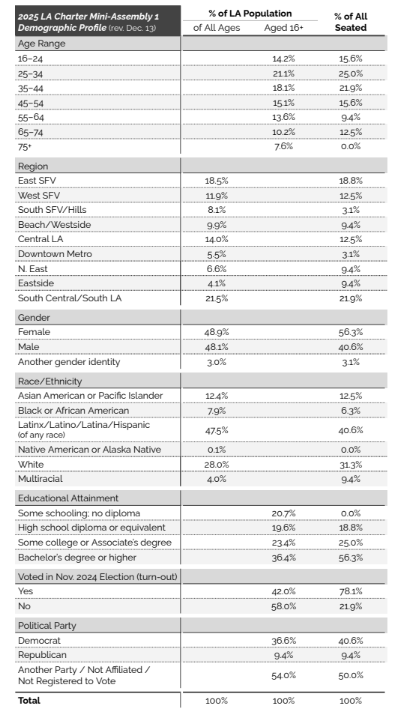
Appendix D: Sample of Small Group Discussions
Recommendation 1: A 5 to 10 year plan for the city’s infrastructure with a transparent community-driven process and requires input from all city departments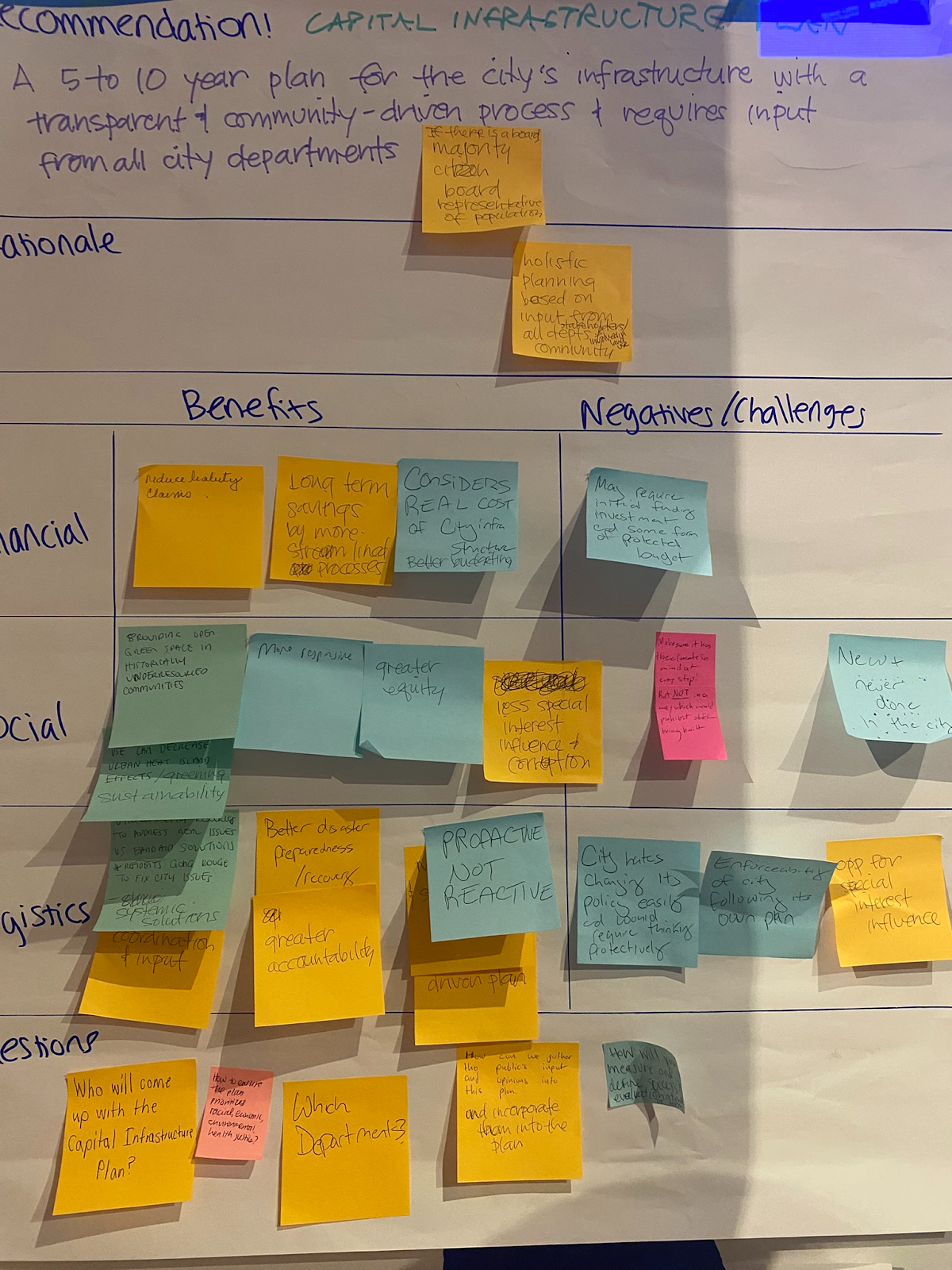
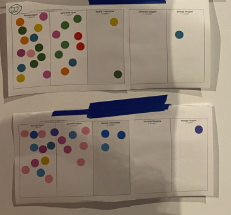
Rationale: Holistic planning based on input from all stakeholders/depts/community involved in land use
Other considerations/questions
-
Space that could be otherwise be used by what the community majority decides?
-
How do we ensure equitable access (ie parks and other green spaces)
-
How do we incorporate human-centered design as an overarching principle for public/municipal improvements