But Its Struggles Affect an Artistic Ecosystem
This story was produced and published by Zócalo Public Square. Photo credit: Tom via Wikimedia Commons (CC BY 3.0)
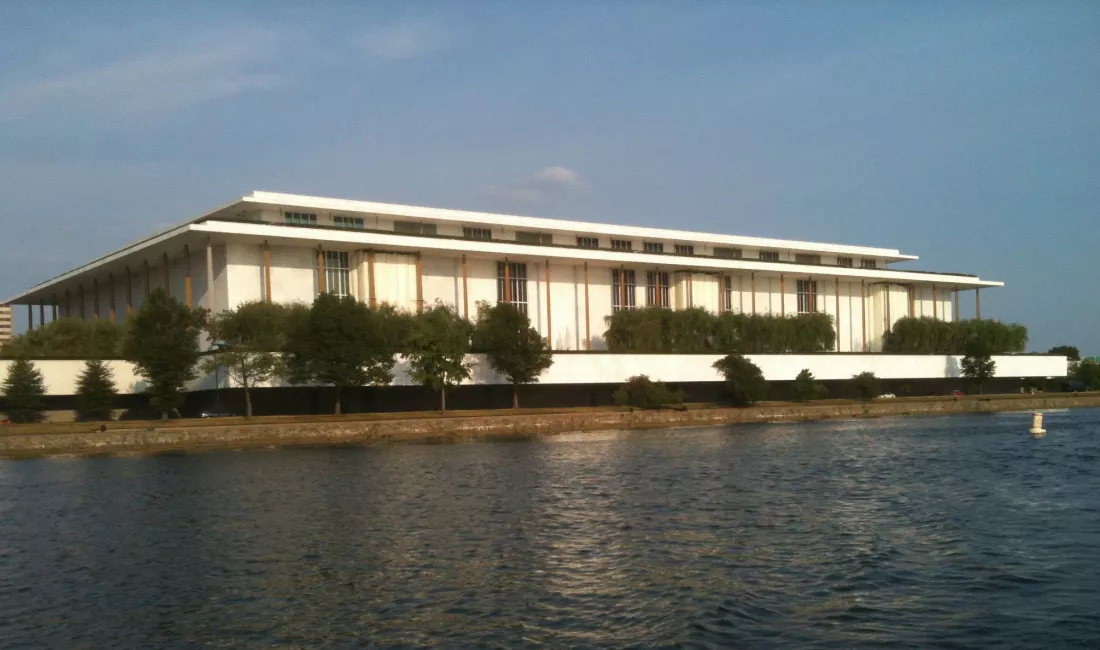
Imagine a large species of mammal—what the biologists call charismatic megafauna—abruptly disappearing from the environment. That’s what’s started to happen over the past year in the Washington, D.C. theatrical ecosystem. A diverse biome, having evolved over decades, the D.C. theater scene is facing the threat of the Kennedy Center’s extinction, which would represent an incalculable loss. The Kennedy Center isn’t gone quite yet, but the organization has lost a punishing number of subscriptions, ticket sales are plummeting, and major stars have refused to perform there.
Luckily, the Kennedy Center is only one venue among several dozen that continue to entertain audiences in my home city. All of the other large-scale theatrical venues around D.C.—Arena Stage, the Shakespeare Theatre, Signature Theatre, Studio Theatre, Woolly Mammoth, Olney Theatre, Round House Theatre, Theater J, the National Theatre—are still producing and presenting plays and musicals. Most of the city’s mid-size and smaller theaters, too, continue to stage new work and welcome audiences. Some of those theaters are benefitting from an influx of former Kennedy Center attendees buying tickets. Less competition means that other “species” of theater suddenly face less competition for prey—sorry, I mean audiences—and more theatrical territory to occupy.
What’s less well understood, but equally important, are the ways in which the diminishment of the Kennedy Center is affecting the artists, artisans, and administrators who work across the city, as well as the overall balance and health of the ecosystem. For decades, the organization has done a great deal more to support theater in D.C. than simply presenting plays and musicals. It has played an outsized role in supporting a large segment of D.C.’s professional theatrical class.
Any number of local playwrights, myself included, have tested new scripts in front of audiences at the Kennedy Center’s now-defunct Page-to-Stage New Play Festival. Opportunities to meet that creative need locally are now few and far between. Likewise, any number of D.C. actors have earned substantial-enough paychecks from performing in Kennedy Center productions to be able to afford accepting smaller, less-well-paying roles throughout the rest of the year and still make ends meet.
During fragile economic times like these, the loss of such opportunities is even more damaging. Will other theaters step in to replace what’s been lost? Will writers and performers (and the rest of the city’s theater makers) adapt to the changed ecosystem, finding new ways to survive and garner support?
Meanwhile, another recent catastrophic loss has rocked the D.C. theater ecosystem. The closing this year of the Capital Fringe Festival has earned vanishingly little national attention, undoubtedly because the annual event was a much smaller theatrical enterprise. But its loss might have an even more chilling effect on the D.C. theater scene than the drama (not the good kind, the bad kind) at the Kennedy Center.
If the struggles of the Kennedy Center are the equivalent of the near-extinction of, say, the tiger, then the loss of the Capital Fringe Festival could be like the disappearance of the honeybee.
For two decades, the Capital Fringe Festival served as an R&D lab for inexpensive creative expression that gave hundreds of local artists an opportunity to showcase their talent for thousands of audience members. At the same time, it also served as a low-cost, low-stakes entry point for new audience members curious about attending the theater. I participated in the first two Fringe Festivals myself, and the attention I earned—reviews of my work in the Washington Post, interest from future collaborators, audience feedback—launched my career.
If the struggles of the Kennedy Center are the equivalent of the near-extinction of, say, the tiger, then the loss of the Capital Fringe Festival could be like the disappearance of the honeybee. It’s hard to say. Luckily, a new group of entrepreneurial D.C. theater artists have stepped in to launch District Fringe, which, with any luck, will fill the newly open ecological niche, making inexpensive theater-making possible again.
Personally, what I’m most worried about in D.C.—theatrically speaking, I hasten to qualify—is the nature of the plays we produce. For a long time, my city was home to a surprising number of new plays. In any given year, pre-pandemic, roughly one-third of the shows appearing on our stages were enjoying their first, second, or third productions. Our local culture was regularly enriched by new, vital voices, without which theater cannot properly engage fully with the present moment. We were very lucky. Theatrical biodiversity is a necessity for us all.
Producing work by new playwrights comes with financial risks, however, and I worry that we may be hearing fewer of them as economic forces put new pressures on our theatrical ecosystem. If our stages fill up with safe, road-tested American culture imported from New York or time-worn (and often dated) resuscitated classics, our art form might become entirely irrelevant to future generations of theatergoers. At that point, the Kennedy Center might only stay afloat as a kind of museum diorama, a memorial to a D.C. theater scene that no longer exists.