A New Model for a Locality That Governs Itself and the World
Below is a link to the Planetary Pueblo, a new model of a city with the capacity to govern itself, and govern the world in collaboration with others. The model draws from existing structures and models in local governments around the world. Joe Mathews welcomes your comments and your suggestions at joemmathews@gmail.com
The Planetary Pueblo: The Next Model of Local and Planetary Governance
INTRO
The Planetary Pueblo is a new model to replace what the world now calls local government. The model is designed for dual functions: to organize problem-solving in local communities, while linking local capacity to address challenges at various scales, including the planetary.
Today’s local government models date from the 19th and early 20th centuries, and generally follow the organization of corporate bureaucracies. Cities and towns are quite literally incorporated as “municipal corporations” or as metropolitan governments that consist of siloed departments.
The Planetary Pueblo is not a reimagination of that model but rather a break and a departure for an age of planetary information and compute. The Pueblo is a great eraser of lines. The Pueblo obliterates the lines that have separated the people and the government, separated service delivery and oversight, separated policymaking and implementation, and separated the local from the global and the planetary.
The fundamental principle of the Planetary Pueblo is:
Every town, city, village, metro region on this earth must be both a local government and a planetary government.
How?
The Planetary Pueblo has a flexible mesh structure to promote flexibility, add capacity, boost finance, and provide collective defense. The Pueblo is a node in the Mesh that connects local jurisdictions around the world.
SUPPORTING DOCUMENTS
This provides links to other elements of the pueblo vision. Please scroll below for a fuller description of the pueblo
The Constitution of the Pueblo, Long and Short Versions
Public Spaces, Sovereign Nexus, Living Palisade
FIVE PILLARS OF PUEBLO STRUCTURE.
- The Sovereign Nexus (The Core): There's no mayor. At the center is the Citizen-Technocrat Partnership. This is where rotating groups of lottery-picked residents and the high-skilled, high-capacity technocrats stay in constant contact online while meeting routinely, taking walks and sharing meals rather than in long, procedure- heavy meetings. Together the Citizen-Technocrat Partnership set The Protocols, the rules of the Mesh
•The Financial Mycelium (LGFV Engine): As a tree has roots, the Pueblo begins with a financial system to stabilize it, to keep it alive. The central institution of the Pueblo is the Local Government Financing Vehicle. The LGFV is a powerful investment firm that functions like a nutrient network. It identifies a project (a new energy grid for its city or a global investment to be pursued with other localities and partners), and pulses” capital directly to the relevant nodes in the mesh.
- Cross-Functional Mission Nodes: Instead of the Department of Sanitation, you have a “Circular Resource Loop” node. It involves technocrats who understand chemistry, logistics, urban design, and local gardening. They co-create the service in real-time with both advice and direct participation of lottery-selected citizens.
- Swiss-Style Hardening (The Substrate): The Civil Defense is the resilience of the mesh itself. Every node is designed to be autonomous if the others fail. If the global network goes dark, the Pueblo’s internal mesh keeps the lights on and the water flowing.
- The Inter-Pueblo Handshake: Planetary Connections Between Localities. The Handshake Bureau, a co-governance bureau, exists within each Pueblo. It’s a set of connections that shape the Mesh, allowing constant collaboration with other localities. It’s how this Pueblo plugs in to a sister Pueblo in another country to co-invest or share a data or a Protocol-design template.
We call these connections the Inter-Pueblo Handshake. Or just, the Handshake.
MORE DETAILS ON THE STRUCTURE
- The Financial Engine: The LGFV comes with a City Bank Unlike traditional cities that rely solely on taxes, fees and payments from higher levels of government, the Planetary Pueblo operates as an investment firm.
The current model for Chinese municipalities resembles this. Each city is organized as a Local Government Financing Vehicle (LGFV), which leverages its land, labor, energy, technology as collateral to fund massive local and global projects.
Each LGFV has a bank (call it the Pueblo Bank or City Bank) with the capacity of today’s largest city banks (like those in major Chinese cities, and Buenos Aires’ publicly owned, municipal Banco Ciudad). The Pueblo Bank functions as a Sovereign Utility, providing the liquidity for The Mesh to function.
Unlike a commercial bank, this is a Sovereign Utility. It holds the Pueblo’s land-backed assets and issues the points or dollars you mentioned. If a neighborhood wants to build a new desalination or grey-water recycling plant, the City Bank invests in it as a partner.
The combination of LGFV and Pueblo Bank enhances the power of combining Pueblo efforts. When 20 Planetary Pueblos pool their investment vehicles, they have more capital than most small nations. They don't lobby for climate action; they buy the companies or fund the massive carbon capture projects themselves as a global investment syndicate.
By rooting itself in the Local Government Financing Vehicle (LGFV), the Pueblo runs on a balance sheet rather than just a budget. It stops begging for state or federal grants and starts acting like a high-stakes institutional investor.
There are three concepts in this work:
- The Land as an Engine: In the Chinese model, the municipality uses land-use rights as collateral. For the Pueblo, this means the physical
commons—the soil, the solar arrays, the water rights— become the foundational capital used to secure the credit needed for massive leaps in infrastructure.
- The Venture Municipality: Instead of passive taxation, the Pueblo generates revenue through its investments. If the Pueblo builds a revolutionary modular housing factory, it houses its people, sells that tech, and invests in similar projects in a Sister Pueblo halfway across the world.
- Circular Reinvestment, on planetary scale. Profits from worldwide investments flow back into the local community's social services, creating a self-sustaining loop where global success directly funds local prosperity.
- Governance: High-Capacity Citizen-Technocrat Nexus The heart of governance is a partnership between high-skilled technocrats and everyday citizens chosen by lottery. Laws and statutes have been replaced with “experimental clauses” (a German idea of the 1950s) to allow flexibility. Policy and implementation are no longer separate. Implementation comes first and shapes “protocols.”
The participation of citizens is not an add-on, it’s integral to this High-Capacity Technocracy.
In a mesh, the role of the expert changes. Technocrats are co-architects of the protocol. Technocrats providing engineering constraints and data-driven insights to shape the Protocols, while citizens provide the human values and lived experience to refine and adapt the Protocols.
For example, If a citizen wants to design a new community garden service via the AI platform, the technocrat provides the high-level engineering constraints (water table data, structural safety, LGFV funding availability) and the AI handles the complex integration.
- Mission Notes and Circular Services
This hyper-localizing of basic services, with the support of the Pueblo/City Bank, transforms the Pueblo from a "service provider" into a mutual-aid platform.
In this model, the Pueblo is less a service provider and more a coordinator, providing the infrastructure and incentives for the people to manage these resources themselves. The concept is a shift from centralized utility monopolies to a distributed network of contributors.
In practice, this resembles the tokenized Circular Economy used in, for example, urban Philippines neighborhoods to collect and sort trash, or in Tehran in desperate efforts to recycle and conserve water.
In trash, the Pueblo, instead of buying garbage trucks or contracting with trash companies, would have an AI-infused digital layer tracks "Waste-to-Resource" flow. When an individual or neighborhood processes waste, the system verifies the "work" (via IoT sensors or neighborhood technocrats) and the City Bank automatically issues credits.
In water, the Pueblo would practice Hydrological Democracy. Residents would be monitors as well as consumers. If a household recycles 80% of its water or maintains a local sensor, they are compensated. The technocracy provides the high-level testing kits and filtration tech; the people provide the labor and stewardship.
By doing trash and water this way, you solve two massive municipal problems at once. First, you eliminate the massive overhead of a central department. Second, you turn chores" into civic contribution that have actual financial value. It makes the Technocrat-Citizen partnership tangible. The technocrat ensures the water is safe; the citizen ensures the water is conserved.
• Civil Defense, Local and Planetary, Swiss-Style Substrate Natural disasters and storms, fueled by human impacts on earth, require stronger civil defense. And since violent and failing nation-states now routinely attack their own communities and cities—and with impunity—the Planetary Pueblo must also protect itself.
The concept is inspired by the Swiss “Total Defense” doctrine
(sometimes called Gesamtverteidigung), in which every citizen is part of the defense infrastructure. “Switzerland does not have an Army. Switzerland is an Army,” is a common saying.
The same is true of the Planetary Pueblo.
The Pueblo is built for extreme resilience. Every neighborhood node is built with redundant, offline capacity. And every Pueblo, and every node in The Mesh, has “Island Mode” capability, with underground redoubts containing 3-year redundancies of water, energy, and data. In a crisis, the mesh decouples pueblos to protect itself without losing local functionality.
Via the mesh, local civil defense addresses planetary threats.
An example: To prevent pandemics, the Pueblo uses a Sentinel Layer of eDNA sensors in its waste streams. If a threat is detected, the city triggers a “Swiss Quarantine,” sealing its redoubts while the City Bank reallocates funds to local vaccine manufacturing.
There is also an aspect of “Mirror Defense.” If one Pueblo is attacked, every other Pueblo acts as a Data Mirror. Your city’s laws, its bank ledgers, and its digital democracy are accessible on the Macro Mesh, and through other cities. You can destroy the city’s buildings, but you cannot delete the city’s data or its governance.
Thus, local civil defense becomes planetary defense.
The Pueblo is perhaps best thought of as a living, hardened organism that functions locally but thinks—and acts—planetarily.
Planetary thinking works locally.
In a traditional city, a threat to the water supply is a single point of failure. If the central reservoir or main treatment plant is compromised, the whole city goes thirsty.
In the Pueblo, when a threat is detected (e.g., contamination in the water lines), the Swiss response is decentralized.
Technocrats immediately push emergency protocols to the AI-infused digital layer, which provides the high-level forensic data on the threat. Because citizens are already hydrological stewards (earning points for testing), they become the first responders. Thousands of residents are already equipped to bypass the main line and activate local atmospheric water generators or neighborhood-scale grey-water filters.
The City Bank can quickly pivot the incentive points. If water is scarce, the reward for conservation triples instantly, incentivizing the entire population to harden their consumption habits in real-time.
• The Inter-Pueblo Handshake
In the old world, a systemic collapse meant the end of services; in the Planetary Pueblo, it triggers a pre-programmed evolution into a hardened island.
Intriguingly, if one Pueblo is in Island Mode, the other Pueblos with the Inter-Pueblo Handshake don't just watch—they act as redundant data and capital backups. If the Pueblo’s local Bank is offline, a Sister Pueblo in another country can host its financial ledger until the threat passes.
This Inter-Pueblo co-governance is possible because there are no silos in the Mesh. Within this structure, Planetary Relations isn’t a department but a dimension of every project. If the Pueblo builds a bridge, it checks if a partner city in South America has already perfected a low-carbon concrete formula.
In this model, there is no headquarters in New York for the Planetary Government. Rather, the Planetary Government consists of Network Protocols shared by all Pueblos.
The Network Protocols have to address all kind of questions. For example, How do various Pueblos decide to co-invest in a global project (like an ocean-cleanup fleet)? Or how do you create a shared ledger between Pueblos? How, for example, does the LGFV of Pueblo A move capital to Pueblo B without a middleman bank?
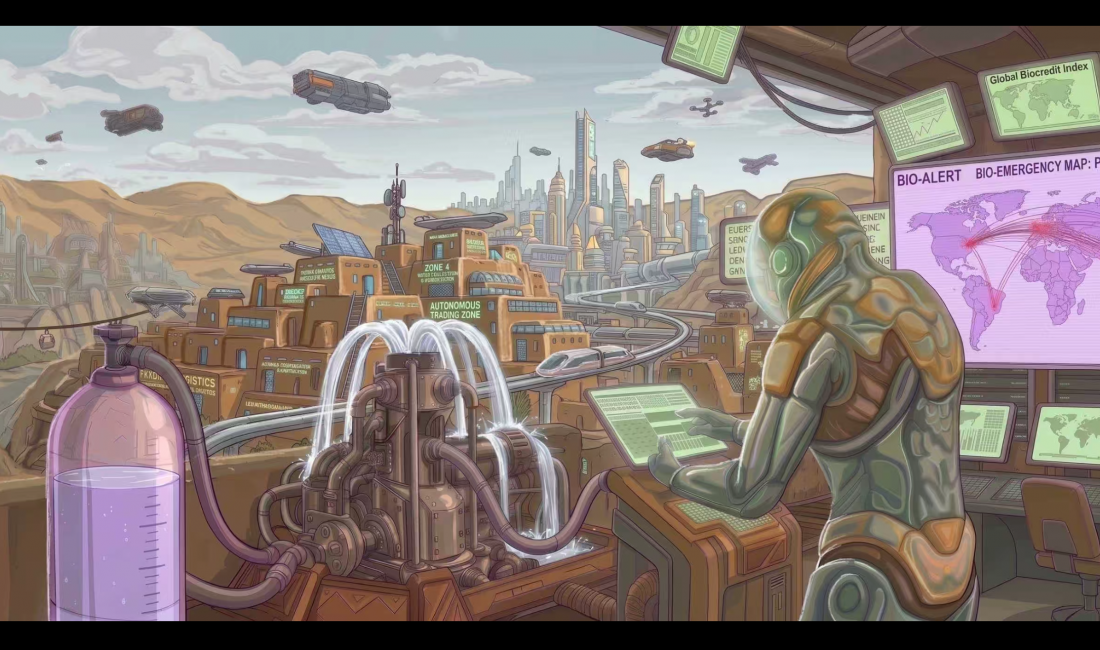
HOW TO VISUALIZE THIS SYSTEM
Instead of just seeing houses or trains or infrastructure or projects, we should see conduits. Lines of energy and capital flowing out from the central LGFV to a network of globes or other pueblos.
Style: A biotechnical blueprint. It looks like a glowing neural network superimposed over a terrestrial pueblo layout.
The Mesh: Instead of departments, we see glowing nodes labeled with missions (Life Support, Knowledge Commons, Planetary Stewardship). The Flow: Golden lines represent Capital (LGFV) and blue lines represent Data/AI. They weave through the nodes. • The People: Small clusters of people (Technocrats and Citizens) are seen at the intersections of these lines, codesigning services in real-time hubs.
The Global Connection: The edges of the mesh don't end; they extend outward into a starry, interconnected Macro Mesh.
Bibliography
Barber, B. R. If Mayors Ruled the World: Dysfunctional Nations, Rising Cities.
Barlow, M. Blue Covenant: The Global Water Crisis and the Coming Battle for the Right to Water.
Bauwens, M., & P2P Foundation. Cosmolocalism.
Bērziņa, I. (2020). From 'Total' to 'Comprehensive' National Defence: the Development of the Concept in Europe. Journal on Baltic Security.
Boelens, R. Water, Power and Identity: The Cultural Politics of Water in the Andes.
Boelens, R., Perreault, T., & Vos, J. (Eds.). (2018). Water Justice.
Bratton, B. The Stack: On Software and Sovereignty.
Clarke, D., & Lu, F. The Law of China’s Local Government Debt Crisis.
Däniker, G. (1996). Schweizerische Selbstbehauptungs-Strategien im Kalten Krieg.
Dehghani, Z. Data Mesh.
DeReticular. Village Infrastructure Genesis Package.
DRIFT (Dutch Research Institute for Transitions). Beyond the Triple Helix.
Escobar, A. Designs for the Pluriverse: Radical Interdependence, Autonomy, and the Making of Worlds.
European Investment Bank. The EIB Circular City Centre (C3) Guidelines.
European Investment Bank. (2024). The Joint Initiative on Circular Economy (JICE).
Federal Council of Switzerland. (1973). Konzeption der Gesamtverteidigung (Concept of Overall Defense).
Halbrook, S. E. (1998). Target Switzerland: Swiss Armed Neutrality in World War II.
Hill, D. Dark Matter and Trojan Horses: A Strategic Design Vocabulary.
IEEE. (2018). IEEE 1547-2018: Standard for Interconnection and Interoperability of Distributed Energy Resources with Associated Electric Power Systems Interfaces.
Khanna, P. Connectography: Mapping the Future of Global Civilization.
McMahon, D. China's Great Wall of Debt.
McPhee, J. (1983). La Place de la Concorde Suisse.
Mulgan, G. (2026, January 7). Working Paper: The City as Mesh. The Institutional Architecture Lab. https://tial.org/publications/working-paper-the-city-as-mesh/
Mulgan, G. The City as a Mesh: Options for Handling Cross-cutting Tasks in City Governments. Bloomberg Center for Cities at Harvard University.
Musacchio, A., Herrero, G. A., & Scott, C. (2011). Banco Ciudad (A): Who is the Owner? Harvard Business School.
National Defense University Press. (2017). Building a Stay-Behind Resistance Organization: The Case of Cold War Switzerland Against the Soviet Union.
Olivera, O. ¡Cochabamba! Water Rebellion in Bolivia.
Open University. (2024). The Circular Transition Through Network Governance.
PwC. (2024). Circular Cities: Building Regenerative Urban Ecosystems.
Reserve Bank of Australia. (2024). The ABCs of LGFVs.
Shiva, V. Water Wars: Privatization, Pollution, and Profit.
Spillmann, K. R. Beyond Soldiers and Arms: The Swiss Model of Comprehensive Security Policy. Center for Security Studies (CSS) at ETH Zürich.
Sturzenegger, F., & Zettelmeyer, J. (2007). Debt Defaults and Lessons from a Decade of Crises. MIT Press.
SWI swissinfo.ch. Switzerland opens Ukraine reconstruction to private sector.
SWI swissinfo.ch. Switzerland revamps its fallout shelters.
Swyngedouw, E. Liquid Power: Contested Hydro-Modernities in Twentieth-Century Spain.
The Boundaries of Building Societal Resilience: Responsibilization and Swiss Civil Defense in the Cold War. (2014). BEHEMOTH A Journal on Civilisation.
The Guardian. Why does Switzerland have more nuclear bunkers than any other country?
Various Authors / Barcelona en Comú. (2017). Fearless Cities: A Guide to the Global Municipalist Movement.
von Dach, H. (1957). Total Resistance (Der totale Widerstand).
Wageningen University. (2025). Network Governance in Regional Circular Built Environment Transformation.